
Distance measurement device and distance measurement method
a technology of distance measurement and distance measurement method, which is applied in the direction of distance measurement, instruments, surveying and navigation, etc., can solve the problems of lowering the accuracy of measurement of affecting the accuracy of measurement, and taking a significant long time for measuring the distance to the object, so as to achieve high accuracy of measurement
- Summary
- Abstract
- Description
- Claims
- Application Information
AI Technical Summary
Benefits of technology
Problems solved by technology
Method used
Image

Examples
second embodiment
[0042]In the distance measurement device 20B of the second embodiment, the wavelength change unit 23 includes a modulator 23a that modulates the intensity of the pulsed light from the ultrashort pulse fiber laser 22 and a variable wavelength optical fiber 23b that varies the wavelength of the pulsed light according to the intensity of the pulsed light. The modulator 23a adopted in this embodiment is an acousto-optical modulator having a transmission rate of not lower than 75% in a modulation bandwidth of 1.8 MHz. The modulator 23a is adjusted to modulate the intensity of the pulsed light and generate sawtooth wave having a period of 10 kHz. The modulated intensity of the pulsed light is output as an adjustment value of the wavelength of the pulsed light to the computer 42. The graph of FIG. 4 shows a variation in intensity of the pulsed light modulated by the modulator 23a against time. The modulator 23a is not restricted to the acousto-optical modulator of the above performance but...
third embodiment
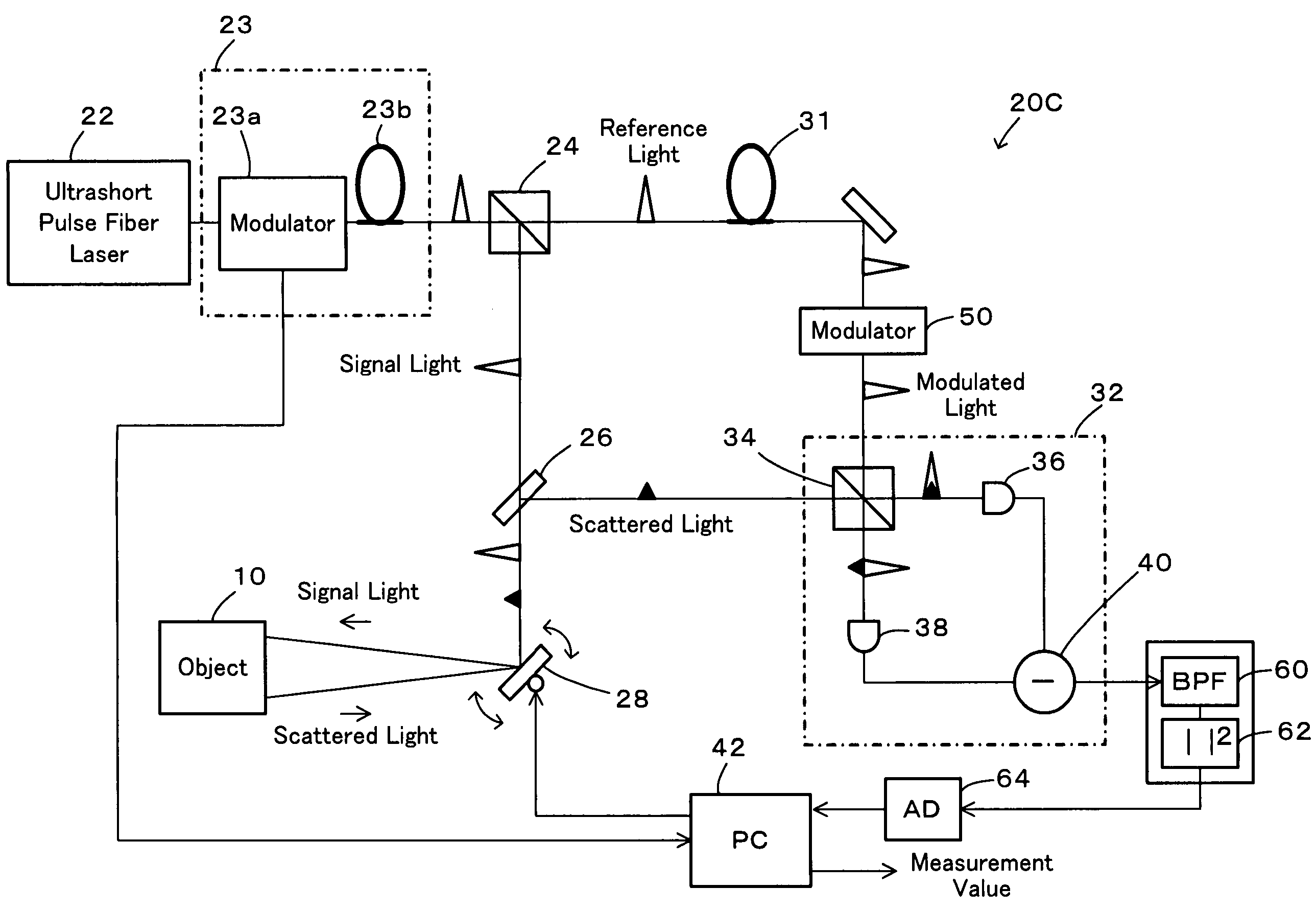
[0053]The modulator 50 adopted in the distance measurement device 20C of the third embodiment is the acousto-optical modulator that shifts the reference light A to the 27 MHz band. The shifted frequency band is, however, not restricted to the 27 MHz band. The modulator 50 may be any acousto-optical modulator that shifts the reference light A to any suitable frequency band. In this case, the band-pass filter 60 is selected corresponding to the shifted frequency band. The modulator 50 is not limited to the acousto-optical modulator but may be another modulator, for example, an electro-optical modulator. A modulator with the capability of varying the shifted frequency band is especially preferable. Appropriate regulation of the shifted frequency band enables three-dimensional measurement with higher accuracy.
[0054]The distance measurement device 20C of the third embodiment has the modulator 50, the band-pass filter 60, the square law detector 62, and the A-D converter 64 in addition to...
PUM
 Login to View More
 Abstract
Description
Claims
Application Information
 Login to View More