Apparatus and method for displaying image
a technology of image display and apparatus, applied in the field of image display apparatus, can solve the problems of difficult to find appropriate images, user cannot easily acquire other images, and cannot recognize the positional relationship between the currently observed landscape image and the imag
- Summary
- Abstract
- Description
- Claims
- Application Information
AI Technical Summary
Benefits of technology
Problems solved by technology
Method used
Image



Examples
first embodiment
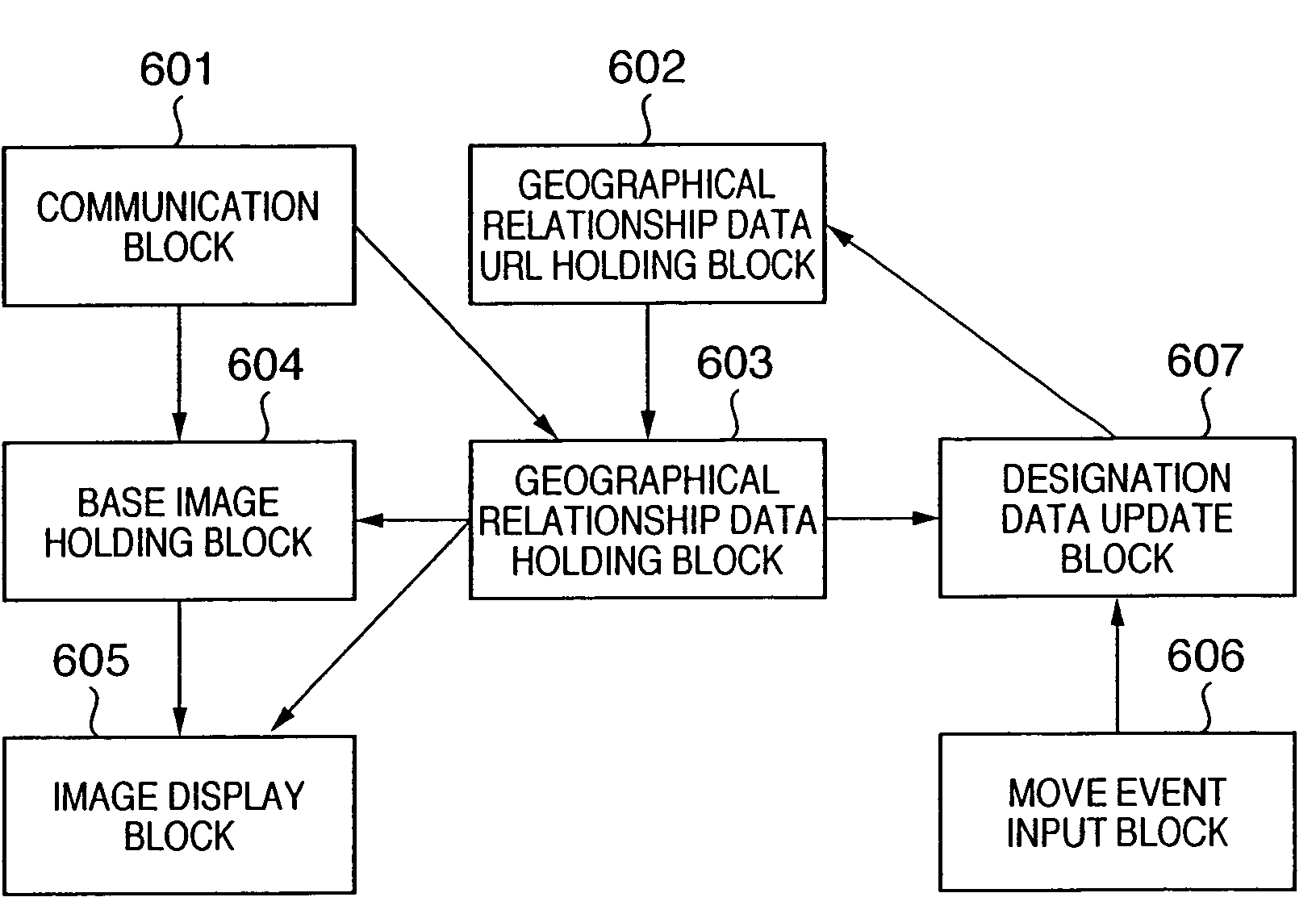
[0036]FIG. 1 shows an overview of a network environment in which an image display apparatus of this embodiment is used. Reference numeral 101 denotes an image display apparatus of this embodiment. Reference numerals 102 and 103 denote Web servers, which hold image data of landscape images, and geographical relationship data that describes a geographical relationship between a plurality of image data. Reference numeral 104 denotes an Internet. The image display apparatus 101 accesses the Web servers 102 and 103 via the Internet 104, and acquires image data and geographical relationship data from the Web servers using HTTP. The image data and geographical relationship data are held by a plurality of distributed servers on the network.
[0037]FIG. 2 shows an example of geographical relationship data. More specifically, FIG. 2 shows geographical relationship data which is referred to by http: / / server1 / img1.gim (identifier). Referring to FIG. 2, a “geoimg” tag 201 designates a base image. ...
second embodiment
[0060]In the description of the above embodiment, the base image is immediately switched to the destination image. Before switching to the destination image, the base image may be switched to the destination image after it is zoomed up toward the move center point. That is, the CPU 701 extracts a new rectangular image whose vertices are located on line segments that connect the vertices of the base image to the move center point from the base image, and displays the extracted rectangular image on the image display block 605, thus obtaining a zoom-in effect. After that, the destination image is displayed.
[0061]Alternatively, a morphing technique may be applied to the base image and destination image. According to the morphing technique, a plurality of intermediate images are generated from the base image and destination image, and are displayed in turn. Since the morphing technique is known to those who are skilled in the art, a detailed description thereof will not be required.
[0062...
third embodiment
[0063]In the description of the above embodiment, geographical relationship data that defines only one destination image with respect to a base image is used. However, according to the present invention, a plurality of destination images may be defined.
[0064]FIG. 11 shows an example of geographical relationship data that defines two destination images. FIG. 12 shows two move center points with respect to the geographical relationship data shown in FIG. 11. In FIG. 12, reference numerals 1201 and 1202 denote two move center points.
[0065]If there are a plurality of move center points, an image display process displays arrows corresponding to these move center points. Also, in a move event input, a function of selecting one of a plurality of destinations is provided. For example, when a cursor (1301) is displayed, as shown in FIG. 13, and the CPU 701 detects that the mouse button is clicked while the cursor overlaps the arrow, a destination corresponding to the clicked arrow is selecte...
PUM
 Login to View More
 Abstract
Description
Claims
Application Information
 Login to View More