Red line emitting phosphors for use in led applications
What is AI technical title?
AI technical title is built by Patsnap AI team. It summarizes the technical point description of the patent document.
a technology of red-emitting phosphors and led backlights, which is applied in the direction of discharge tubes/lamp details, instruments, luminescent screens in discharge tubes, etc., can solve the problems of reducing the effective ler of led backlights, not being suitable for lighting use, and reducing the color gamut of backlights
Active Publication Date: 2010-01-19
GENERAL ELECTRIC CO
View PDF109 Cites 203 Cited by
Summary
Abstract
Description
Claims
Application Information
AI Technical Summary
This helps you quickly interpret patents by identifying the three key elements:
Problems solved by technology
Method used
Benefits of technology
Problems solved by technology
Until quite recently, LEDs have not been suitable for lighting uses where a bright white light is needed, due to the inherent color of the light produced by the LED.
However, due to the use of yellow phosphors (e.g. having a peak emission between 550 nm and 610 nm), the spectra of these LEDs contain excessive emission in the yellow region of the spectrum, which strongly reduces the color gamut of the backlight.
In order to improve the gamut of LED backlights using yellow phosphors, the yellow light is filtered out, thereby reducing the effective LER of the LED backlight.
Current red fluorescent lamp phosphors doped with Eu3+ cannot be used successfully in UV LED lamps because they have virtually no absorption of near-UV (370-420 nm) light, leading to unacceptable light loss due to scattering by the phosphor.
Method used
the structure of the environmentally friendly knitted fabric provided by the present invention; figure 2 Flow chart of the yarn wrapping machine for environmentally friendly knitted fabrics and storage devices; image 3 Is the parameter map of the yarn covering machine
View more
Image
Smart Image Click on the blue labels to locate them in the text.
Viewing Examples
Smart Image
Click on the blue label to locate the original text in one second.
Reading with bidirectional positioning of images and text.
Smart Image
Examples
Experimental program
Comparison scheme
Effect test
example 1
Preparation of K2[AlF5]:Mn4+ Phosphor
[0105]The raw materials (3.52 g of Al(OH)3 and 6.23 g of K2CO3) are dissolved by careful gradual addition into 40 ml of 50% aqueous HF under heating and stirring of the Teflon dish on a hot plate. The solution is evaporated to dryness to form the K2[AlF5] host complex, which is then dissolved in 50 ml of 50% HF along with 0.97 g of K2[MnF6], prepared according to Bode's method [H. Bode, H. Jenssen, F. Bandte, Angew. Chem., N11(1953), 304] while stirring under heating. The second solution is evaporated on a water bath to dryness.
example 2
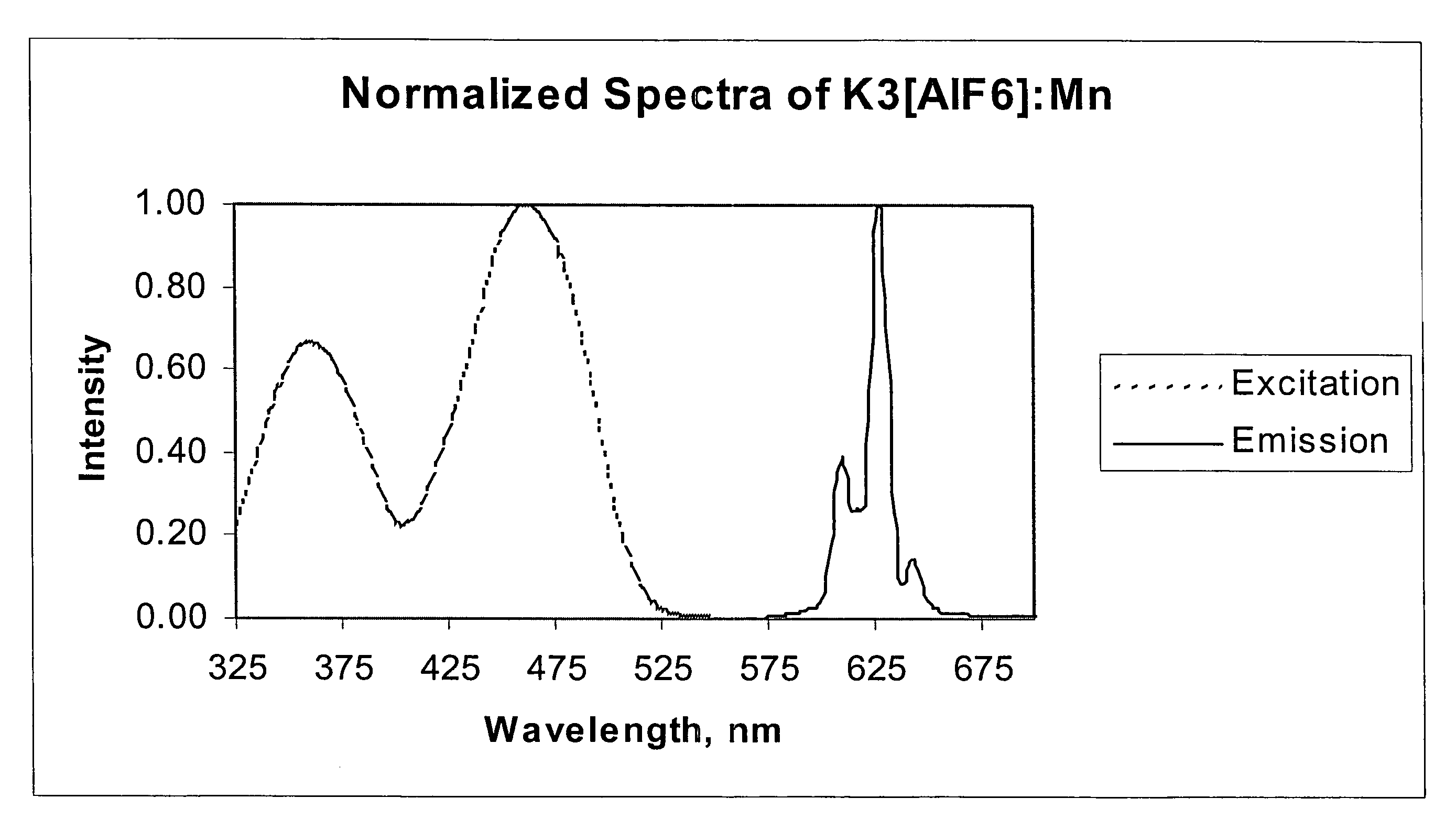
Preparation of K3[AlF6]:Mn4+ Phosphor
[0106]For this phosphor, 2.79 g of Al(OH)3 and 7.41 g of K2CO3 are dissolved by careful gradual addition into 40 ml of 50% aqueous HF under heating and stirring of the Teflon dish on a hot plate. The solution is evaporated to dryness to form the K3[AlF6] host complex, which is then dissolved in 50 ml of 50% HF along with 0.77 g of K2[MnF6] and evaporated on a water bath to dryness.
example 3
Preparation of K3[GaF6]:Mn4+ Phosphor
[0107]This preparation is carried in the same manner as in the previous example, using 2.91 g of Ga2O3 and 6.43 g of K2CO3 in the first step (dissolution in 50 ml of 50% HF), followed by 0.67 g of K2[MnF6] in the second step.
the structure of the environmentally friendly knitted fabric provided by the present invention; figure 2 Flow chart of the yarn wrapping machine for environmentally friendly knitted fabrics and storage devices; image 3 Is the parameter map of the yarn covering machine
Login to View More
PUM
Property
Measurement
Unit
wavelength
aaaaa
aaaaa
CRI
aaaaa
aaaaa
CRI
aaaaa
aaaaa
Login to View More
Abstract
Light emitting devices including backlights having a light source and a phosphor material including a complex fluoride phosphor activated with Mn4+ which may include at least one of (A) A2[MF5]:Mn4+; where A is selected from Li, Na, K, Rb, Cs, NH4, and combinations thereof; and where M is selected from Al, Ga, In, or combinations thereof; (B) A3[MF6]:Mn4+, where A is selected from Li, Na, K, Rb, Cs, NH4, and combinations thereof; and where M is selected from Al, Ga, In, or combinations thereof; (C) Zn2[MF7]:Mn4+, where M is selected from Al, Ga, In, or combinations thereof; and (D) A[In2F7]:Mn4+ where A is selected from Li, Na, K, Rb, Cs, NH4, or combinations thereof.
Description
[0001]The present application is a continuation-in-part and claims priority from U.S. patent application Ser. No. 11 / 364,611, filed Feb. 28, 2006, now U.S. Pat. No. 7,497,973 which in turn is a continuation in part of U.S. patent application Ser. Nos. 11 / 049,598 and 11 / 285,442, filed on Feb. 2, 2005 now U.S. Pat. No. 7,358,542 and Nov. 22, 2005, respectively.BACKGROUND OF THE INVENTION[0002]The present exemplary embodiments relate to phosphor compositions, particularly phosphors for use in lighting applications. More particularly, the present embodiments relate to red emitting phosphors and a lighting apparatus employing these phosphors.[0003]Light emitting diodes (LEDs) are semiconductor light emitters often used as a replacement for other light sources, such as incandescent lamps. They are particularly useful as display lights, warning lights and indicator lights or in other applications where colored light is desired. The color of light produced by an LED is dependent on the type...
Claims
the structure of the environmentally friendly knitted fabric provided by the present invention; figure 2 Flow chart of the yarn wrapping machine for environmentally friendly knitted fabrics and storage devices; image 3 Is the parameter map of the yarn covering machine
Login to View More
Application Information
Patent Timeline
Application Date:The date an application was filed.
Publication Date:The date a patent or application was officially published.
First Publication Date:The earliest publication date of a patent with the same application number.
Issue Date:Publication date of the patent grant document.
PCT Entry Date:The Entry date of PCT National Phase.
Estimated Expiry Date:The statutory expiry date of a patent right according to the Patent Law, and it is the longest term of protection that the patent right can achieve without the termination of the patent right due to other reasons(Term extension factor has been taken into account ).
Invalid Date:Actual expiry date is based on effective date or publication date of legal transaction data of invalid patent.



 Login to View More