
Casing mount for a cylindrical vial
a casing mount and cylindrical technology, applied in the field of leveling, can solve the problems of increasing the cost of level manufacturing, and reducing the clarity of the vial, so as to improve the casing mount, improve the quality of the casing mount, and improve the effect of the overall structur
- Summary
- Abstract
- Description
- Claims
- Application Information
AI Technical Summary
Benefits of technology
Problems solved by technology
Method used
Image

Examples
Embodiment Construction
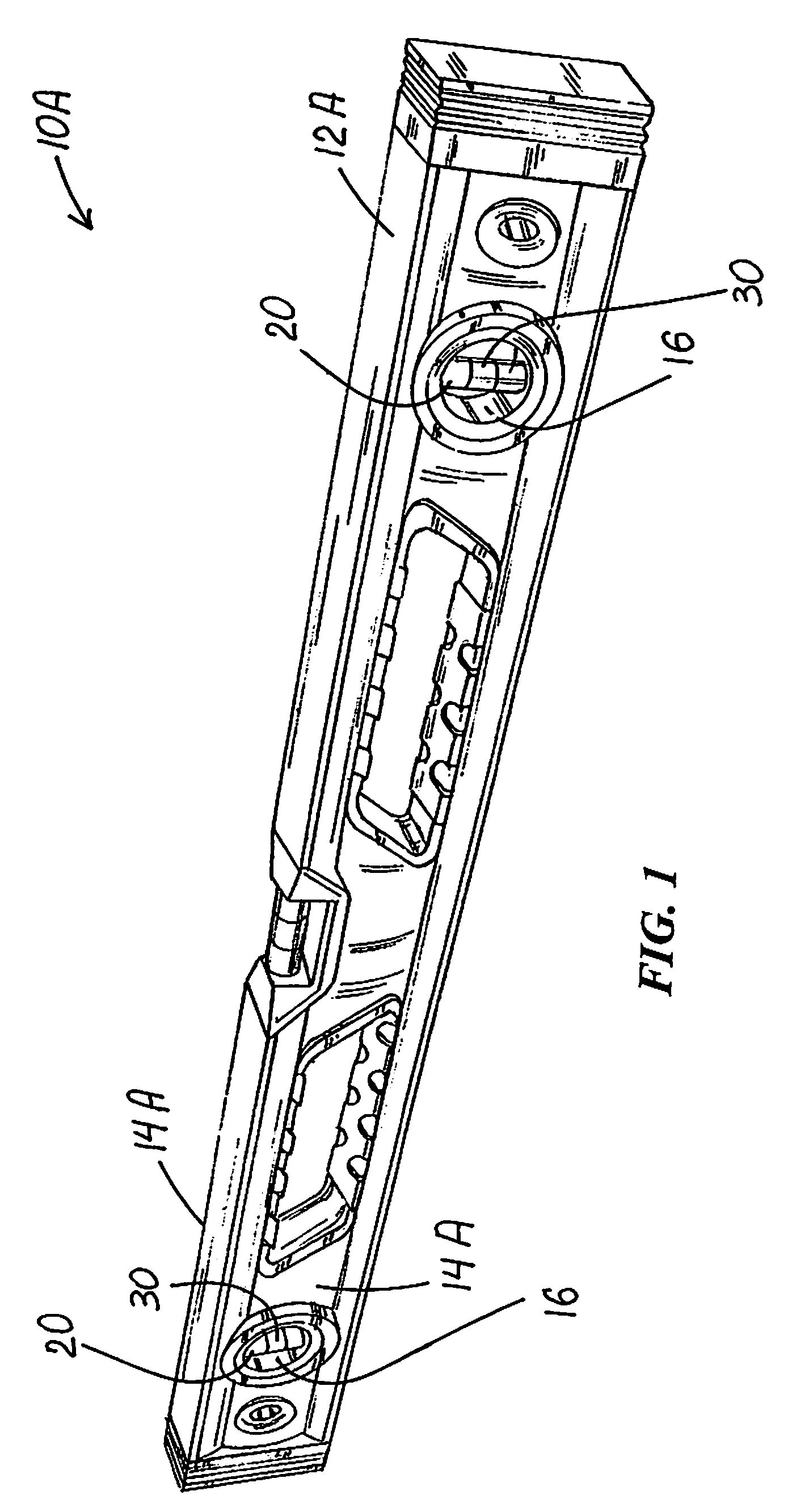
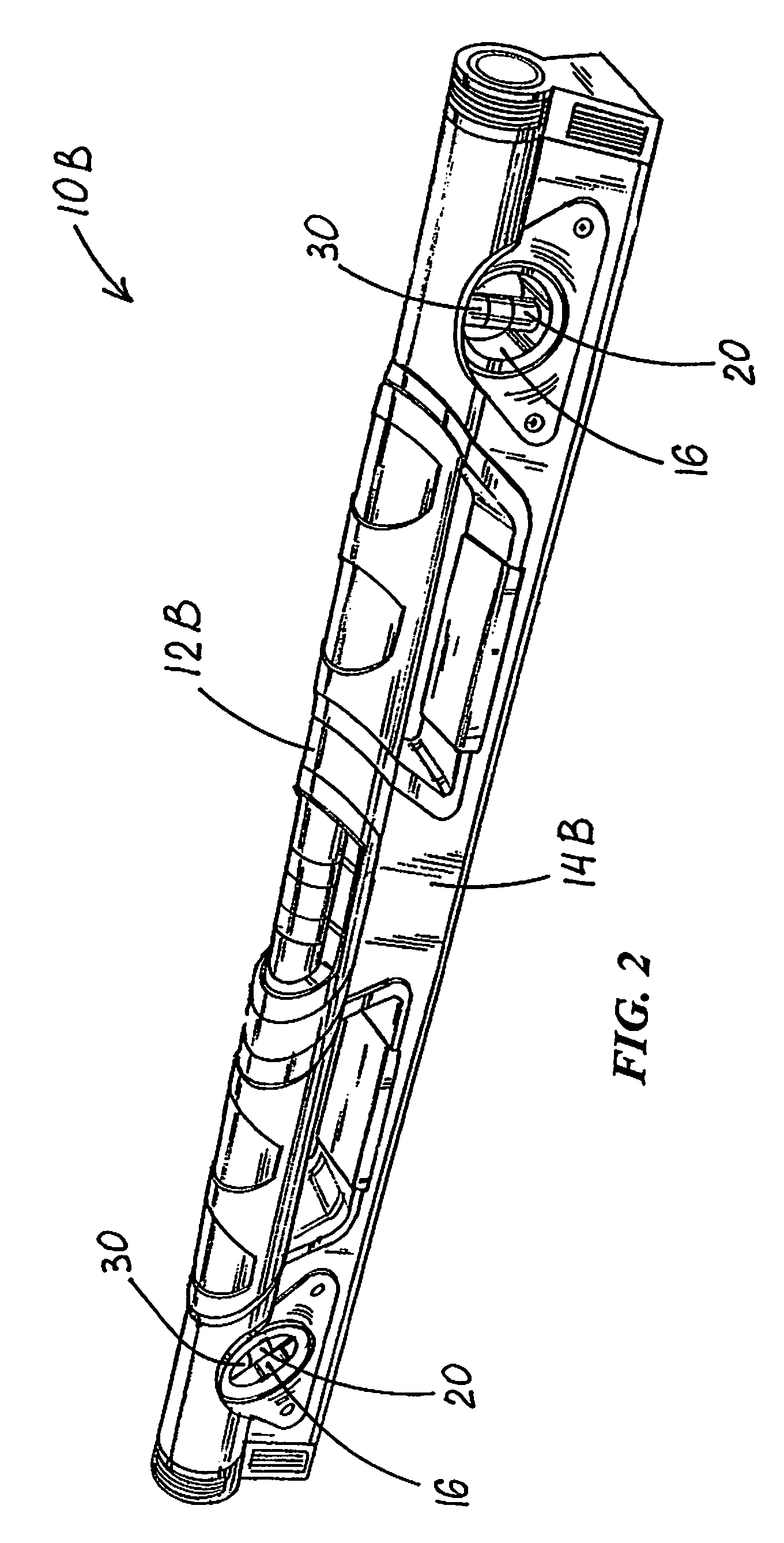
[0038]FIGS. 1 and 2 show levels 10A and 10B each including an elongate hollow frame 12 (A and B, respectively) formed by two sidewalls 14 (A and B, respectively) each defining axially aligned vial openings 16 into frame 12. Each of levels 10A and 10B has a liquid-and-bubble vial 20.
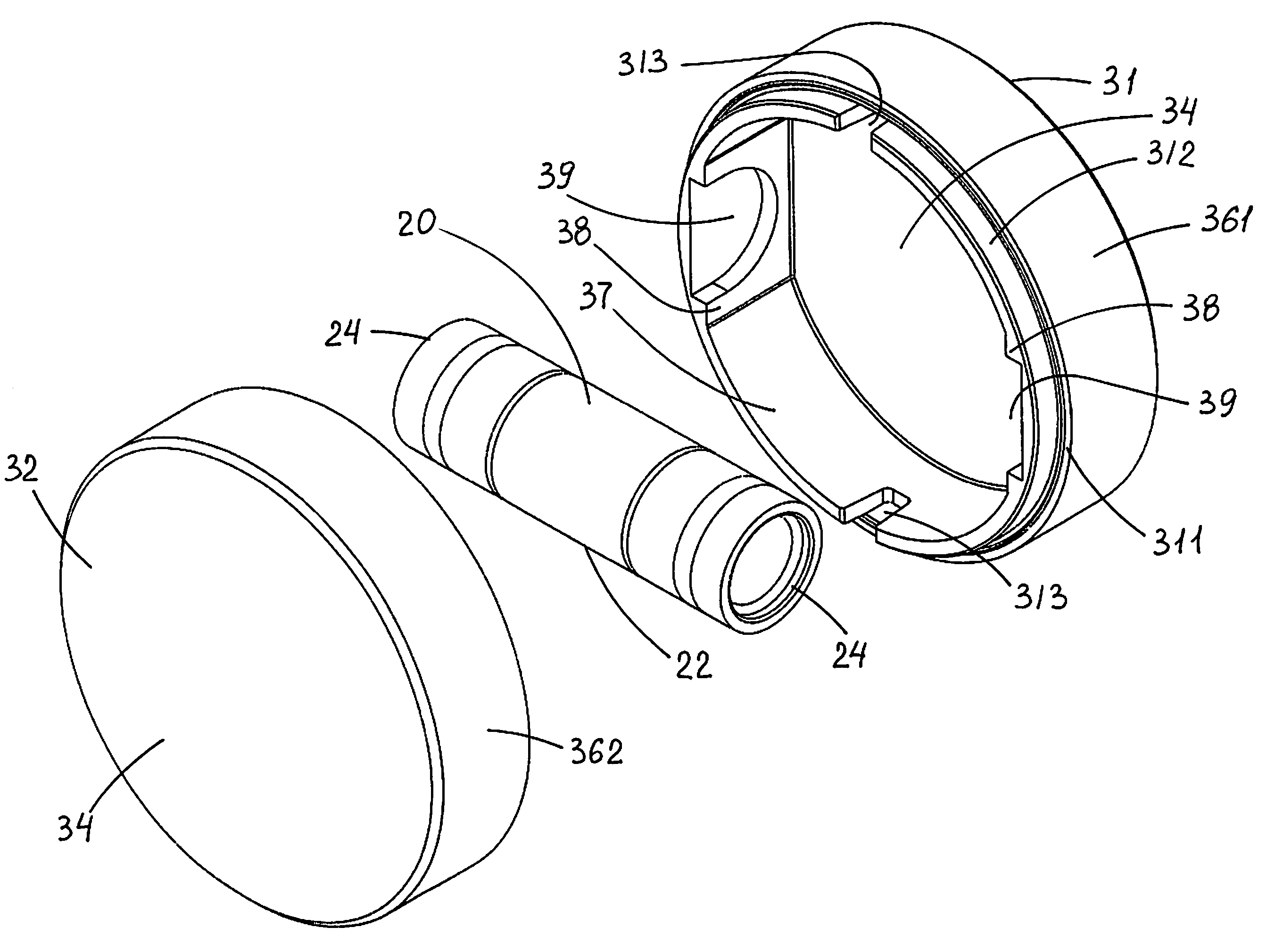
[0039]FIGS. 3-8 best illustrate a vial casing 30, which is secured with respect to frame 12. Casing 30 defines a hermetically sealed single-cavity casing interior 33 entirely enclosing vial 20. Vial 20 has a substantially cylindrical outer surface 22 extending between two vial ends 24. Casing 30 is formed of two opposite round face-walls 34 and a surrounding cylindrical wall 36 therebetween. It is best seen in FIGS. 3 and 6-8 that surrounding cylindrical wall 36 has a pair of opposed major wall-portions 37 of first thickness 37A and a pair of opposed intervening wall-portions 38 of second thickness 38A. Second thickness 38A is greater than first thickness 37A. Each intervening wall-portion 38 defines a re...
PUM
 Login to View More
 Abstract
Description
Claims
Application Information
 Login to View More