AI technical title is built by Patsnap AI team. It summarizes the technical point description of the patent document.
a technology of peak water use and system, applied in the field of water management, can solve the problems of low water reserve and higher than normal water demand for irrigation, irrigations that do not meet the water requirements of plants, and restrictions imposed on irrigation applications, etc., and achieve the effect of automatically reducing high peak water use values
Inactive Publication Date: 2012-03-27
AQUA CONSERVATION SYST
View PDF26 Cites 17 Cited by
Summary
Abstract
Description
Claims
Application Information
AI Technical Summary
This helps you quickly interpret patents by identifying the three key elements:
Problems solved by technology
Method used
Benefits of technology
Problems solved by technology
Municipalities, water districts, and other agencies that supply water to consumers sometimes regulate the distribution of water because they have an insufficient supply of water to meet consumer demand, maintain water reserves for fire control, etc.
Although, insufficient water supplies may occur anytime during the year, they generally occur during the summer and especially during periods of extended drought that frequently result in low water reserves and higher than normal water demands for irrigation.
However, restrictions have been imposed on irrigation applications when there is high usage of water on specific days and even intra-day high water use.
This generally prevents high water applications being applied on any one day but may also result in irrigations that do not meet the water requirements of the plants.
Method used
the structure of the environmentally friendly knitted fabric provided by the present invention; figure 2 Flow chart of the yarn wrapping machine for environmentally friendly knitted fabrics and storage devices; image 3 Is the parameter map of the yarn covering machine
View more
Image
Smart Image Click on the blue labels to locate them in the text.
Viewing Examples
Smart Image
Click on the blue label to locate the original text in one second.
Reading with bidirectional positioning of images and text.
Smart Image
Examples
Experimental program
Comparison scheme
Effect test
Embodiment Construction
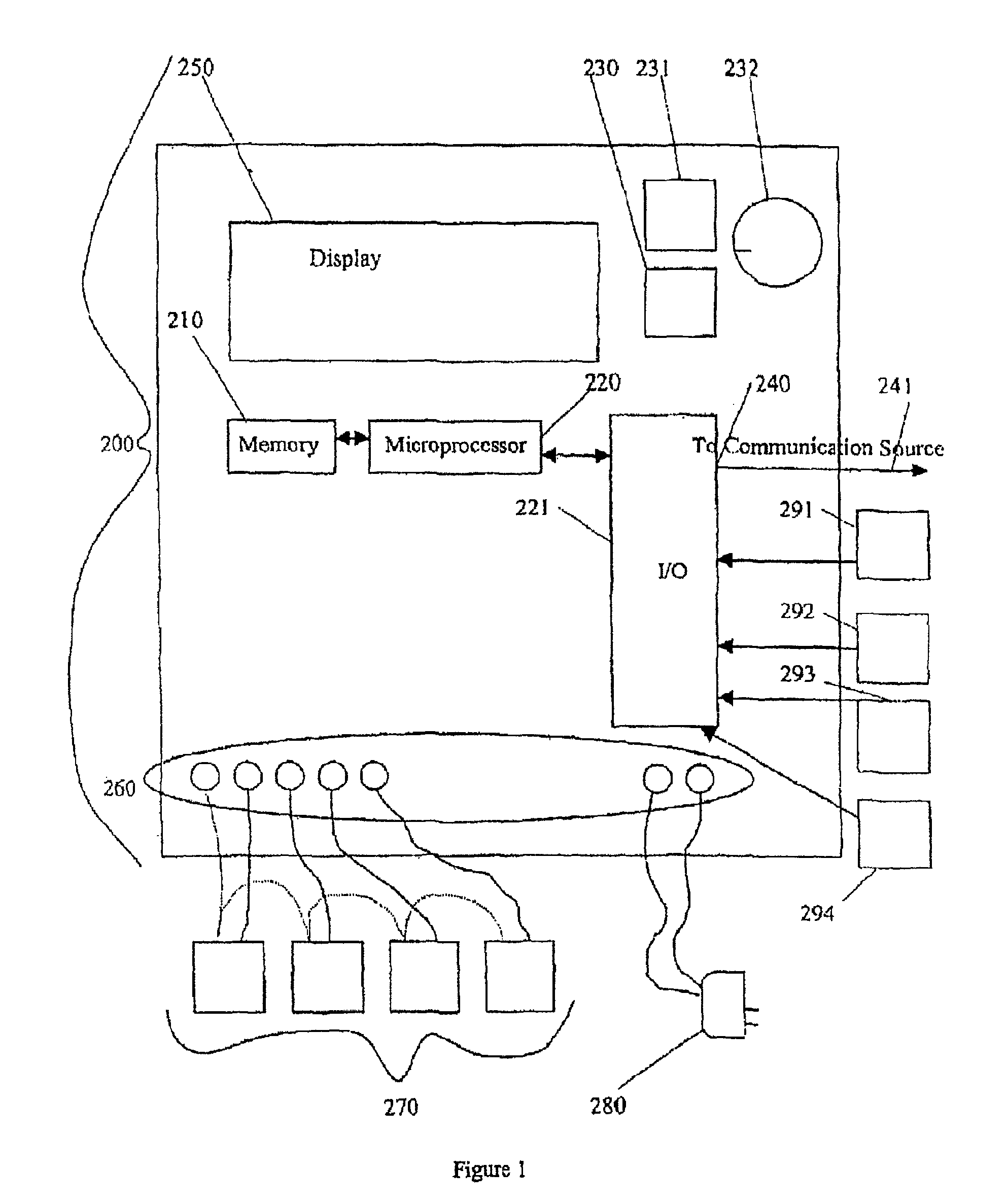
[0019]FIG. 1 is a schematic of an irrigation controller 200 according to the present invention that generally includes a microprocessor 220, an on-board memory 210, some manual input devices 230 through 232 (buttons and / or knobs), an input / output (I / O) circuitry 221 connected in a conventional manner, a display screen 250, a communications port 240, a serial, parallel or, other communications connection 241 coupling the irrigation controller to one or more communication sources, electrical connectors 260 which are connected to a plurality of irrigation stations 270 and a power supply 280, a rain detection device 291, a flow sensor 292, a pressure sensor 293 and a temperature sensor 294. Each of these components by itself is well known in the electronic industry, with the exception of the programming of the microprocessor in accordance with the functionality set forth herein. There are hundreds of suitable chips that can be used for this purpose. At present, experimental versions hav...
the structure of the environmentally friendly knitted fabric provided by the present invention; figure 2 Flow chart of the yarn wrapping machine for environmentally friendly knitted fabrics and storage devices; image 3 Is the parameter map of the yarn covering machine
Login to View More
PUM
Login to View More
Abstract
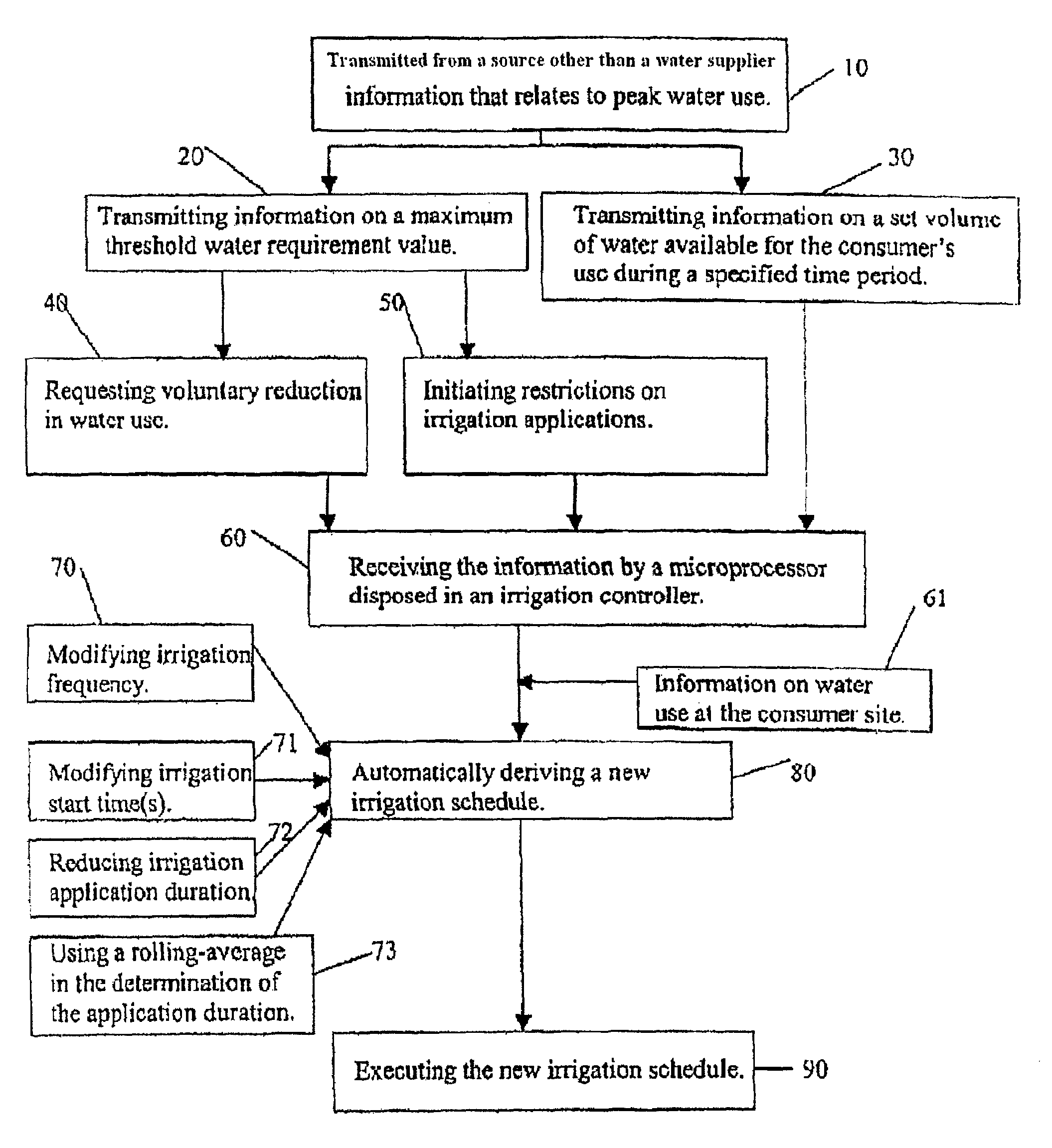
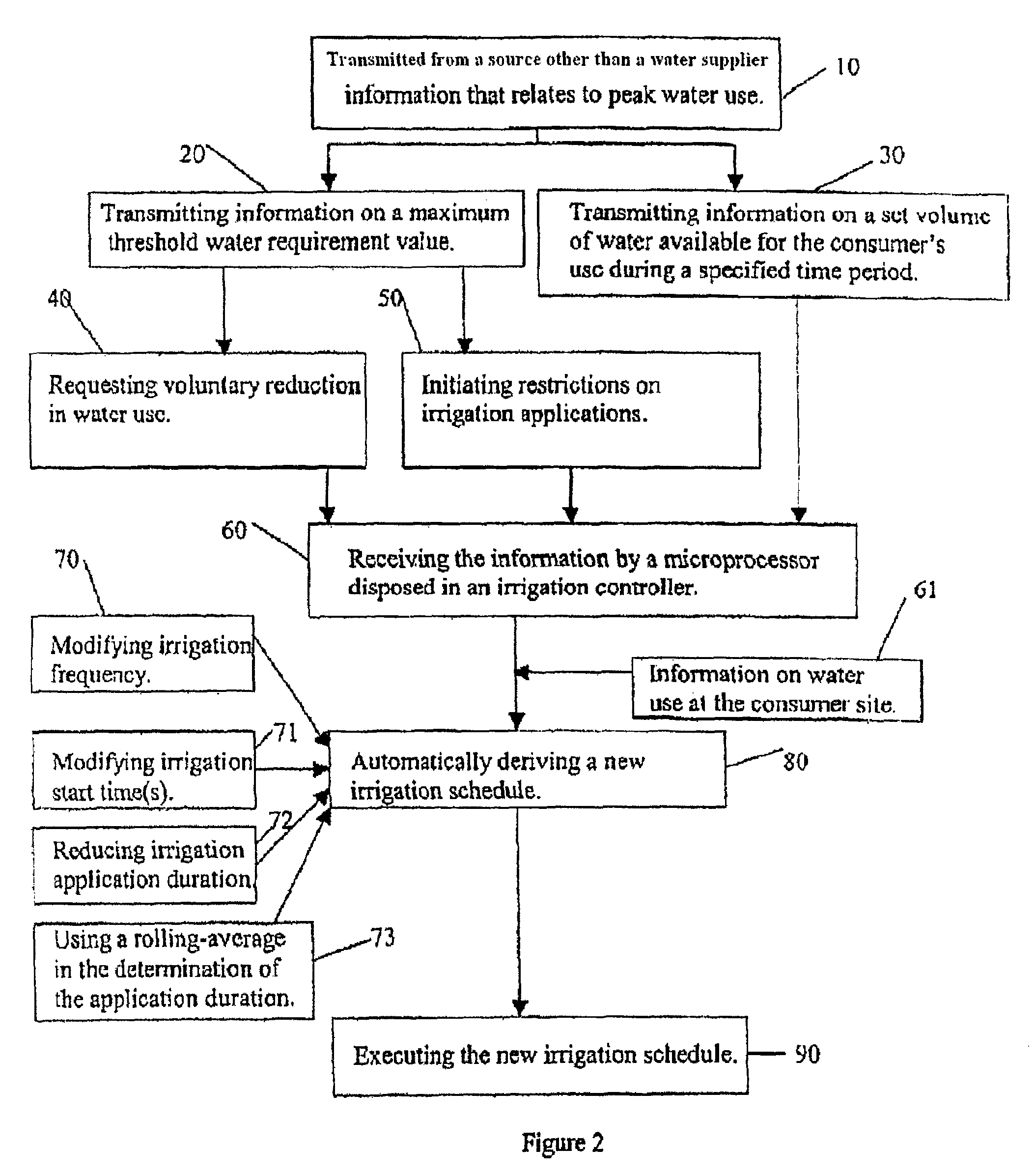
An irrigation management system reduces high peak water use values by utilizing a microprocessor disposed in an irrigation controller to (a) receive peak water use information from a source other than a water supplier (b) receive water use information at a consumer site, and (c) automatically derive a new irrigation schedule that is at least partly based on the information received. The new irrigation schedule preferably includes at least one of a modification in a default irrigation frequency or start time, a reduction in a default irrigation application duration, the use of a rolling-average in the determination of the new irrigation application duration and other changes or modifications to the default irrigation schedule that will provide for the reduction in high peak water use values. Additionally, the microprocessor will display to the water user and / or third parties details on the new irrigation schedule and information received from the water supplier.
Description
CROSS-REFERENCE TO RELATED APPLICATIONS[0001]This application is a Continuation-In-Part of pending U.S. application Ser. No. 11 / 347,521, filed Feb. 2, 2006 which is a Continuation-In-Part of U.S. patent application Ser. No. 11 / 217,252, filed on Aug. 31, 2005, now issued as U.S. Pat. No. 7,330,796, which claims priority from U.S. patent application Ser. No. 10 / 297,146, filed on Nov. 26, 2002, now issued as U.S. Pat. No. 6,963,808, which claims priority from PCT Application No. PCT / US00 / 15480, filed on Jun. 5, 2000, all of which are hereby incorporated by reference in their entirety.FIELD OF THE INVENTION[0002]The field of the invention is water management.BACKGROUND OF THE INVENTION[0003]Municipalities, water districts, and other agencies that supply water to consumers sometimes regulate the distribution of water because they have an insufficient supply of water to meet consumer demand, maintain water reserves for fire control, etc. Although, insufficient water supplies may occur any...
Claims
the structure of the environmentally friendly knitted fabric provided by the present invention; figure 2 Flow chart of the yarn wrapping machine for environmentally friendly knitted fabrics and storage devices; image 3 Is the parameter map of the yarn covering machine
Login to View More
Application Information
Patent Timeline
Application Date:The date an application was filed.
Publication Date:The date a patent or application was officially published.
First Publication Date:The earliest publication date of a patent with the same application number.
Issue Date:Publication date of the patent grant document.
PCT Entry Date:The Entry date of PCT National Phase.
Estimated Expiry Date:The statutory expiry date of a patent right according to the Patent Law, and it is the longest term of protection that the patent right can achieve without the termination of the patent right due to other reasons(Term extension factor has been taken into account ).
Invalid Date:Actual expiry date is based on effective date or publication date of legal transaction data of invalid patent.



 Login to View More
  Login to View More