
Control of blood vessel physiology to treat skin disorders
a blood vessel physiology and skin disorder technology, applied in the field of compositions and methods for treating skin disorders, can solve the problems of skin inflammation, skin irritation, and skin irritation, and achieve the effects of reducing the number and size of targeted blood vessels, promoting degradation and absorption of necrotic tissue, and enhancing treatmen
- Summary
- Abstract
- Description
- Claims
- Application Information
AI Technical Summary
Benefits of technology
Problems solved by technology
Method used
Image

Examples
example 1
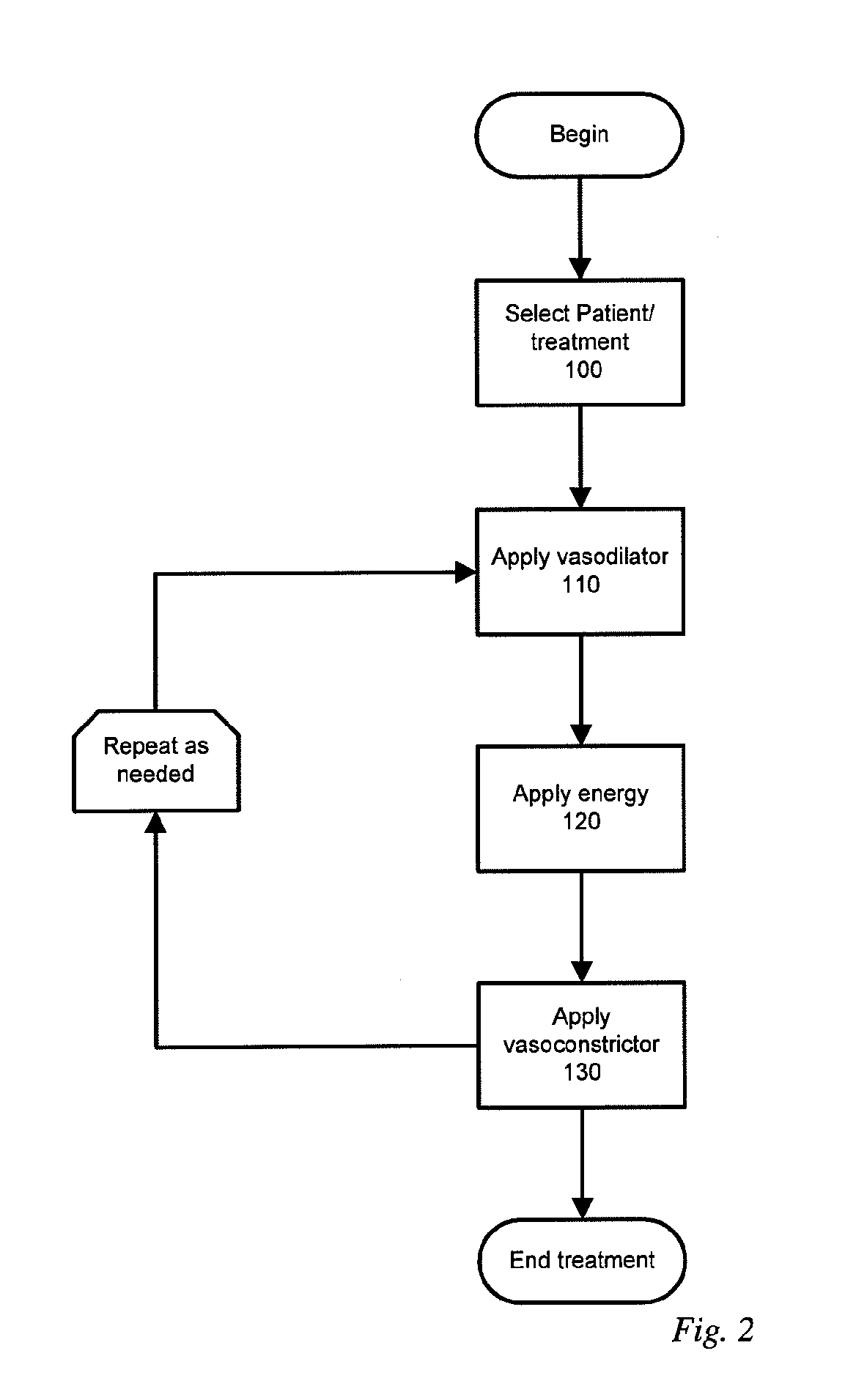
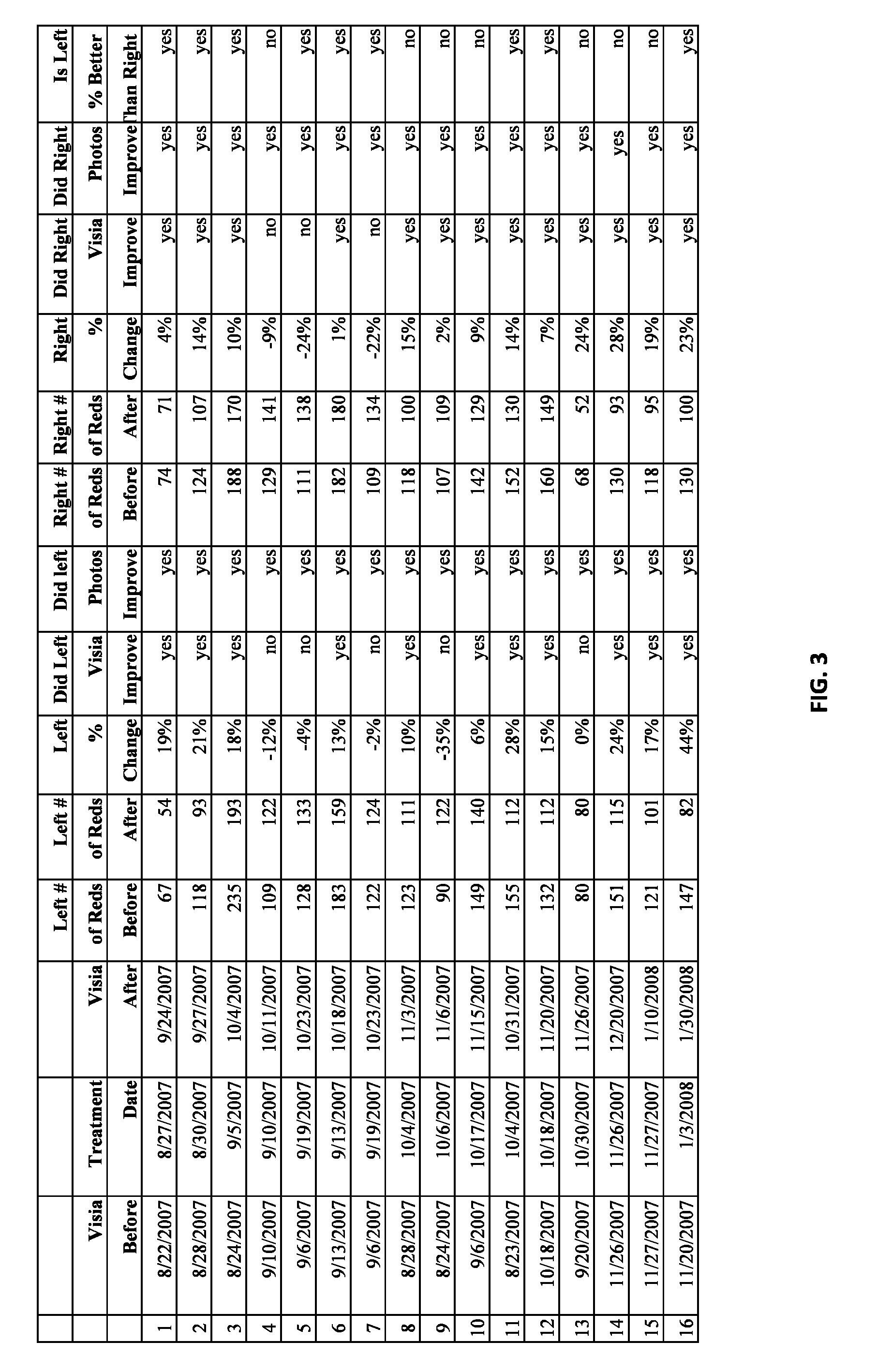
[0069]A clinical study was undertaken in order to demonstrate the effectiveness of the method of FIG. 2 in improving the outcome of laser / photo facial treatments. In the study, 16 patients with moderate facial redness served as their own test subject and control.
[0070]Prior to treatment, the right and left side of the face were digitally photographed using the VISIA™ Complexion Analysis System (Canfield Scientific, Fairfield N.J.). The VISIA™ system has the ability to visualize skin conditions related to abnormal melanin concentrations or vascular disorders. Visualized abnormalities include conditions such as sun damage, rosacea, melasma, telangiectasia and others.
[0071]For the clinical trial in this example the vasodilator composition contained water, arginine HCl, urea, glycerin, hydroxyethylcellulose, allantoin, methylisothiazolinone. The percentage of each reagent in the vasodilation composition is shown in Table 1 on a weight / weight basis. This vasodilation composition had a pH...
example 2
[0090]The compositions of the invention can be supplied in the form of a kit. The kit can be supplied to a patient, or to a health care provider or cosmetologist treating a patient. The kit can include, without limitation, a first topical skin formulation including a vasodilation composition, and a second topical skin formulation including a vasoconstriction composition. The kit can include written instructions for use, by or on a patient, of the first topical skin formulation prior to receipt by the patient of an ischemia-inducing treatment and of the second topical skin formulation after receipt by the patient of an ischemia-inducing treatment. Other components can optionally be added to the kit, such as topical compositions to be applied while inducing ischemia, such as, e.g., a pain medication in a topical formulation. Vasodilation compositions and vasoconstriction compositions useful in such a kit are prepared according to the methods set forth above, and are preferably supplie...
PUM
| Property | Measurement | Unit |
|---|---|---|
| wavelength | aaaaa | aaaaa |
| wavelength | aaaaa | aaaaa |
| energy | aaaaa | aaaaa |
Abstract
Description
Claims
Application Information
 Login to View More