
Optical film
a technology of optical film and film film, applied in the field of optical film, can solve the problems of low light transmittance, low productivity, and darkening, and achieve the effect of low photoelastic constan
- Summary
- Abstract
- Description
- Claims
- Application Information
AI Technical Summary
Benefits of technology
Problems solved by technology
Method used
Image

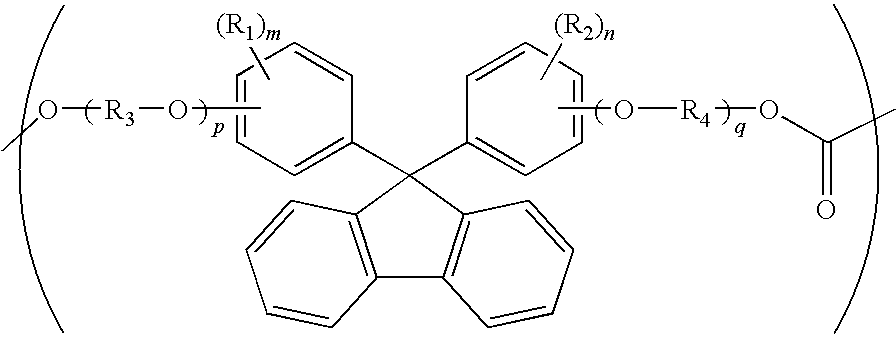
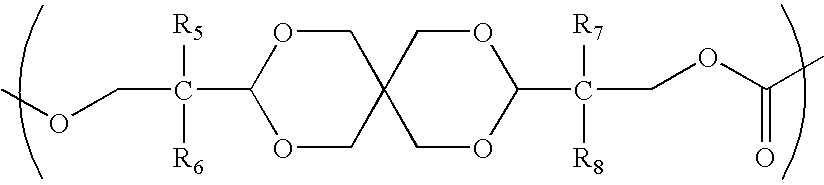
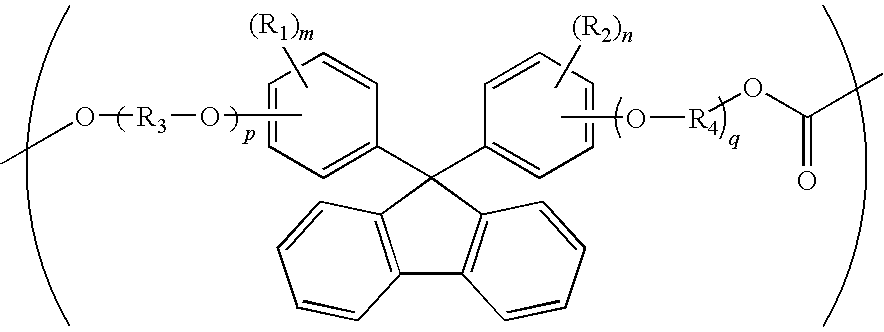
Examples
example 1
Production of Polycarbonate Copolymer
[0165]109.45 parts of 3,9-bis(2-hydroxy-1,1-dimethylethyl)-2,4,8,10-tetraoxasp iro[5.5]undecane (to be referred to as “spiroglycol” hereinafter), 15.12 parts of 9,9-bis(4-hydroxy-3-methylphenyl)fluorene (to be referred to as “BCF” hereinafter), 89.29 parts of diphenyl carbonate, and 1.8×10⁻² part of tetramethylammonium hydroxide and 1.6×10⁻⁴ part of sodium hydroxide as catalysts were heated at 180° C. in a nitrogen atmosphere to be molten. Thereafter, the degree of vacuum was set to 13.4 kPa over 30 minutes. Then, the temperature was raised to 260° C. at a rate of 20° C. / hr and maintained at that temperature for 10 minutes, and the degree of vacuum was set to 133 Pa or less over 1 hour. A reaction was carried out under agitation for a total of 6 hours.
[0166]After the end of the reaction, tetrabutylphosphonium dodecylbenzenesulfonate was added in an amount 4 times the total molar amount of the catalysts to deactivate the catalysts, and the resulti...
example 2
Production of Polycarbonate Copolymer
[0168]The operation of Example 1 was repeated except that 103.37 parts of spiroglycol, 22.68 parts of BCF and 89.29 parts of diphenyl carbonate were used to obtain an aromatic-aliphatic copolycarbonate. The composition ratio of the copolycarbonate was measured by NMR.
[0169]A film (thickness of 60±0.8 μm) was produced in the same manner as in Example 1. The photoelastic constant of the obtained film was evaluated in the same manner as in Example 1. The film was stretched to 2.0 times monoaxially at Tg+10° C. like Example 1 to obtain a stretched film having a length of 200 mm, a width of 57 mm and a thickness of 42 μm, and the retardation and chromatic dispersibility of the obtained film were measured. The results are shown in Table 1.
example 3
Production of Polycarbonate Copolymer
[0170]The operation of Example 1 was repeated except that 97.29 parts of spiroglycol, 30.24 parts of BCF and 89.29 parts of diphenyl carbonate were used to obtain an aromatic-aliphatic copolycarbonate. The composition ratio of the copolycarbonate was measured by NMR.
[0171]A film (thickness of 61±0.7 μm) was produced in the same manner as in Example 1. The photoelastic constant of the obtained film was evaluated in the same manner as in Example 1. The film was stretched to 2.0 times monoaxially at Tg+10° C. like Example 1 to obtain a stretched film having a length of 200 mm, a width of 57 mm and a thickness of 42 μm, and the retardation and chromatic dispersibility of the obtained film were measured. The results are shown in Table 1.
PUM
| Property | Measurement | Unit |
|---|---|---|
| wavelengths | aaaaa | aaaaa |
| wavelengths | aaaaa | aaaaa |
| wavelengths | aaaaa | aaaaa |
Abstract
Description
Claims
Application Information
 Login to View More