Supercharge Your Innovation With Domain-Expert AI Agents!

Applying bias voltage during formation of granular recording media

a technology of bias voltage and granular recording media, applied in the field of applying bias voltage during the formation of granular recording media, can solve the problems of high surface roughness of media, most difficult along the hard axis of magnetization, and high porosity and low density of perpendicular recording media of the prior ar

Active Publication Date: 2015-03-31
SEAGATE TECH LLC
View PDF11 Cites 0 Cited by
  • Summary
  • Abstract
  • Description
  • Claims
  • Application Information

AI Technical Summary

Problems solved by technology

The magnetization is most easily obtained along the easy axis of magnetization but most difficult along the hard axis of magnetization.
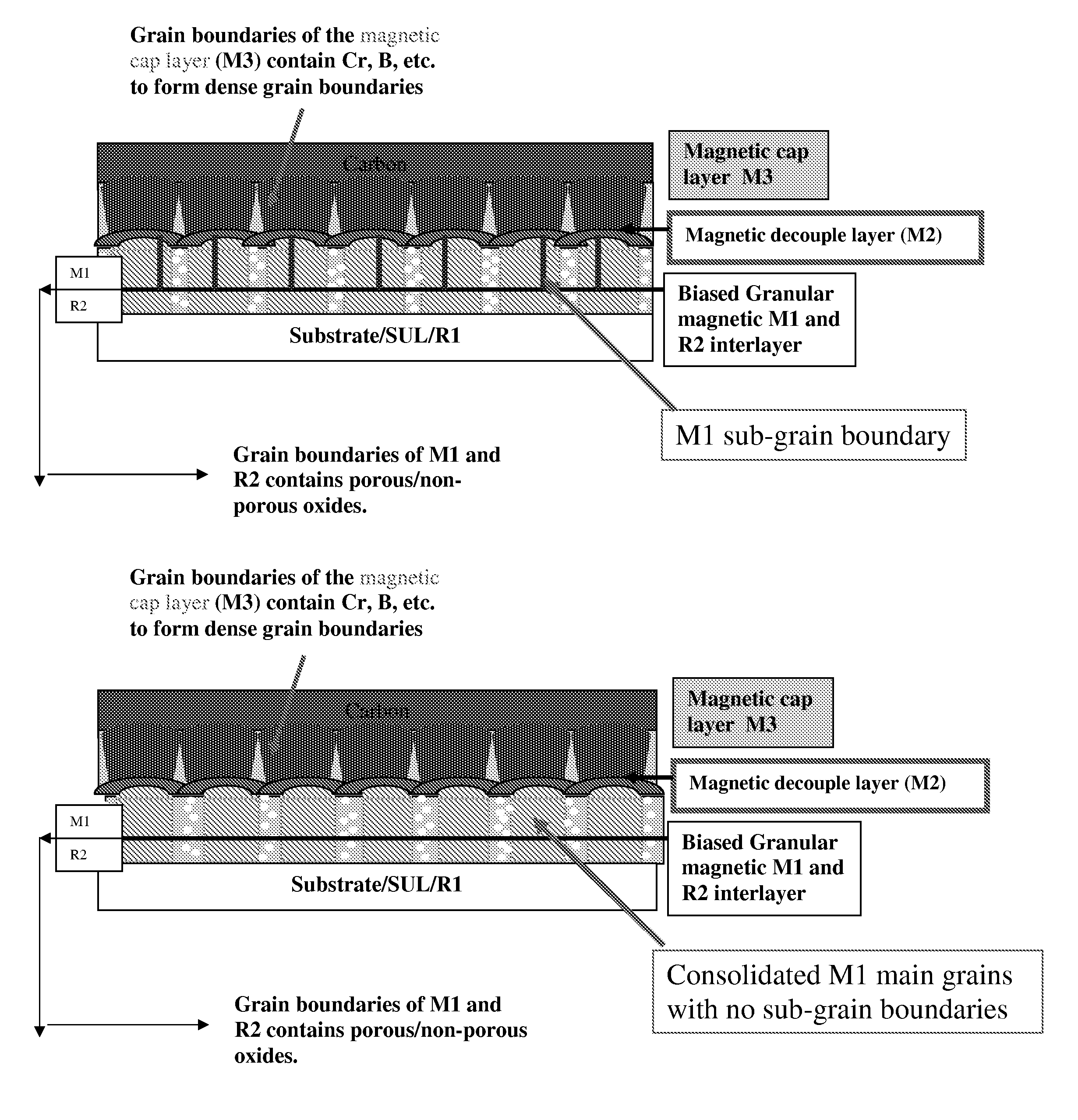
The perpendicular recording media of the prior art have high porosity and low density in the media film stack and a high surface roughness of the media.
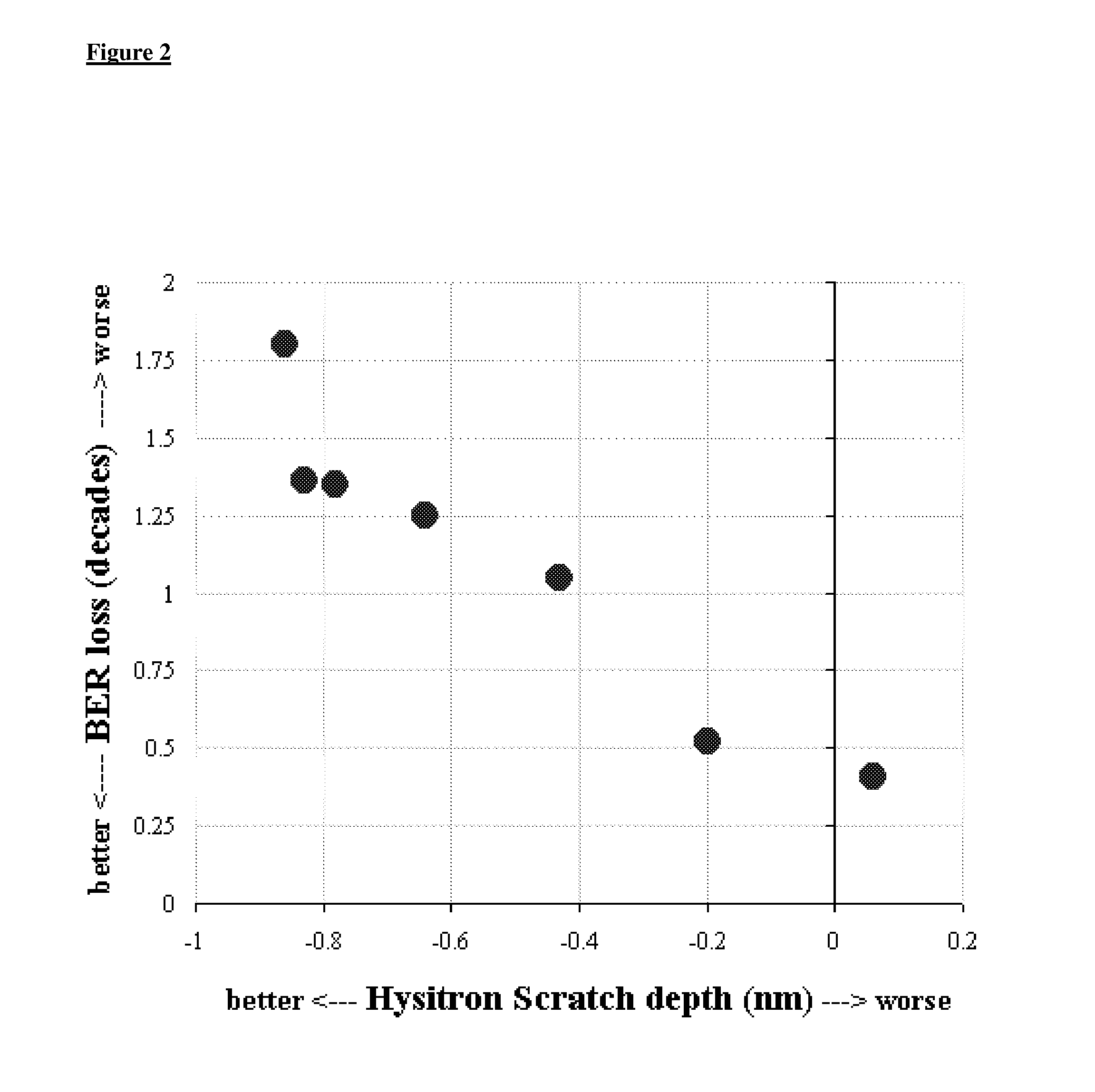
As a result, the prior art perpendicular recording media suffer from two big failure modes: (a) poor scratch resistance in high RPM drives, and (b) poor corrosion performance in hot and humid environment.

Method used

the structure of the environmentally friendly knitted fabric provided by the present invention; figure 2 Flow chart of the yarn wrapping machine for environmentally friendly knitted fabrics and storage devices; image 3 Is the parameter map of the yarn covering machine
View more

Image

Smart Image Click on the blue labels to locate them in the text.
Viewing Examples
Smart Image
  • Applying bias voltage during formation of granular recording media
  • Applying bias voltage during formation of granular recording media
  • Applying bias voltage during formation of granular recording media

Examples

Experimental program
Comparison scheme
Effect test

examples

[0038]All samples described in this disclosure were fabricated with DC magnetron sputtering except carbon films were made with AC magnetron sputtering. Example data demonstrating the reduction of exchange coupling by reactive sputtering are explained herein.

[0039]A magnetic recording medium having an aluminum substrate was made having the layer structure shown in the table below. This table also provides the processing conditions (pressure and bias voltage applied to different layers on the substrate).

[0040]

Thick-Film stackMaterialPressurenessBias VoltageCarbonCHN1-5mTorr 32 Å150VMagnetic 2-3CoCrPtB1-5mTorr100 Å150-250VMagnetic 1CoCrPt(TiO2)30-100mTorr100 Å150-300VInterlayer 2Ru30-100mTorr100 Å50VInterlayer 1RuCr1-5mTorr150 Å250VSeedlayerTa1-5mTorr 25 Å50VSULFeCoCrB1-5mTorr275 Å250VAFCRu1-5mTorr 17 Å0VSULFeCoCrB1-5mTorr275 Å250V

[0041]Applicants found that the application of bias on interlayer 2 and / or magnetic layer 1 had considerable improvement in the performance of the magnetic r...

the structure of the environmentally friendly knitted fabric provided by the present invention; figure 2 Flow chart of the yarn wrapping machine for environmentally friendly knitted fabrics and storage devices; image 3 Is the parameter map of the yarn covering machine
Login to View More

PUM

PropertyMeasurementUnit
bias voltageaaaaaaaaaa
pressureaaaaaaaaaa
Login to View More

Abstract

An embodiment of the invention relates to a perpendicular magnetic recording medium comprising (1) a substrate, (2) an interlayer comprising hexagonal columns and (3) a magnetic layer, wherein the magnetic layer is deposited applying a bias voltage to the substrate such that the magnetic layer comprises magnetic grains having substantially no sub-grains within the magnetic layer, and the magnetic layer has perpendicular magnetic anisotropy.

Description

BACKGROUND[0001]A magnetic material is composed of a number of domains. Each domain contains parallel atomic moments and is magnetized to saturation, but the directions of magnetization of different domains are not necessarily parallel. Local preferred directions of magnetization depend upon the underlying microscopic structure of the material. Magnetic recording media microstructure generally includes grains or particles comprising regions of constant crystal structure or geometry. The local directions of easiest magnetization depend upon the geometry of the crystals. In the absence of an applied magnetic field, adjacent domains may be oriented in different directions, controlled by the underlying grain structure. The resultant effect of all these various directions of magnetization may be zero, as is the case with an unmagnetized specimen. When a magnetic field is applied, domain nearly parallel to the direction of the applied field become more prevalent at the expense of the othe...

Claims

the structure of the environmentally friendly knitted fabric provided by the present invention; figure 2 Flow chart of the yarn wrapping machine for environmentally friendly knitted fabrics and storage devices; image 3 Is the parameter map of the yarn covering machine
Login to View More

Application Information

Patent Timeline
no application Login to View More
Patent Type & Authority Patents(United States)
IPC IPC(8): G11B5/74G11B5/65G11B5/667G11B5/73G11B5/851
CPCG11B5/851G11B5/65G11B5/667G11B5/7325G11B5/7377G11B5/7369G11B5/676G11B5/672
Inventor XU, WEILULU, MIAOGENMUNTEANU, MARIANA R.WU, MICHAEL Z.ROU, SHANGHSIEN ALEXHWANG, STEVE KUO-HSINGYEN, ED
Owner SEAGATE TECH LLC
Features
  • R&D
  • Intellectual Property
  • Life Sciences
  • Materials
  • Tech Scout
Why Patsnap Eureka
  • Unparalleled Data Quality
  • Higher Quality Content
  • 60% Fewer Hallucinations
Social media
Patsnap Eureka Blog
Learn More