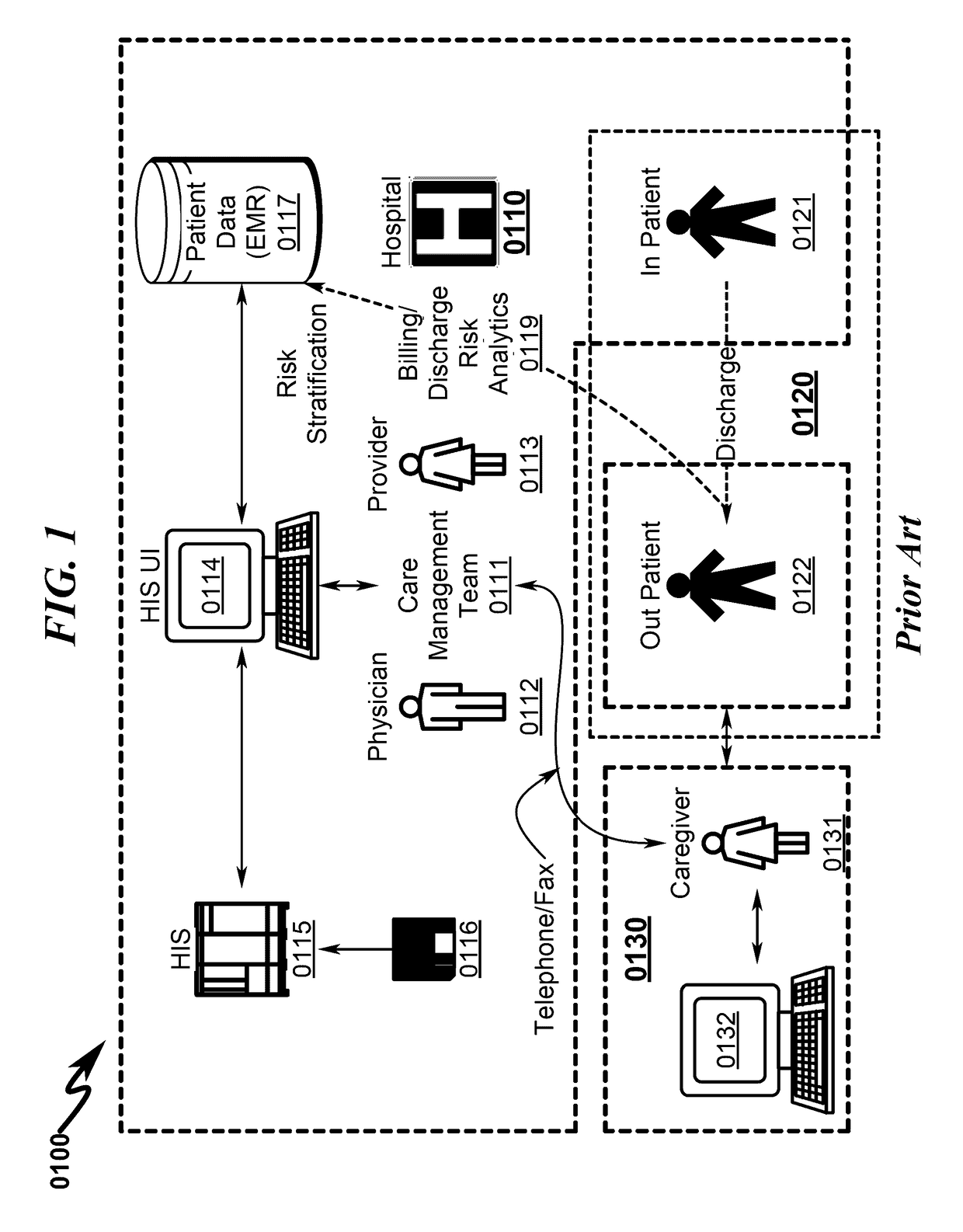
Within this healthcare delivery context, a significant problem exists in that while the patient (0120) may be fully monitored while being treated by the care management team (0111), once the patient (0120) progresses from in-patient (0121) to out-patient (0122) status, healthcare delivery is often reduced in quality because it is impossible to adequately monitor the patient (0120) once the patient (0120) transitions from in-patient (0121) to out-patient (0122) and leaves the confines of the hospital (0110) or other healthcare provider.
This follow-up treatment is typically much more expensive than monitored or preventative care delivered by a healthcare provider (0130).
An additional issue with this model of healthcare delivery is the fact that
risk stratification analytics (0119) relating to the delivery of healthcare to the patient (0120) are determined AFTER the patient has progressed from in-patient (0121) to out-patient (0122) status.
However, once the patient (0120) leaves (0122) the hospital (0110) confines the patient health state may change radically and it is not possible for this information to be incorporated into the HIS (0115) for use by the care management team (0111) to determine what if any additional healthcare should be directed towards the discharged patient (0122).
In summary, once the patient leaves the confines of the hospital environment the healthcare given to the patient is uncontrolled and for the most part unmonitored.
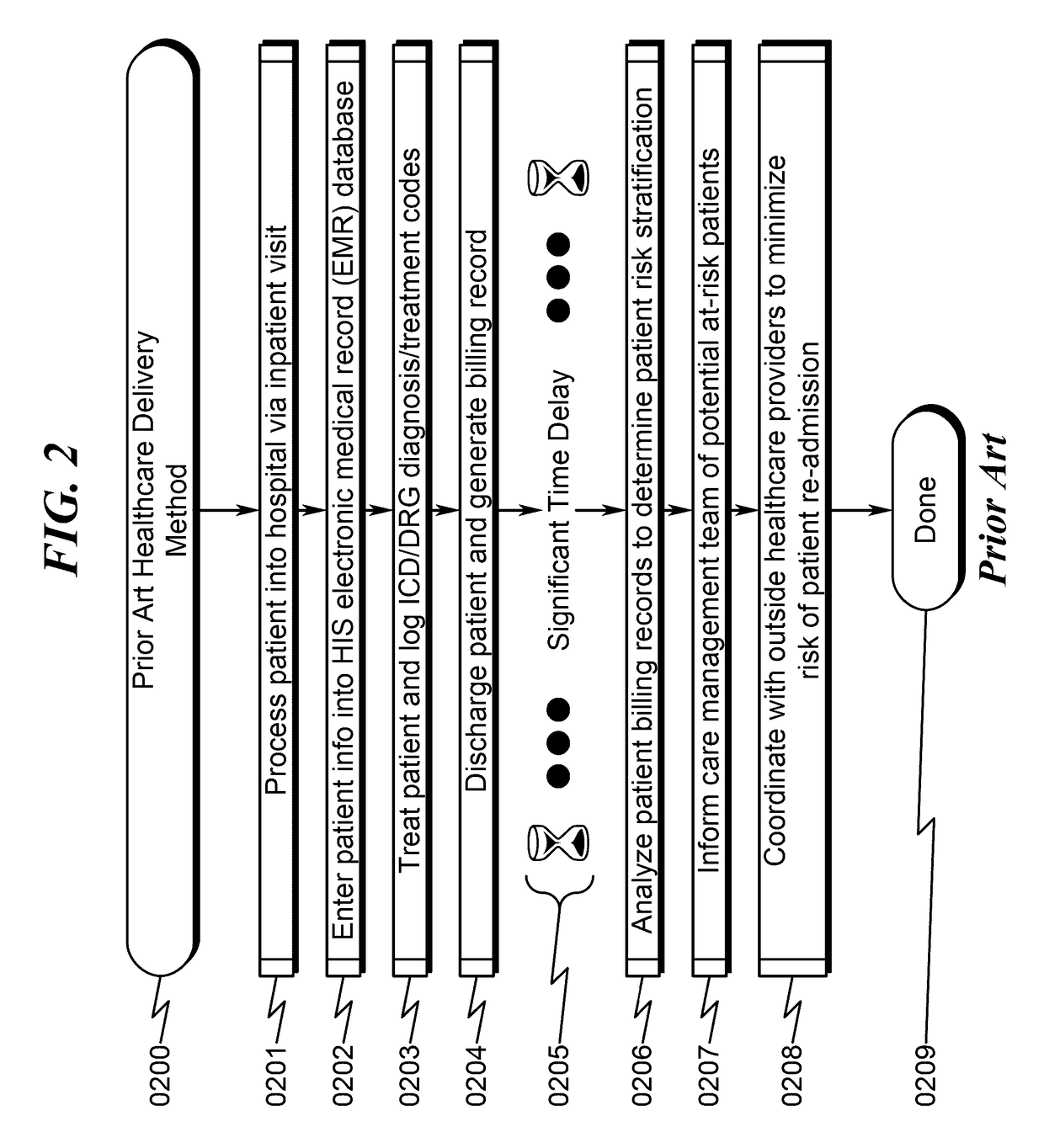
While a number of different variations on this methodology may exist in various healthcare environments, the basic problem with this methodology is that it statically determines the at-risk patients based on an analysis of ICD / DRG codes and other information as part of the billing cycle.
As such, there is no methodology in this process flow to account for changes
in patient risk stratification while the patient is being treated at the hospital.
Additionally, information concerning at-risk patients once statically determined is never updated based on changing
patient status after discharge from the hospital.
Finally, it is not possible to economically deploy healthcare professionals in the field to perform the necessary patient monitoring required to update patient at-
risk status once
discharge from the hospital has occurred.
As a result, many patients experience a decline in health status after leaving the hospital because there is little or no medical feedback to the CMT or other healthcare providers as to the actual condition of the patient.
The prior art as detailed above suffers from the following deficiencies:Prior art healthcare delivery systems and methods do not perform
patient risk stratification while the patient is being treated at the hospital or medical facility.Prior art healthcare delivery systems and methods do not dynamically collect
patient information for
risk stratification while the patient is in the hospital environment.Prior art healthcare delivery systems and methods do not dynamically determine
patient risk stratification.Prior art healthcare delivery systems and methods do not accurately determine at-risk patients once these patients leave the hospital environment.Prior art healthcare delivery systems and methods do not coordinate
patient data between outside healthcare providers and the hospital HIS / EMR systems.Prior art healthcare delivery systems and methods are generally unaware of changes
in patient vital statistics after the patient has left the hospital environment.Prior art healthcare delivery systems and methods lack interaction with the patient for the purposes of determining changes
in patient status or behavior.Prior art healthcare delivery systems and methods lack any mechanisms to link
patient care with
patient education.
While some of the prior art may teach some solutions to several of these problems, the core issue of integrating healthcare remotely among various healthcare providers in an effort to reduce patient re-admissions has not been solved by the prior art.



 Login to View More
  Login to View More