
Method for treating an exhaust gas
a technology for treating and exhaust gas, applied in the direction of machines/engines, separation processes, electric control, etc., can solve the problems of oxygen sensor “drift”, affecting oxygen sensors, and a particular problem, so as to achieve the effect of reducing the generation of nox on or in the second stage catalyst, reducing the amount of air contaminants, and reducing the generation of nox
- Summary
- Abstract
- Description
- Claims
- Application Information
AI Technical Summary
Benefits of technology
Problems solved by technology
Method used
Image

Examples
Embodiment Construction
Definition of Terms
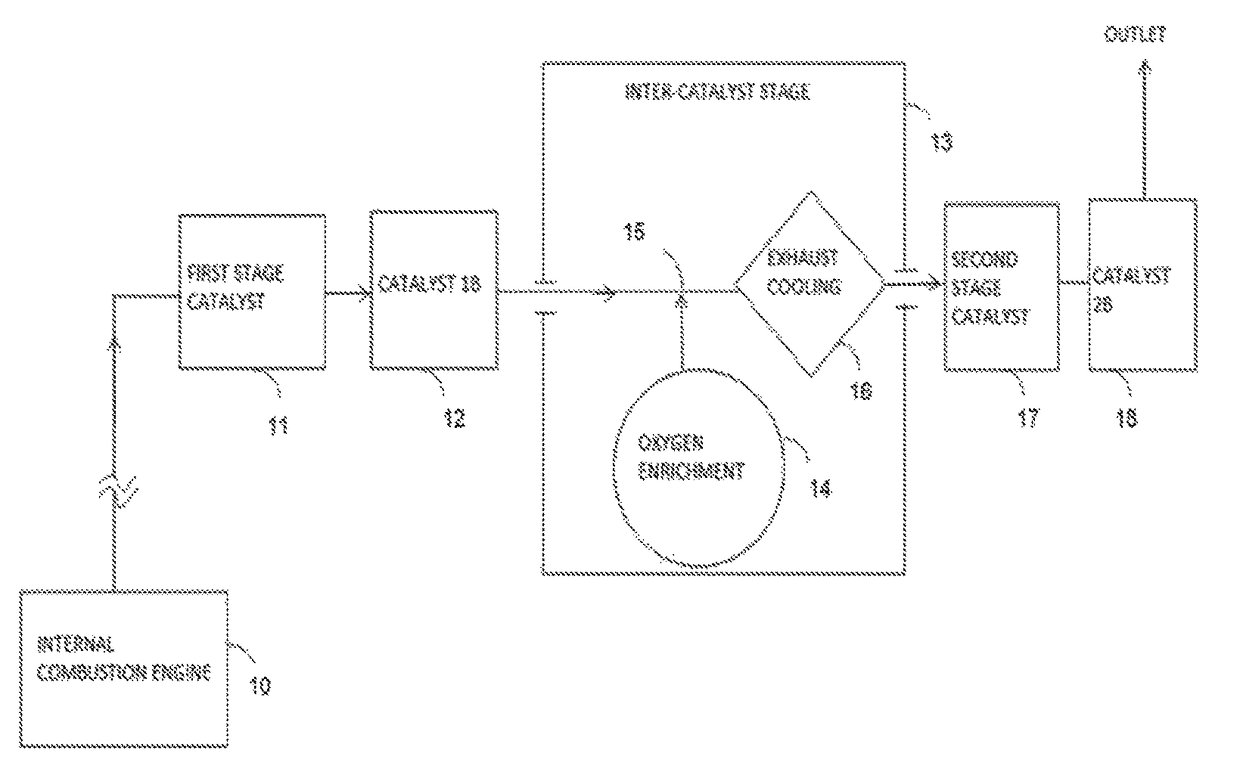
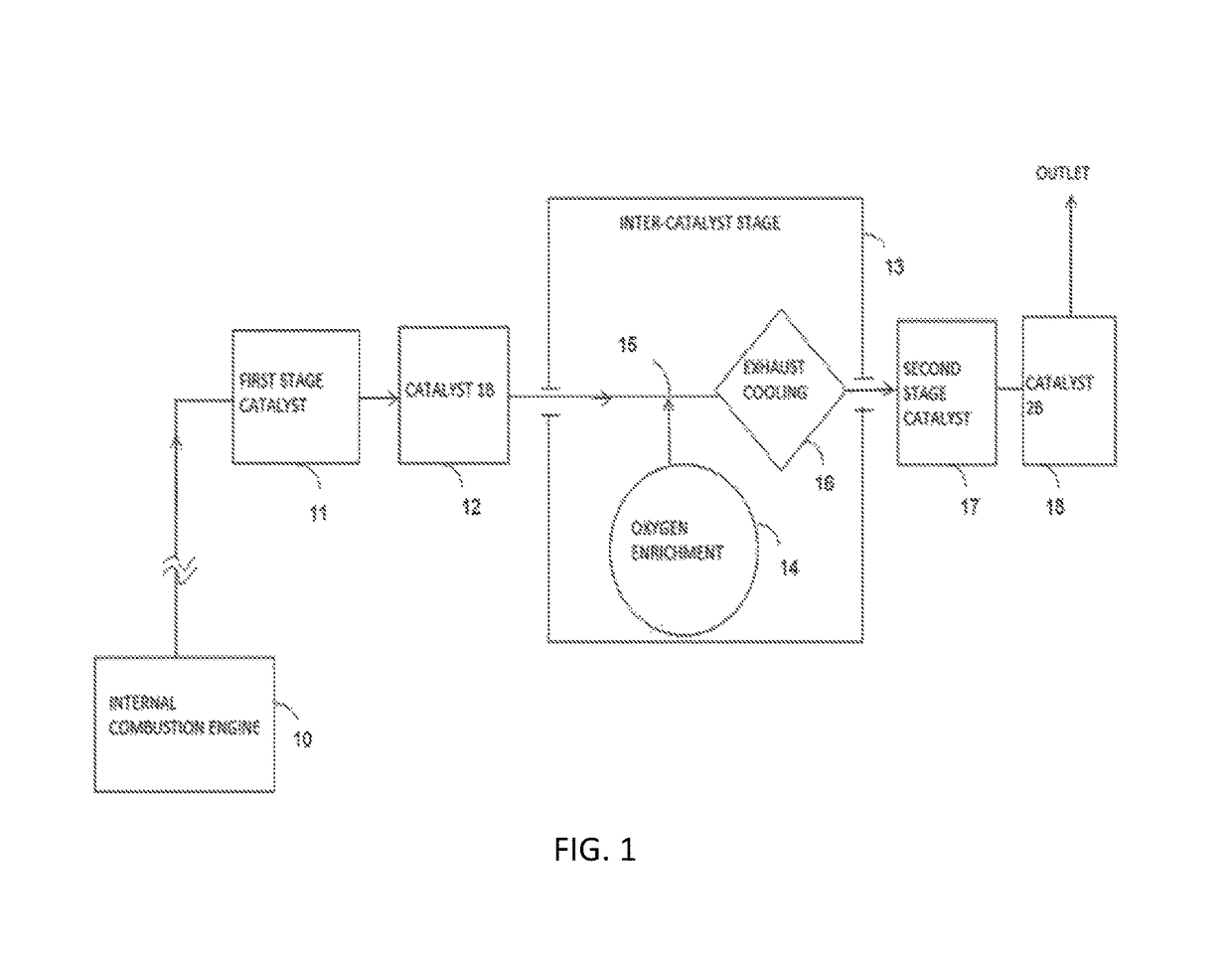
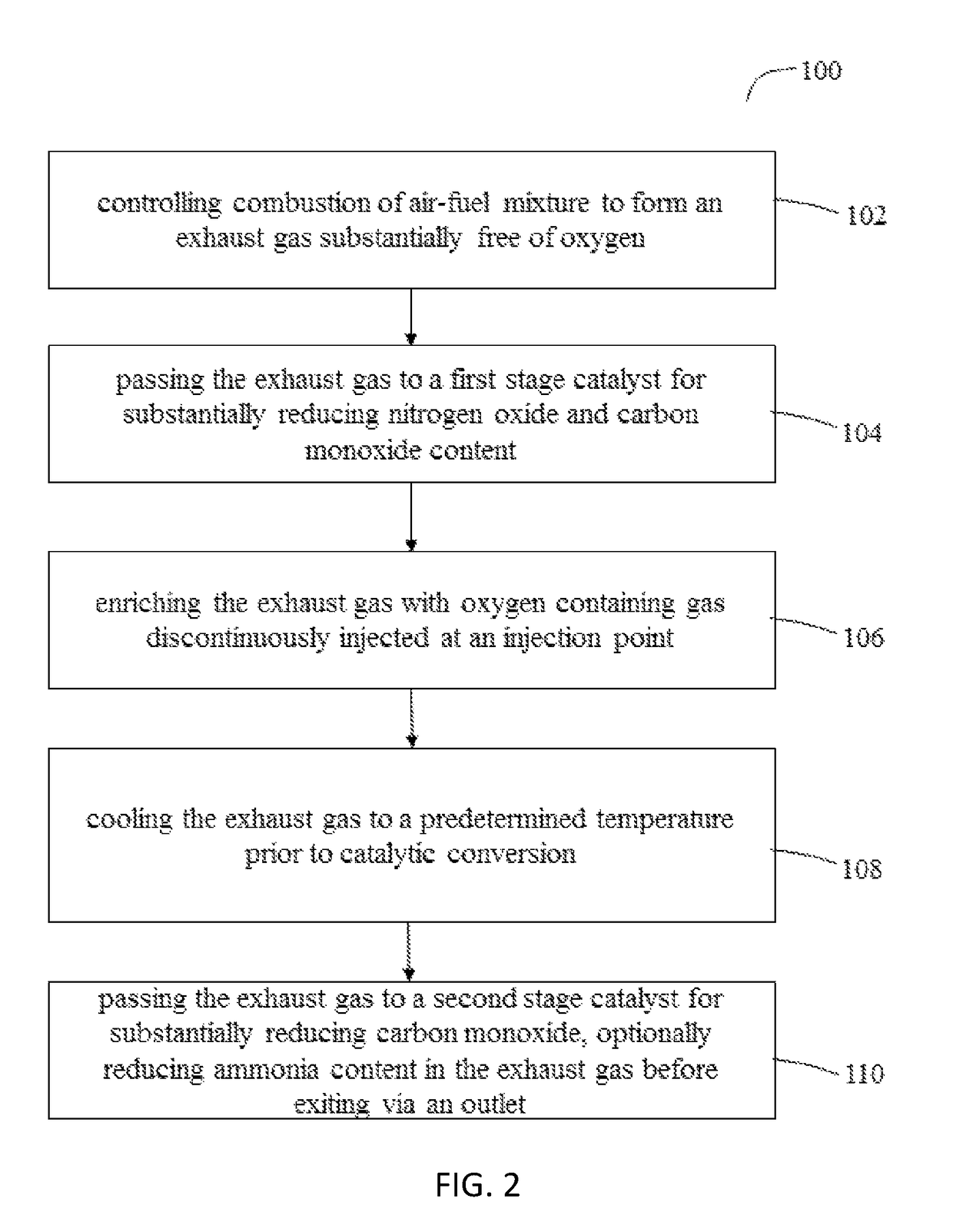
“Exhaust cooling process” refers to a device that functions to control the temperature of an exhaust gas and is located within the inter-catalyst stage.
“First stage catalyst” refers to a first catalyst in the path of an exhaust after the exhaust leaves an engine.
“Second stage catalyst” refers to a first catalyst in the path of the exhaust after an inter-catalyst stage.
“NOx” refers to nitrogen oxides including NO and NO2.
“Discontinuous” means not constant or not continuous.
“Dithering” refers to oscillating the air to fuel ratio around a set point.
“Parts per million (ppm)” refers to parts per million by volume.
“Cleaning period” refers to a period up to 30 minutes in duration.
“Inter-catalyst stage” refers to a device containing an exhaust cooling device and an oxygen enrichment device.
[0012]“Oxygen containing gas” refers to a gas containing oxygen and consisting of air, oxygen gas, oxygen containing exhaust gas, or mixtures of those gases and nitrogen gas, exhaust ga...
PUM
| Property | Measurement | Unit |
|---|---|---|
| temperature | aaaaa | aaaaa |
| exhaust gas temperature | aaaaa | aaaaa |
| temperature | aaaaa | aaaaa |
Abstract
Description
Claims
Application Information
 Login to View More