[0008]This model provides the entire capabilities of the device with feature classifications, such as load balancing, SSL, Basic, etc. The model also covers relationships between function definitions and configuration entities and it also provides configurable object grouping. For example, all the policy objects are grouped under one object called ‘Policy’ and the object is referred in each function. Similarly, network entities are grouped as ‘Network’ object, global parameters are grouped in ‘Global’ object, etc. These groupings allow an administrator to navigate large number of objects easily and the same can be referred for each function definition as well. The model provides implicit object relationships under each object definitions such that the SDN controller can identify how the object relationships are built in the device. This also extends the simplification such that an administrator can fill the relationship details at the time of object creation.
[0009]The device management model provides feature-centric configuration flow. In traditional configuration flow, an administrator creates individual entities, such as a load balancing virtual service, and binds the individual entities with any service or service group. By using the model, the administrator can select required features, such as load balancing, SSL offload, Content switching, etc. These function definitions internally provide required objects, mandatory parameters, and object relationships, among others. In this way, the administrator does not need to handle the configuration sequencing and object-specific operations. The device management model can provide in-depth device capabilities, parameter classifications, feature definitions, device profiles, validations, object relationship, among others.
[0010]The device management model can provide generic capabilities which can be consumed by the SDN controller to manage the entire feature set of the device. The device management model allows the SDN controller to configure the entire network flow from the application's perspective. A rich device management model can provide a very good user experience as well since declarative validations, such as enumerator values validation, take place at the controller itself. Unlike in a traditional datacenter environment where a user must be familiar with each device-specific configurable entity and its configuration flow, the model-centric configuration from the SDN controller eliminates this dependency. In this way, the administrator does not need to be familiar with device-specific intricacies as the device management model abstracts all these intricacies.
[0013]The ADC device can support a large number of configurable entities to provision various features, such as load balancing. Each feature can be configured in many different ways using command line interface (CLI) or a graphical user interface (GUI). The present solution involves the creation and use of generic APIs, also known as function definitions, to configure entire feature sets from the ADC. Each function definition constitutes a complete set of parameters, which are required to provision the particular feature / function. These parameters can be classified in the form of basic and advanced. Most of the configurable parameters are grouped at various levels to improve the usability and ease of use. An administrator can call these functions using REST APIs and parameters can be passed in JSON or Python dictionary format.
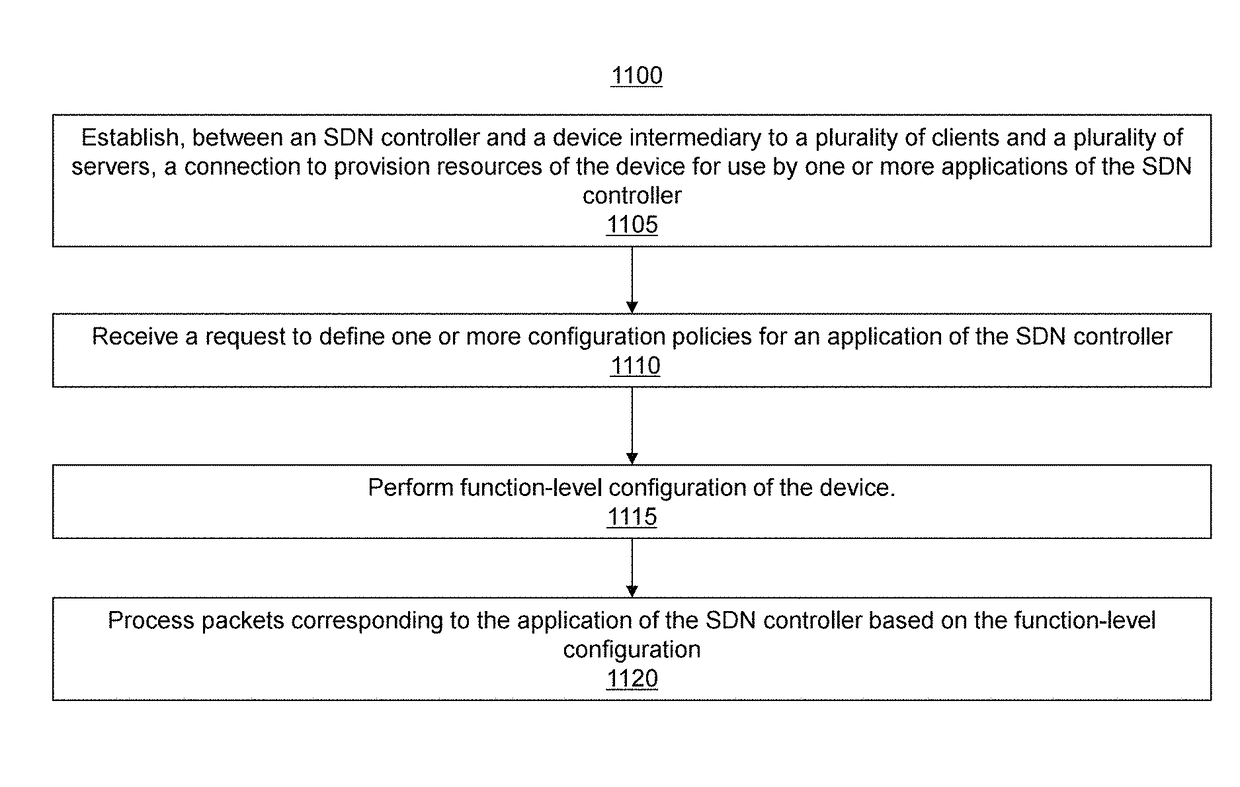
[0022]The present disclosure provides methods and systems to configure the ADC device where any application, such as Microsoft Exchange, can be provisioned in the ADC via one or more function definitions. Parameters of the function definitions can be pushed in a single API call. The SDN controller can use a single API to configure any features or functions in the ADC. The present disclosure can determine the type of operation by a parameter's state. For example, the ‘create’ state can trigger an add operation, the ‘delete’ state can trigger a remove operation, and if there is no change in the state, then the system can ignore the data. The present disclosure provides a solution that completely abstracts a device-centric view and provides an application-specific configuration flow. The solution also hides tedious sequencing and handles all bindings internally, making the integration of the ADC with any SDN controller much smoother without compromising on any functionality.


 Login to View More
  Login to View More