Segmentation method of natural image in robustness

A natural image, robust technology that can be used in instruments, character and pattern recognition, computer components, etc. to solve problems such as the inability to meet the needs of practical vision processing tasks

CN100378752CInactive Publication Date: 2008-04-02INST OF AUTOMATION CHINESE ACAD OF SCI
1 Cites 2 Cited by

Patent Information

Authority / Receiving Office
CN · China
Patent Type
Patents(China)
Current Assignee / Owner
Publication Date
2008-04-02
Estimated Expiration
Not applicable · inactive patent

Smart Images

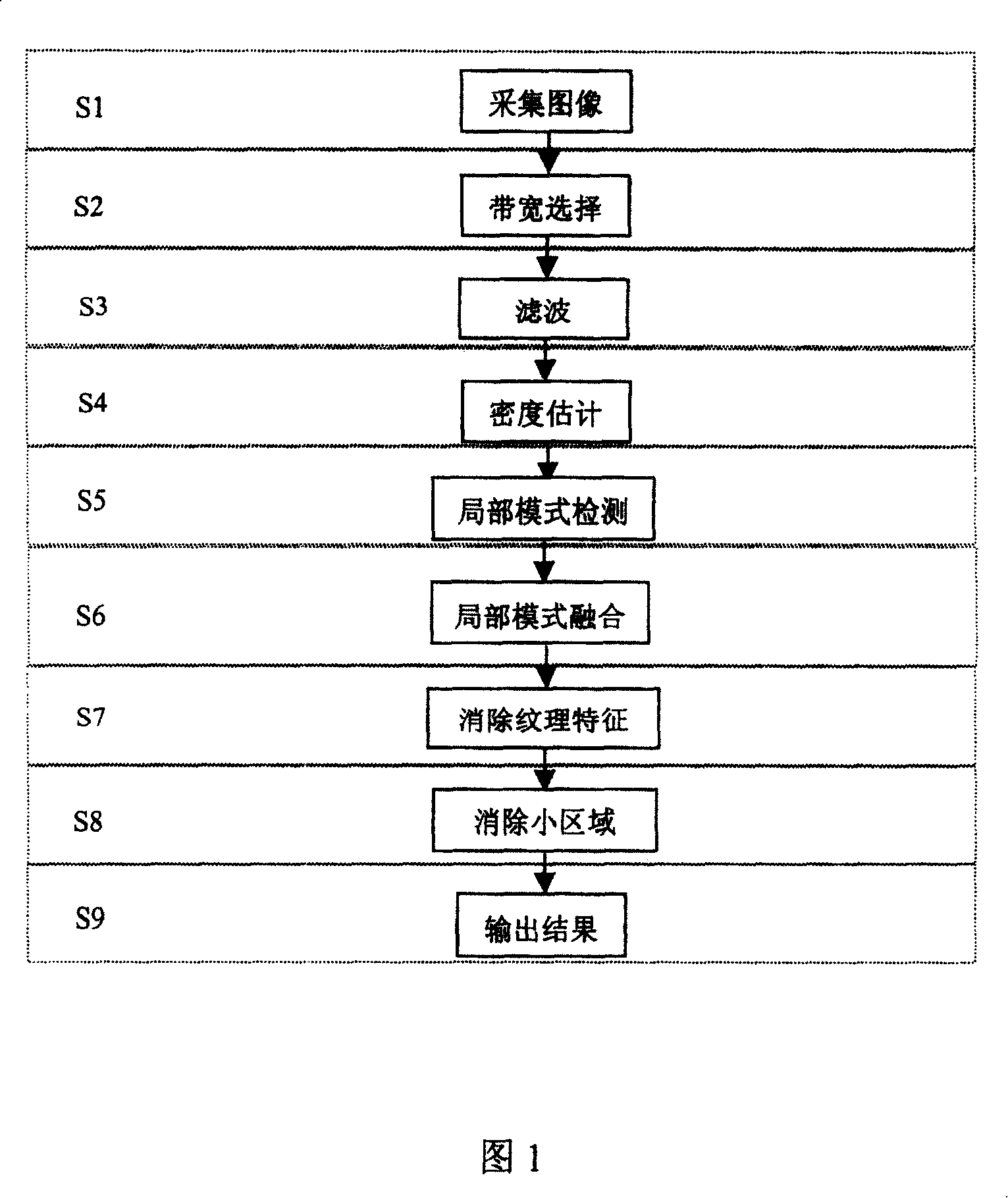
  • Figure 1
    Figure 1
Patent Text Reader

Abstract

The invention discloses a method of picture division and the picture understanding technology, a robustness natural picture division method. Method step: S1, gathering a picture into the memory; S2,according to the multi-variables and non-parameter consistency, estimating superior width choice method, counting the color width by the picture YUV component, and confirming space width according to upper formation vision duty; S3, carrying on the bilateral filter to the picture; S4, estimating each pels probability density with estimates the color width further; S5, partial modes examination, this process is also the pels gather one, belongs to the identical partial modes the pels gathers into the identical kind; S6, partial modes fusion, gathering once more, merging color near block in the picture; S7, eliminating the texture characteristic influence to divided result; S8, eliminating the area to be smaller than 100 pels; S9, producing output.
Need to check novelty before this filing date? Find Prior Art

Description

technical field

[0001] The invention relates to the technical field of image segmentation and image understanding, in particular to a robust natural image segmentation method. Background technique

[0002] Indoor and outdoor irregular application environments are common situations encountered by robot vision navigation. To accommodate these environments, some dedicated artificial targets can be set up while navigating. The application of using artificial targets as landmarks for navigation is limited because it is difficult to set artificial targets in many applications. In contrast, the navigation method based on natural target detection and recognition has more general applicability, and it is suitable for robot navigation in random scenarios. In natural object detection and recognition, the segmentation of natural images and the stability (robustness) of segmentation performance are key. Therefore, Lubang's natural image segmentation method has important application va...

Examples

Embodiment Construction

[0022] The robust natural image segmentation process is illustrated in Figure 1. The whole segmentation process consists of seven parts: color bandwidth estimation, filtering, density estimation, local mode detection, local mode fusion, elimination of texture features, and elimination of regions smaller than 100 pixels.

[0023] Specific steps include:

[0024] Step S1, collecting a frame of image to memory;

[0025] Step S2, according to the optimal bandwidth selection method in multivariate non-parametric kernel density estimation, calculate the color bandwidth from the YUV component of the image, and determine the spatial bandwidth according to the upper-level visual task;

[0026] Step S3, performing bilateral filtering on the image;

[0027] Step S4, using the estimated color bandwidth to further estimate the probability density at each pixel;

[0028] Step S5, local pattern detection, on the estimated probability density, use local direct density search method to sear...