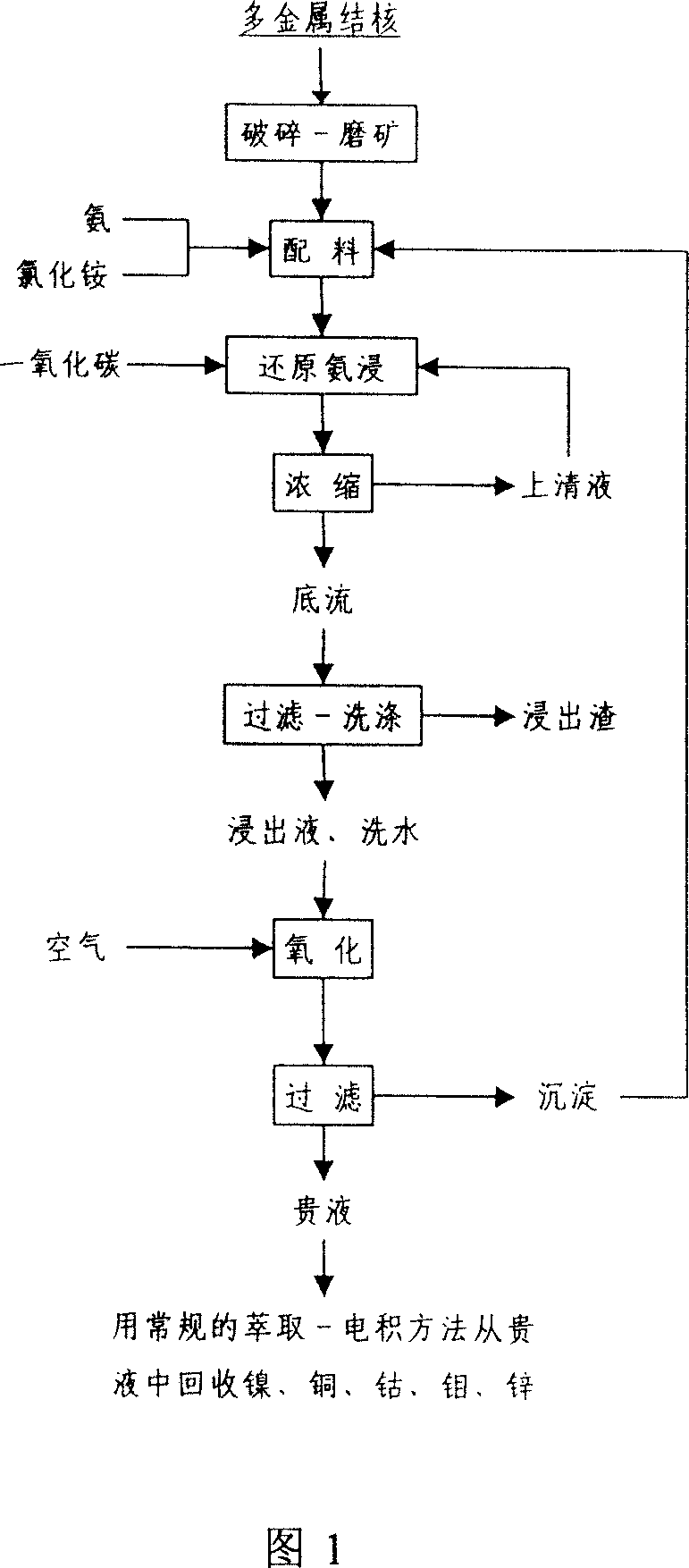
Self catalyzed reduction ammonia soaking process of deep sea polymetallic nodule in ammonia-ammonium chloride system

A technology of polymetallic nodules and ammonium chloride, applied in the direction of improving process efficiency, etc., can solve the problems of increased carbon monoxide consumption, high energy consumption of ammonia distillation operation, huge leaching equipment, etc., to improve processing capacity, realize autocatalytic reduction, The effect of reducing carbon monoxide consumption

CN101020962AInactive Publication Date: 2007-08-22BEIJING GENERAL RES INST OF MINING & METALLURGY
2 Cites 13 Cited by

Patent Information

Authority / Receiving Office
CN · China
Current Assignee / Owner
Publication Date
2007-08-22
Estimated Expiration
Not applicable · inactive patent

Smart Images

  • Figure 1
    Figure 1
Patent Text Reader

Abstract

The present invention is self catalyzed reduction ammonia soaking process of deep sea polymetallic nodule in ammonia-ammonium chloride system, and relates to method of optionally leaching out Ni, Cu, Co, Mo and other valuable metals from polymetallic nodule. The soaking process includes the following steps: leaching out ground polymetallic nodule in ammonia-ammonium chloride solution containing NH3 in 60-180 g / l, Cl- in 10-60 g / l and Cu+ over 4 g / l; concentrating and separating the leached out ore pulp; returning the supernatant to the leaching process and filtering and washing the underflow; oxidizing the leached liquid with air to eliminate impurity and returning the precipitate to the leaching process; and conventional extraction-electric depositing to recover Ni, Cu, Co, Mo and Zn from the oxidized leached solution. The process has simple leaching system, high metal leaching rate, low power consumption and other advantages.
Need to check novelty before this filing date? Find Prior Art

Description

technical field

[0001] A method for the self-catalytic reduction of ammonia leaching of deep-sea polymetallic nodules ammonia-ammonium chloride system relates to a method for selectively leaching valuable metals such as nickel, copper, cobalt, and molybdenum from polymetallic nodules, especially in ammonia-ammonium chloride In the solution, the autocatalytic reduction ammonia leaching method using carbon monoxide as the reducing agent. Background technique

[0002] Deep-sea polymetallic nodules are an important metal mineral resource in the international seabed area. They are widely distributed on the surface of the ocean bottom at a water depth of 3500-6000m. The reserves are about 3×10¹²t, and the Pacific Ocean alone has 1.7×10¹²t, and it is still growing. It is estimated that the global The new growth of polymetallic nodules reaches 1×10⁷t every year. Polymetallic nodules are rich in nickel, copper, cobalt and other metals, of which the content of nickel and copper is ab...

Examples

Embodiment 1

[0046] Take 10g of rough polymetallic nodules, grind to -0.074mm to account for 81%, add to 120g / l NH 3 , 40g / l Cl - , 2.0g / l Co 2+ , 8.6g / l Ni 2+ , 15.5g / l Cu + In the ammonia-ammonium chloride solution, the liquid-solid weight ratio is 40:1, the leaching temperature is 45°C, and the carbon monoxide flow rate is 2m 3 / t·min, leaching for 2.5h. The leaching rate of cobalt is 89.33%.

Embodiment 2

[0048] Take 10g of rough polymetallic nodules, grind to -0.074mm to account for 70%, add to 160g / l NH 3 , 10g / l Cl - , 2.0g / l Co 2+ , 10.2g / l Ni 2+ , 20g / l Cu + In the ammonia-ammonium chloride solution, the liquid-solid weight ratio is 20:1, the leaching temperature is 50°C, and the carbon monoxide flow rate is 1.5m 3 / t·min, leaching for 4h. The leaching rate of cobalt is 91.42%.

Embodiment 3

[0050] Take 10g of rough polymetallic nodules, grind to -0.074mm to account for 50%, add to 100g / l NH 3 , 30g / l Cl - , 1.9g / l Co 2+ , 11.3g / l Ni 2+ , 8g / l Cu + In the ammonia-ammonium chloride solution, the liquid-solid weight ratio is 5:1, the leaching temperature is 55°C, and the carbon monoxide flow rate is 0.4m 3 / t·min, leaching for 4h. The leaching rate of cobalt is 89.7%.