
Zn-Al alloy having excellent high-speed deformation properties and its making method
An alloy and excellent technology, applied in the field of Zn-Al alloy and its manufacturing, can solve problems such as unstable deformation energy, and achieve the effect of excellent static deformation energy and dynamic deformation energy.
- Summary
- Abstract
- Description
- Claims
- Application Information
AI Technical Summary
Problems solved by technology
Method used
Image

Examples
Embodiment l
[0087] [Manufacture of Zn-Al alloy]
[0088] The Zn-22%Al alloy melt was casted using an iron mold or a copper mold with a cross-sectional shape of 200mm long×350mm wide, under both air-cooled or water-cooled conditions. In addition, a part (No. 12 of Table 1 described later) was continuously casted using a water-cooled copper mold with a cross-sectional shape of 200 mm. In this way, an ingot (ingot size: 180 kg) of Zn-22%Al (total impurity amount: 0.5% or less) in which alloy components tend to undergo macrosegregation was obtained.
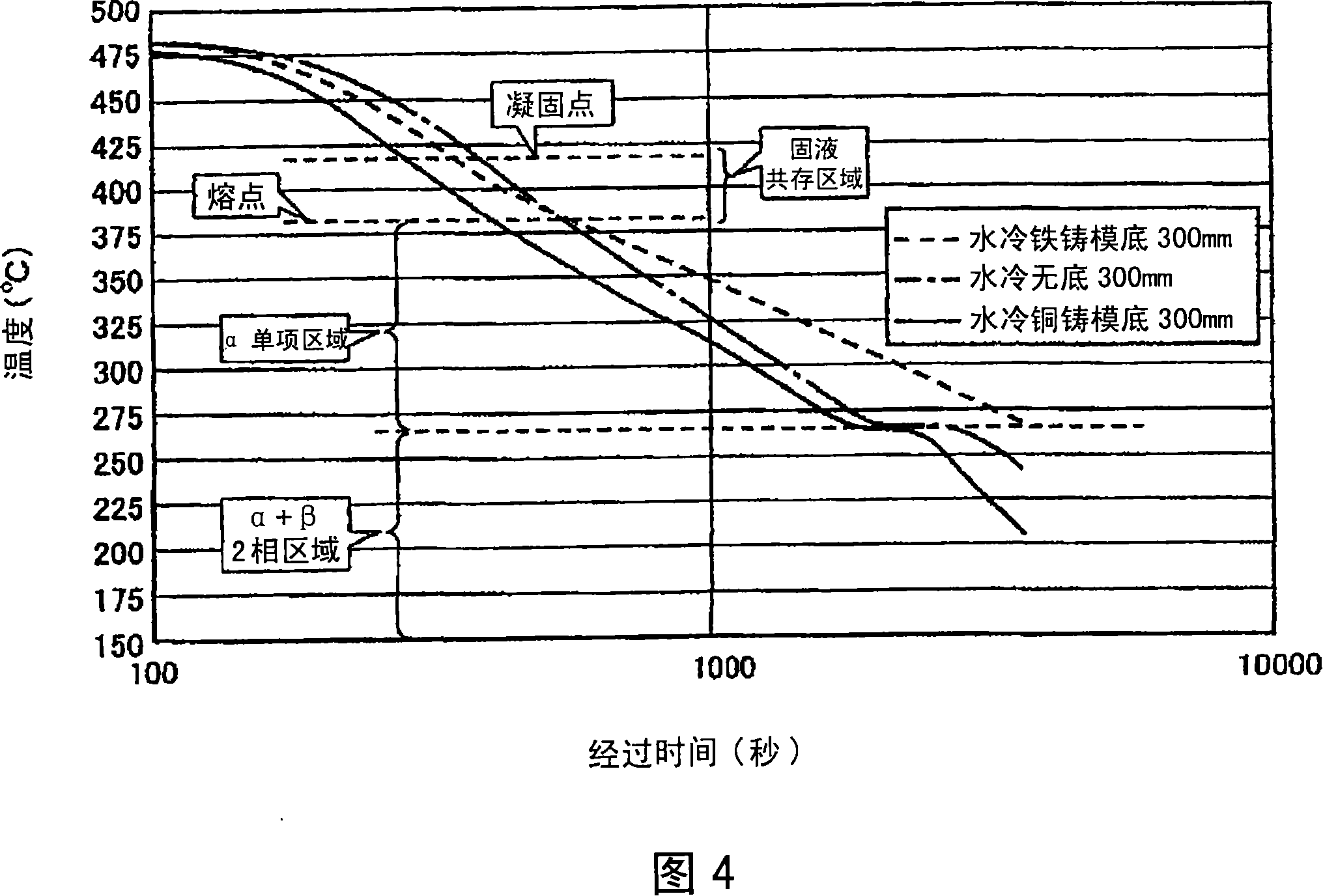
[0089] In addition, the cooling behavior of the ingot was measured by installing a thermocouple at a position 300 mm from the bottom surface of each ingot (cross-sectional center position). An example of the temporal change (cooling curve) of the ingot internal temperature is shown in FIG. 4 . Based on the above cooling curve, the cooling rate (average cooling rate 1) in the solid-liquid two-phase domain (425-375°C) and the cooling rate (avera...
PUM
| Property | Measurement | Unit |
|---|---|---|
| yield point | aaaaa | aaaaa |
| elongation | aaaaa | aaaaa |
| elongation | aaaaa | aaaaa |
Abstract
Description
Claims
Application Information
 Login to View More