Mite-killing pesticide composition containing pyridaben and fenpyroximate

A technology of pesticide composition and fenpyrox, which is applied in the field of pesticide compositions containing pyridaben and pyridaben, can solve the problems of large amount of mites, short reproduction cycle, and rapid resistance increase, and reduce the use of dose, overcoming disease resistance, and reducing selection pressure

CN102726413AInactive Publication Date: 2012-10-17JIANGSU ESSENCE AGROCHEM
1 Cites 1 Cited by

Patent Information

Authority / Receiving Office
CN · China
Patent Type
Applications(China)
Current Assignee / Owner
Publication Date
2012-10-17
Estimated Expiration
Not applicable · inactive patent

Smart Images

  • Figure 1
    Figure 1
  • Figure 2
    Figure 2
Patent Text Reader

Abstract

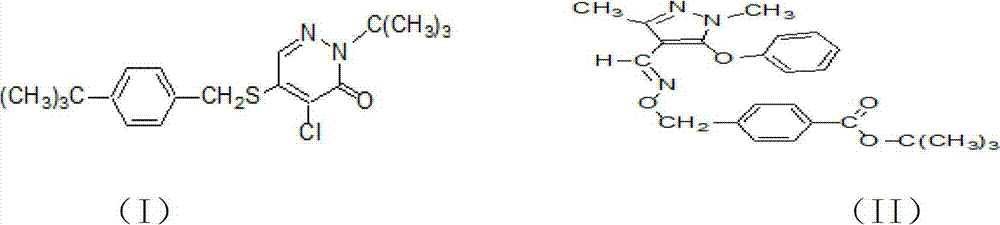
The invention discloses a mite-killing pesticide composition containing pyridaben and fenpyroximate, comprising effective drug components of pyridaben and fenpyroximate as well as auxiliary component which can be accepted in pesticide, wherein the weight ratio of the effective drug components, namely the weight ratio of pyridaben to fenpyroximate, is (30-1):(1-30). The composition disclosed by the invention can be applied to control or killing on insect pests such as mite and especially has obvious synergic control and killing effect on panonychus. Through synergetic application of pyridaben and fenpyroximate in the composition disclosed by the invention, application dosage can be reduced, and single selection pressure to mite is reduced, thus being beneficial to avoiding production of disease resistance and delaying the production of disease resistance and being capable of improving mite control effect.
Need to check novelty before this filing date? Find Prior Art

Description

technical field

[0001] The invention belongs to the field of pesticides, and in particular relates to a pesticide composition containing pyridaben and fenpyrid. Background technique

[0002] Acarids, commonly known as red spiders, are arachnid pests. Most of the common harmful mites belong to the orders Eucarina and Acarina, and they are one of the important pests that harm a variety of crops. Domestically, it is mainly distributed in South China, Central China, Northeast China and North China, etc., and it is distributed in economic crop areas at the same latitude abroad. Harm the leaves, stems, and flowers of various crops such as fruit trees, vegetables, wheat, cotton, corn, flowers, and beans, and pierce and suck the stems and leaves of plants. A large number of chlorosis shrinks and falls off from bottom to top, resulting in a large number of fallen leaves. Occurs sometimes from leaves in the middle of the plant, leaves gradually turn yellow and do not fall early (App...

Examples

Embodiment 1

[0022] Example 1: Determination of indoor drug efficacy of pyridaben and pyraclofen compound against Panonychus citrus

[0023] Test object: Panonychus citri Wcgregov

[0024] Test method: refer to the indoor bioassay test guidelines for pesticides of the People's Republic of China NY / T1154.12-2008 Tetranychus slide dipping method.

[0025] After 48 hours of treatment, it was measured. After statistical analysis, the test results are shown in Table 1.

[0026] Table 1 The results of the indoor drug efficacy test of pyridaben and pyraclofen in a series of ratios against Panonychus citrus

[0027] Drug composition (wt)

[0028] The test results show that pyridaben and pyraclofen are compounded at a weight ratio of 10:1-1:5, and the co-toxicity coefficients are all above 120 in the control of Panonychus citrus, which has a synergistic effect; among them, the ratio is 5 :1-1:1, the co-toxicity coefficient is the highest.

Embodiment 2

[0029] Example 2: 21.7% pyridaben-pyridaben water dispersible granules

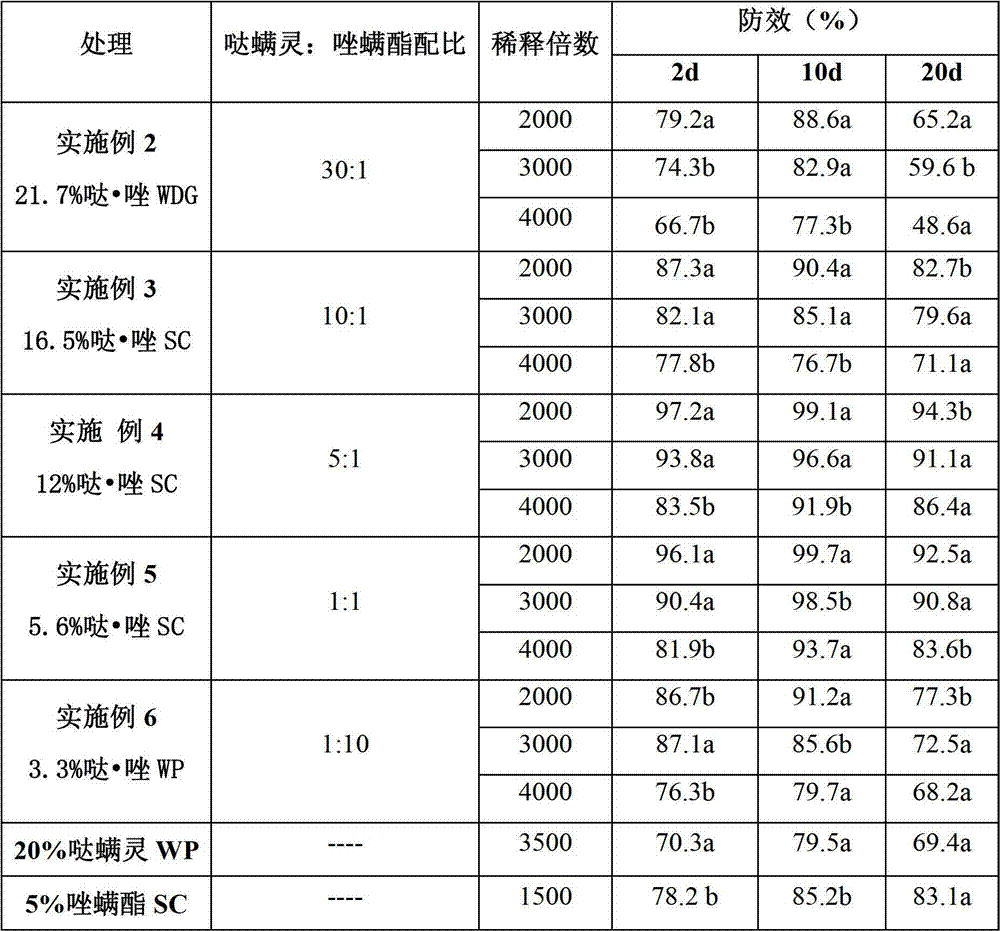
[0030] Composition: 21% pyridaben, 0.7% pyraclofen, 9% sodium lignosulfonate, 4% sodium lauryl sulfate, and 100% bentonite.

Embodiment 3

[0031] Example 3: 16.5% pyridaben-pyridaben suspension concentrate

[0032] Composition: 15% pyridaben, 1.5% pyraclofen, 10% sodium methylnaphthalene sulfonate formaldehyde condensate, 0.4% xanthan gum, 1% bentonite, 5% glycerol, water to 100%.