
Manufacture method for electric conduction dust-free health care carbon granule
A production method and technology of carbon granules, applied in the field of polymers, can solve the problems of health care function to be improved, poor antistatic property, poor stability, etc. Effect
- Summary
- Abstract
- Description
- Claims
- Application Information
AI Technical Summary
Problems solved by technology
Method used
Image


Examples
Embodiment 1
[0034] The plant raw material used in this embodiment is corncob.
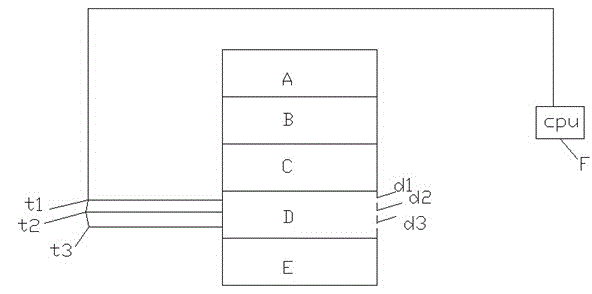
[0035] Put the plant material into the microwave vacuum tank, vacuumize to -0.02MPa, and then conduct microwave treatment, the microwave frequency is 300MHz, and the microwave treatment time is 1min; the plant material obtained after pretreatment is dried and pre-carbonized in sequence , carbonization, calcination and cooling, the temperature of each temperature measurement point, the drying zone A is 150°C, the pre-carbonization zone B is 275°C, and the carbonization zone C is 450°C. figure 1 The zone D shown is the temperature of different positions in the combustion zone. When the temperature of a certain place in the combustion zone, such as d2, is too low, open the small hole in that place, introduce air and burn it nearby, so as to raise the temperature in this place and control the bamboo to move down. The temperature of the combustion zone experienced during the process, control the combustion to raise...
Embodiment 2
[0041] The plant material used in this example is bamboo chips (about 40 cm long).
[0042] Put the plant material into the microwave vacuum tank, vacuumize until the vacuum degree is -0.001MPa, and then carry out microwave treatment, the microwave frequency is 950MHz, and the microwave treatment time is 3min;
[0043] The plant raw materials obtained through pretreatment are dried, pre-carbonized, carbonized, calcined, and cooled in sequence. The temperature at each temperature measurement point is 150°C in drying area A, 275°C in pre-carbonization area B, and 450°C in carbonization area C. Observation during warming figure 1 The zone D shown is the temperature of different positions in the combustion zone. When the temperature of a certain place in the combustion zone, such as d2, is too low, open the small hole in that place, introduce air and burn it nearby, so as to raise the temperature in this place and control the bamboo to move down. The temperature of the combustion...
Embodiment 3
[0048] The plant raw material used in this embodiment is pine tree, and the pine tree is first cut after the skin impurities are removed, and the length is controlled to be no more than 15 cm.
[0049] Put the plant raw material into the microwave vacuum tank, evacuate until the vacuum degree is -0.01~-0.005MPa, and then carry out microwave treatment, the microwave frequency is 550MHz, and the microwave treatment time is 1.2-2min;
[0050] The pre-treated plant raw materials are dried, pre-carbonized, carbonized, calcined, and cooled in sequence. The temperature at each temperature measurement point is 180°C in the drying area A, 325°C in the pre-carbonization area B, and 530°C in the carbonization area C. Observation during warming figure 1 The zone D shown is the temperature of different positions in the combustion zone. When the temperature of a certain place in the combustion zone, such as d2, is too low, open the small hole in that place, introduce air and burn it nearby,...
PUM
| Property | Measurement | Unit |
|---|---|---|
| diameter | aaaaa | aaaaa |
Abstract
Description
Claims
Application Information
 Login to View More