AI technical title is built by Patsnap AI team. It summarizes the technical point description of the patent document.
A high-frequency pulse, refrigerator technology, applied in the direction of refrigerators, refrigeration and liquefaction, compressors, etc., can solve the problems of large volume, difficult gas storage layout, etc., to improve the cooling capacity, reduce the quality and volume, reduce the The effect of length
Active Publication Date: 2015-11-04
TECHNICAL INST OF PHYSICS & CHEMISTRY - CHINESE ACAD OF SCI
View PDF6 Cites 0 Cited by
Summary
Abstract
Description
Claims
Application Information
AI Technical Summary
This helps you quickly interpret patents by identifying the three key elements:
Problems solved by technology
Method used
Benefits of technology
Problems solved by technology
[0008] However, if the volume is too large, the layout of the gas storage becomes difficult
Ordinary gas storage has occupied a considerable part of the overall volume and mass of the refrigerator, and a larger gas storage will limit the application of this type of refrigerator and become a constraint factor for the miniaturization of the refrigerator
Method used
the structure of the environmentally friendly knitted fabric provided by the present invention; figure 2 Flow chart of the yarn wrapping machine for environmentally friendly knitted fabrics and storage devices; image 3 Is the parameter map of the yarn covering machine
View more
Image
Smart Image Click on the blue labels to locate them in the text.
Viewing Examples
Smart Image
Click on the blue label to locate the original text in one second.
Reading with bidirectional positioning of images and text.
Smart Image
Examples
Experimental program
Comparison scheme
Effect test
Embodiment Construction
[0025] Embodiments of the present invention will be described in detail below with reference to the accompanying drawings.
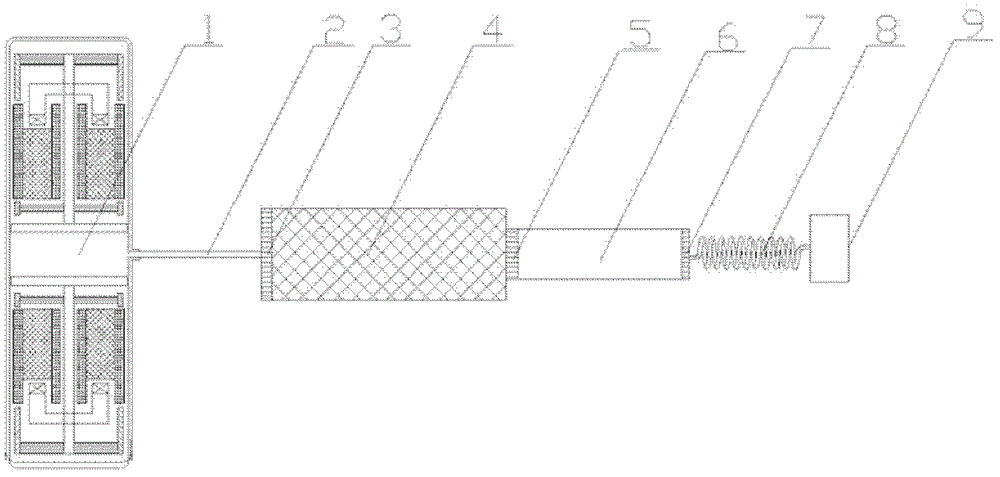
[0026] figure 1 A pulse tube refrigerator system using a common gas store in the prior art is shown. In this pulse refrigerator, the alternating flowing working medium generated by the pulse pressure wave of the linear compressor enters the heat exchanger 3 at the hot end of the regenerator through the connecting pipe 2, and after exchanging heat with the heat exchanger at the hot end of the regenerator It enters the regenerator 4, absorbs the cold energy in the regenerator, enters the pulse tube 6, and repeatedly compresses and expands in the pulse tube 6 to generate a temperature difference between the cold end and the hot end of the pulse tube. The heat exchange between the hot end heat exchanger 7 and the outside cools the hot end to close to room temperature. At this time, the cold end of the pulse tube has a temperature lower than room temperature...
the structure of the environmentally friendly knitted fabric provided by the present invention; figure 2 Flow chart of the yarn wrapping machine for environmentally friendly knitted fabrics and storage devices; image 3 Is the parameter map of the yarn covering machine
Login to View More
PUM
Login to View More
Abstract
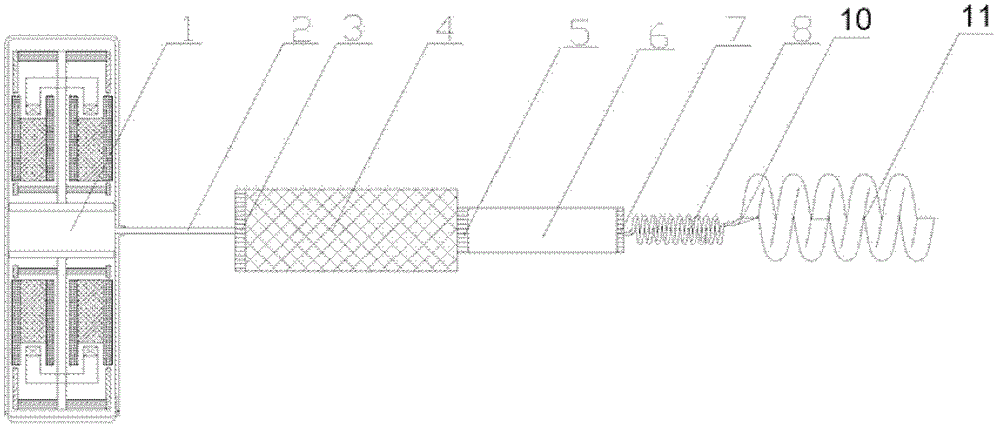
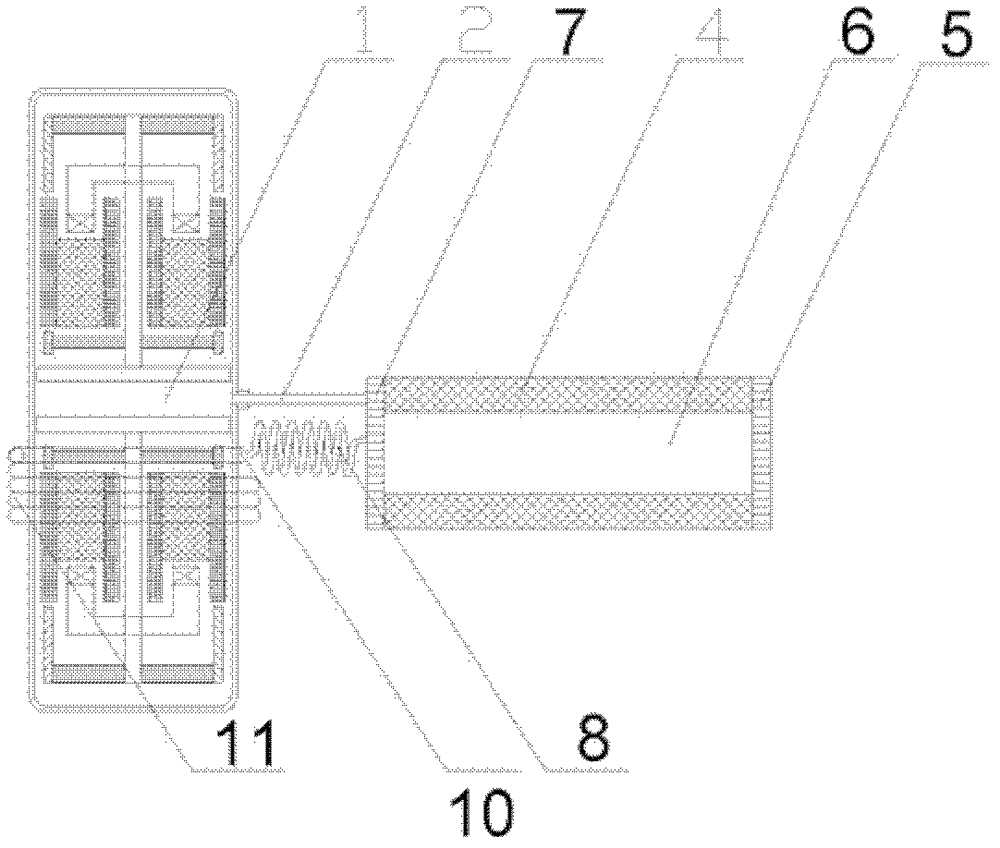
The invention provides a high-frequency pulse tube refrigerating machine which comprises a linear compressor (1), a connecting pipe (2), a heat regenerator hot end heat exchanger (3), a heat regenerator (4), a cold end heat exchanger (5), a pulse tube (6), a hot end heat exchanger (7), an inertia pipe (8), and a tubular air reservoir (11), wherein the linear compressor (1), the connecting pipe (2), the heat regenerator hot end heat exchanger (3), the heat regenerator (4), the cold end heat exchanger (5), the pulse tube (6), the hot end heat exchanger (7), the inertia pipe (8), and the tubular air reservoir (11) are connected in sequence. The tubular air reservoir adopts a pipe with the diameter ranging from 8 to 20 millimeters as an air reservoir, one end of the tubular air reservoir is connected with the inertia pipe, and the other end of the tubular air reservoir is closed. Compared with an ordinary air reservoir, the tubular air reservoir is greatly reduced in weight and size. The tubular air reservoir can play a role of the ordinary air reservoir on one hand, and can use the inertia effect of air in the pipe to adjust the phase in the inertia pipe to further improve the performance of the refrigerating machine on the other hand. At the same time, the adoption of the tubular air reservoir enables the structure of the high-frequency pulse tube refrigerating machine to be compact, and is beneficial for the practicability and application in space.
Description
technical field [0001] The invention relates to the field of small low-temperature refrigerators, in particular to high-frequency pulse tube refrigerators. Background technique [0002] With the continuous development of space technology, the research on small and micro cryogenic refrigerators for cooling infrared detectors and high temperature superconducting devices has aroused great interest of scholars from all over the world. As a kind of small low-temperature refrigerator, high-frequency pulse tube refrigerator has the advantages of no moving parts at the cold end, simple structure, high reliability and good anti-electromagnetic interference. applications in the space field. [0003] The development of pulse tube refrigerators has gone through basic type, small hole type, two-way inlet type, multi-way bypass type and inertial tube type. The basic pulse tube refrigerator is the original type of high frequency pulse tube refrigerator. It uses a hollow tube, when there...
Claims
the structure of the environmentally friendly knitted fabric provided by the present invention; figure 2 Flow chart of the yarn wrapping machine for environmentally friendly knitted fabrics and storage devices; image 3 Is the parameter map of the yarn covering machine
Login to View More
Application Information
Patent Timeline
Application Date:The date an application was filed.
Publication Date:The date a patent or application was officially published.
First Publication Date:The earliest publication date of a patent with the same application number.
Issue Date:Publication date of the patent grant document.
PCT Entry Date:The Entry date of PCT National Phase.
Estimated Expiry Date:The statutory expiry date of a patent right according to the Patent Law, and it is the longest term of protection that the patent right can achieve without the termination of the patent right due to other reasons(Term extension factor has been taken into account ).
Invalid Date:Actual expiry date is based on effective date or publication date of legal transaction data of invalid patent.
Login to View More
Patent Type & AuthorityPatents(China)
IPC IPC(8): F25B9/14
Inventor杨鲁伟刘彦杰梁惊涛
OwnerTECHNICAL INST OF PHYSICS & CHEMISTRY - CHINESE ACAD OF SCI


 Login to View More
  Login to View More