
Dynamic planning pre-detection tracking method for heterogeneous clutter background
A non-uniform clutter and dynamic planning technology, applied in radio wave measurement systems, instruments, etc., to reduce false alarms, suppress clutter, and quickly detect tracks
- Summary
- Abstract
- Description
- Claims
- Application Information
AI Technical Summary
Problems solved by technology
Method used
Image

Examples
Embodiment Construction
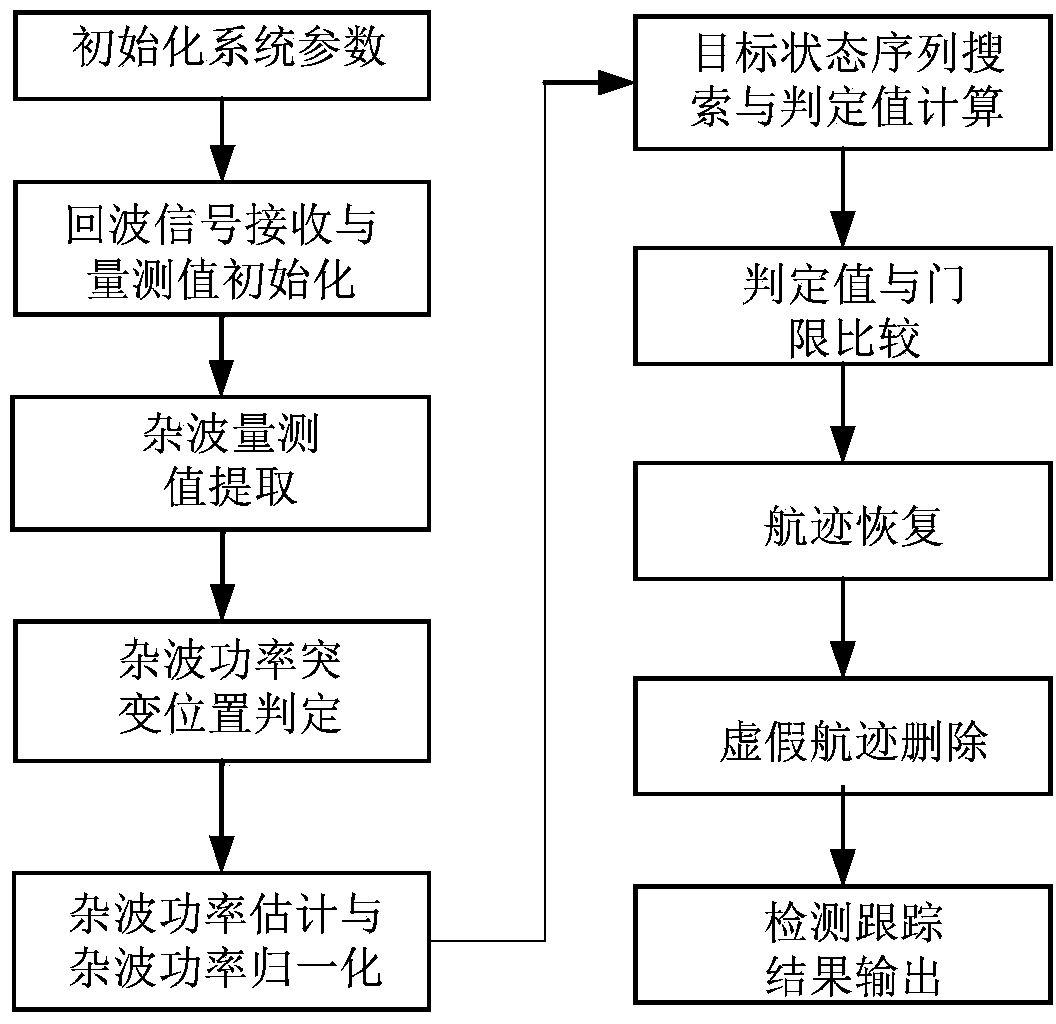
[0036] The present invention mainly adopts the method of simulation test for verification, and all steps and conclusions are verified correctly on MATLAB R2011b. The specific implementation steps are as follows:
[0037] Step 1. Initialize system parameters including: data plane size 50×50, number of processing frames K=6, number of state transitions q=4, threshold V calculated by Monte Carlo simulation test T =33.0761, the OS CFAR reference window length R=20, the ordered statistic is selected as the r=15th, the constant α OS =6.857;
[0038] Step 2. Receive the echo signal of the first frame, take the square of the echo signal amplitude of each resolution unit as the measurement value of the resolution unit; record the measurement value of this row as z 1 ,z 2 ,…,z 50
[0039] Step 3. Eliminate the target measurement value in the measurement value of the resolution unit in the first row of the first frame to obtain the clutter measurement value;
[0040] Step 3.1, calc...
PUM
 Login to View More
 Abstract
Description
Claims
Application Information
 Login to View More