
Gesture radar signal processing method based on RDTM and ATM fusion
A radar signal processing and baseband signal technology, applied in the direction of radio wave reflection/re-radiation, using re-radiation, measurement devices, etc., can solve problems such as large data sets, clutter and noise, complex network structure, etc.
- Summary
- Abstract
- Description
- Claims
- Application Information
AI Technical Summary
Problems solved by technology
Method used
Image

Examples
Embodiment Construction
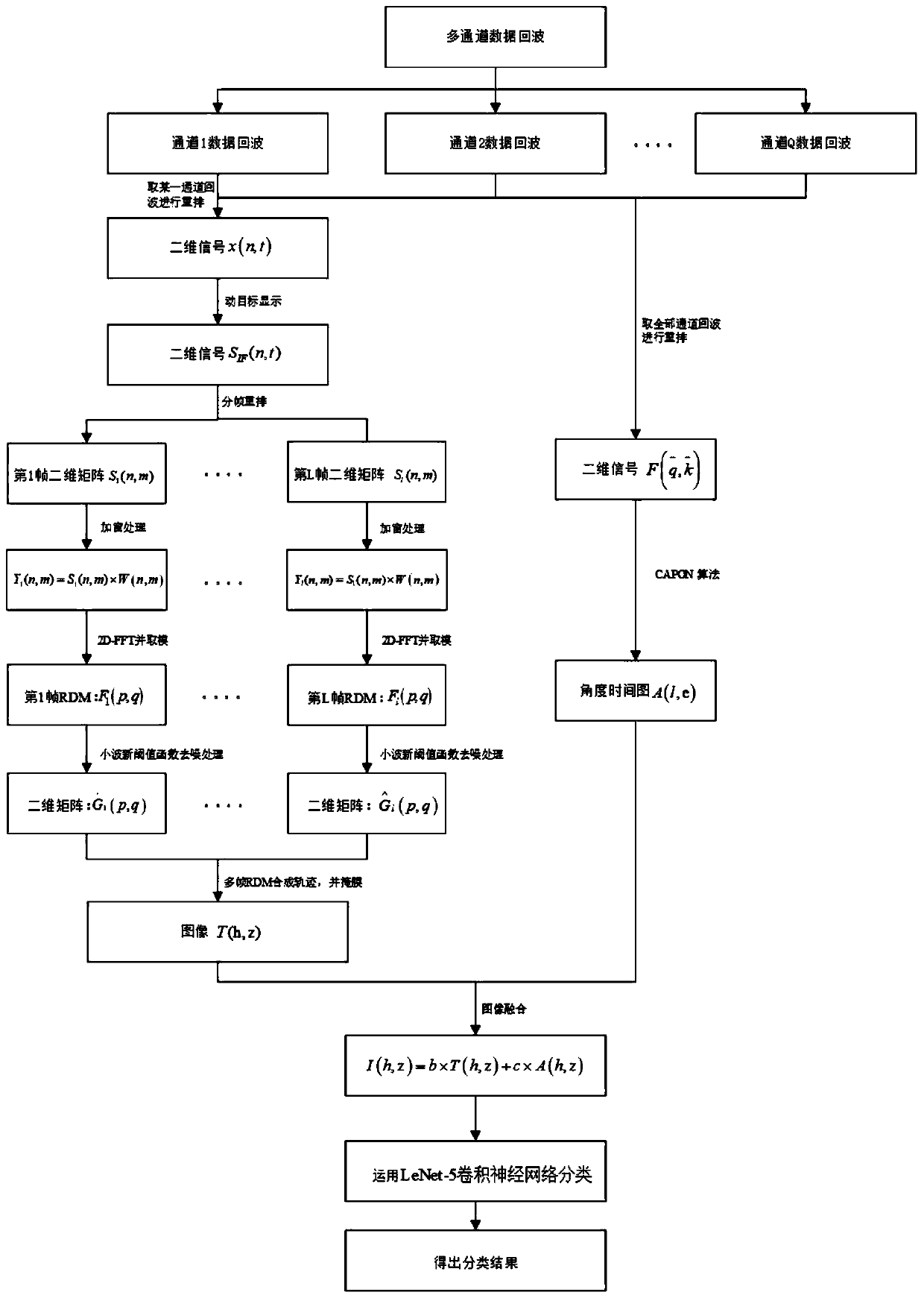
[0077] A kind of gesture radar signal processing method based on RDTM and ATM fusion, comprises the following steps,
[0078] A. The gesture radar emits a linear frequency modulation signal, detects the gesture and records the echo, and obtains the intermediate frequency signal after mixing and sampling; the intermediate frequency echo x 0 (t) is a complex signal, including two mutually orthogonal baseband signals. Let the radar echo recorded by a single gesture include L frames, each frame includes M intermediate frequency signals, and the number of sampling points of each intermediate frequency signal after A / D sampling is N points; 0 (t) rearrange to obtain a two-dimensional signal x(n, t); 1≤n≤N, 1≤t≤T, where T=L×M is the intermediate frequency echo x 0 (t) the total number of IF signals. Perform moving target display processing on x(n, t), suppress interference signals, and obtain a two-dimensional signal S IF (n,t);
[0079] For x(n, t) to display the moving target, ...
PUM
 Login to View More
 Abstract
Description
Claims
Application Information
 Login to View More