A Logging Curve Restoration Method for Tight Gas-bearing Sandstone Reservoir Prediction

A technology of well logging curve and recovery method, which is applied in the field of petroleum geophysical exploration, can solve the problems that cannot effectively solve the geological problems of tight gas-bearing sandstone reservoirs, and achieve the effects of fast calculation speed, high calculation accuracy and strong noise resistance

CN104345347BActive Publication Date: 2017-03-08CHINA PETROLEUM & CHEM CORP +1
3 Cites 0 Cited by

Patent Information

Authority / Receiving Office
CN · China
Patent Type
Patents(China)
Current Assignee / Owner
Publication Date
2017-03-08

Smart Images

  • Figure 1
    Figure 1
  • Figure 2
    Figure 2
  • Figure 3
    Figure 3
Patent Text Reader

Abstract

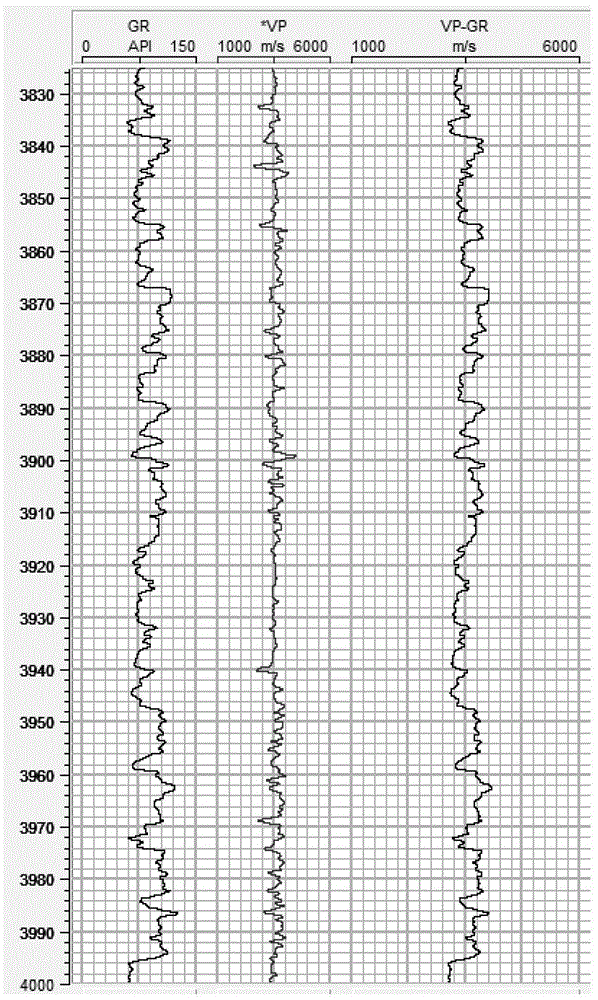
The invention provides a logging curve recovery method used for compact gas-containing sandstone reservoir prediction. The recovery method is a method for obtaining a recovered curve, trend field factors are introduced to a target logging curve AC and a curve to be recovered GR, and high-frequency components of the target logging curve AC and the curve to be recovered GR are matched and integrated by using frequency spectrum integration technology, thereby obtaining the recovered curve which has dimension features of the target logging curve and keeps the high-frequency components. The logging curve recovery method used for compact gas-containing sandstone reservoir prediction provided by the invention relatively completely keeps features of the curve to be recovered, can obviously reflect longitudinal spatial variation of lithofacies and lithological characters, has the characteristics of fast computation speed, good stability, high computation accuracy and strong anti-noise capability, and can be directly used for inversion of seismic data.
Need to check novelty before this filing date? Find Prior Art

Description

technical field

[0001] The invention relates to the technical field of petroleum geophysical exploration, in particular to a logging curve recovery method for tight gas-bearing sandstone reservoir prediction Background technique

[0002] Seismic exploration technology is the most widely used geophysical method in oil and gas exploration. It uses the changes in the velocity, amplitude, frequency, phase, and waveform of seismic waves propagating in different media to analyze and predict the distribution range of oil and gas reservoirs. layer properties. With the deepening of exploration and development, seismic exploration has gradually developed from the structural exploration of understanding the underground structure to the lithology exploration of directly using seismic information to judge lithology, analyze lithofacies, and quantitatively calculate the physical parameters of rock formations. Reservoirs in these complex depositional environments are usually characterized...

Examples

Embodiment Construction

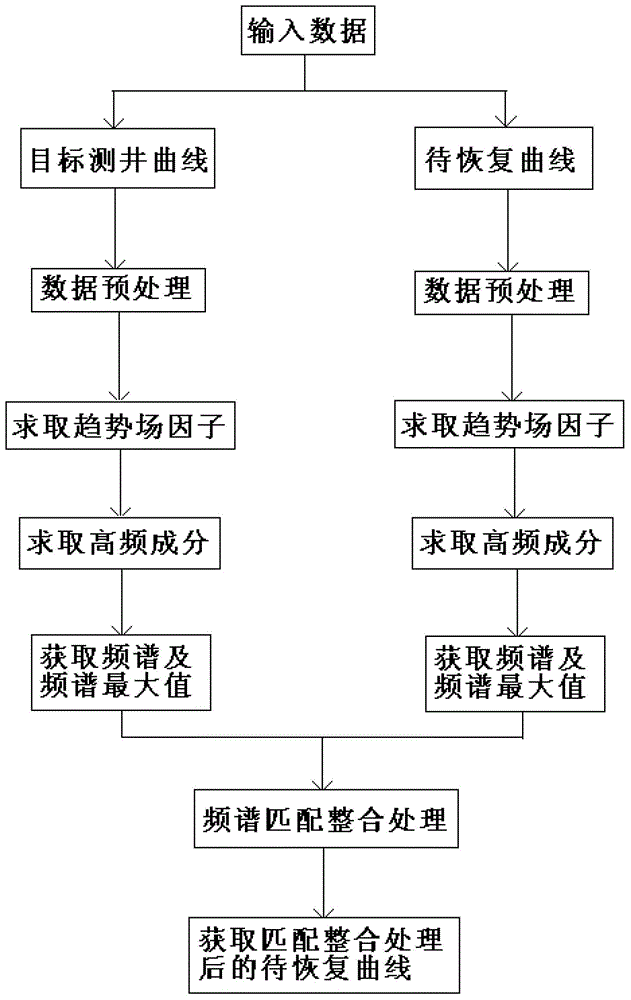
[0068] like figure 1 As shown, a log curve recovery method for prediction of tight gas-bearing sandstone reservoirs, the specific steps are as follows:

[0069] Step 1, enter data:

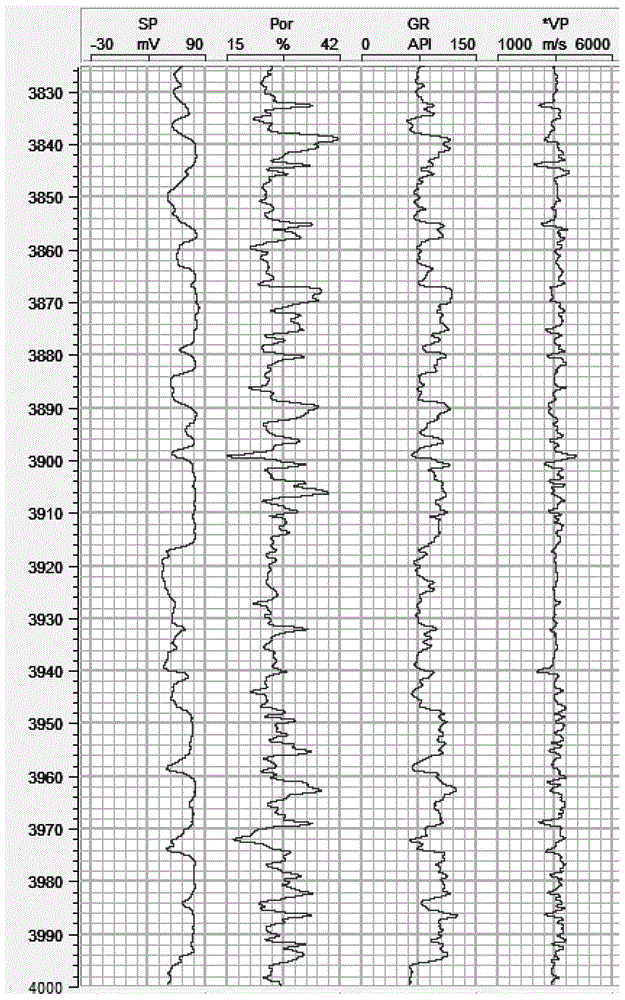
[0070] That is, input the target logging curve AC and the recovery curve GR; the target logging curve AC is the P-wave velocity logging curve, and the recovery curve GR is the natural gamma ray curve;

[0071] Step 2, preprocessing the input data:

[0072] For the sample point values ​​without physical meaning in the target logging curve AC and the curve GR to be restored, take the average value of the upper and lower sample point values ​​with physical meaning, and use this average value to replace the sample point values ​​without physical meaning. pip value.

[0073] Step 3, obtain the trend field factor LAC of the target logging curve AC:

[0074] Step 3-1, establish the least squares fitting equation, as shown in formula 1:

[0075]

[0076] Among them, a and b are undetermined coeffi...