Method for preparing glutamic acid decarboxylase mutant by utilizing ramachandran map information and mutant thereof

A glutamic acid decarboxylase and mutant technology, applied in the field of molecular biology, can solve the problems of low GAD specific activity and unfavorable application, and achieve the effects of saving time, facilitating widespread promotion, and improving experimental efficiency

CN104694524AInactive Publication Date: 2015-06-10NINGBO INST OF TECH ZHEJIANG UNIV ZHEJIANG
7 Cites 8 Cited by

Patent Information

Authority / Receiving Office
CN · China
Patent Type
Applications(China)
Current Assignee / Owner
Publication Date
2015-06-10
Estimated Expiration
Not applicable · inactive patent

Smart Images

  • Figure 1
    Figure 1
  • Figure 2
    Figure 2
  • Figure 3
    Figure 3
Patent Text Reader

Abstract

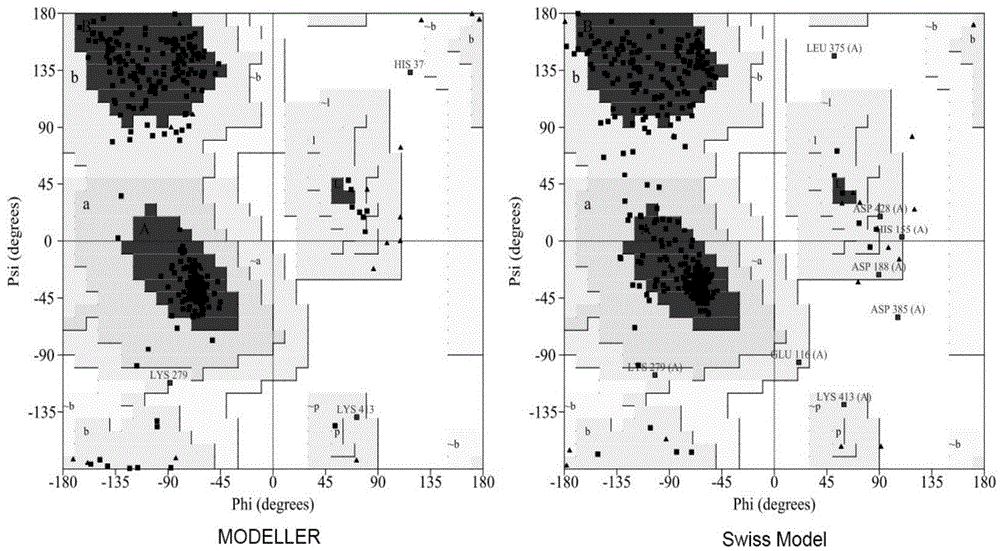
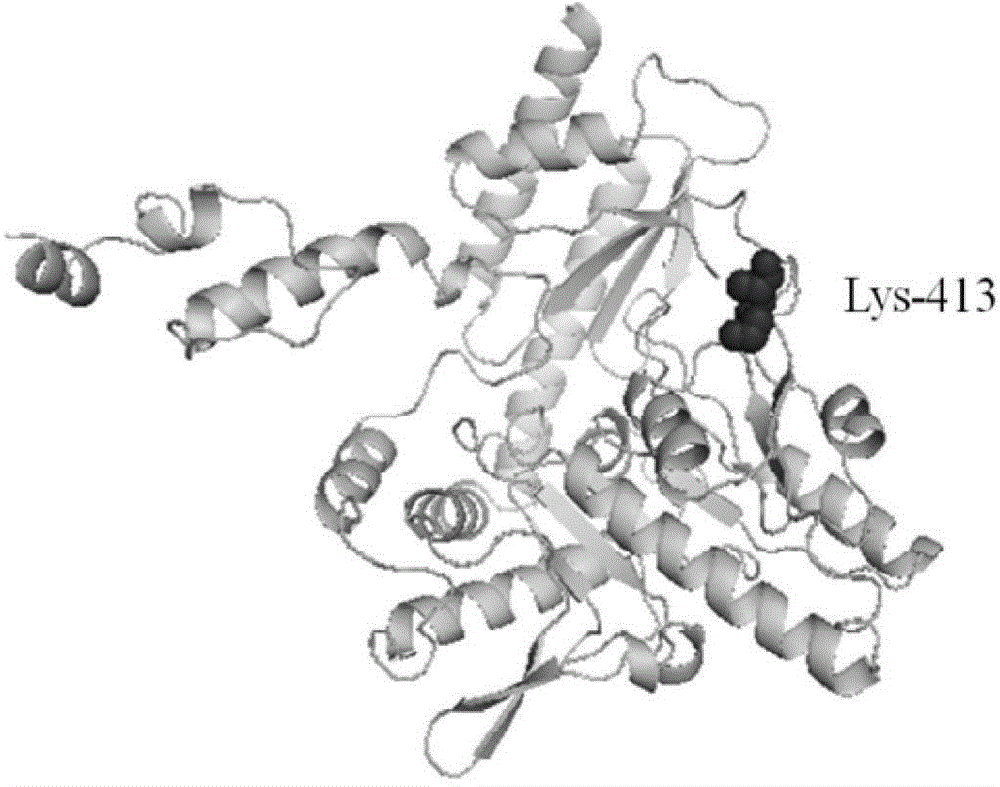
The invention discloses a method for preparing a glutamic acid decarboxylase mutant by utilizing ramachandran map information and a mutant thereof. The method comprises the following steps of: constructing a three-dimensional structural model of glutamic acid decarboxylase, carrying out dihedral angle reasonable evaluation to generate a ramachandran map, and determining an amino acid residue site in an unreasonable conformation area from the ramachandran map; designing a site-specific mutation primer aiming at the site, and carrying out site-specific PCR (Polymerase Chain Reaction) amplification by taking a glutamic acid decarboxylase gene as a template so as to obtain a site-specific mutation library; and screening the glutamic acid decarboxylase mutant from the site-specific mutation library. Enzyme is rationally designed through structural information provided by the ramachandran map; in combination with a site-specific mutation technology, the mutation probability is effectively increased; the time is saved; the experimental efficiency is increased; mutant enzyme the catalytic activity of which is superior to wild type enzyme can be obtained by screening; the mutant enzyme is capable of increasing the reaction rate for generating gamma-aminobutyric acid (GABA) by catalyzing L-glutamic acid or sodium salts thereof; and thus, industrial production of GABA is easily carried out.
Need to check novelty before this filing date? Find Prior Art

Description

technical field

[0001] The invention relates to the technical field of molecular biology, in particular to a method for preparing glutamic acid decarboxylase mutants by using Lascher diagram information and the mutants thereof. Background technique

[0002] Site-directed mutagenesis (site-directed mutagenesis or site-specific mutagenesis) refers to the technology of introducing specific base pair changes at the designated site of the target DNA fragment, which is the basis of recombinant DNA evolution. It is often used to study the influence of certain (some) amino acid residues on protein structure, catalytic activity, and ligand-binding ability. It can also be used to modify the characteristic sequence of DNA regulatory elements and modify expression vectors. Introduce new enzyme cutting sites, etc. Especially in the rational design of enzymes, or the use of random mutation and other directed evolution techniques to screen out important amino acid residue sites with poten...

Examples

Embodiment 1

[0032] 1. Construction of mutant library

[0033] According to the glutamic acid decarboxylase gene design of Lactobacillus brevis (Lactobacillus brevis) CGMCC NO.1306, 19 pairs of site-directed mutagenesis primers are as follows:

[0034] K413X_F 5'-CACCTATCCCTTACCA YYY AACATGACGGACCGC-3'

[0035] K413X_R 5'-GCGGTCCGTCATGTT YYY TGGTAAGGGATAGGTG-3'

[0036] Note: where X represents the remaining 19 amino acids except lysine, YYY represents the codon corresponding to amino acid X.

[0037] Among them, the primers for amplifying and obtaining K413I are:

[0038] Upstream primer: 5'-CACCTATCCCTTACCA ATT AACATGACGGACCGC-3'

[0039] Downstream primer: 5'-GCGGTCCGTCATGTT AAT TGGTAAGGGATAGGTG-3'

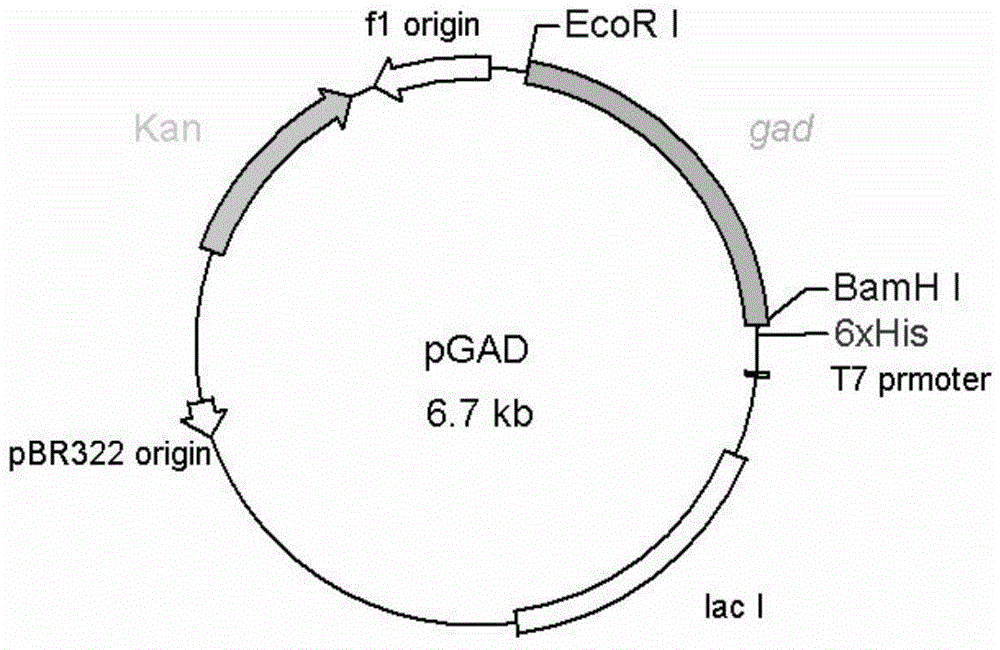
[0040] Using the plasmid containing the GAD1407 gene (Gene ID: 4412752) as a template, site-directed PCR amplification was performed. The PCR amplification system is 50 μL, including: 10 μL 5×PCR buffer, 4 μL dNTPs (2.5 mmol / L), 1 μL upstream primer (10 mmol / L), 1 μL downstream...