
Method and device for securing connections in a communication network
A technology for user equipment and equipment, which is applied in wireless communication, security communication devices, security devices, etc., and can solve problems such as undesired, slowing down the authentication process, and time-consuming users.
- Summary
- Abstract
- Description
- Claims
- Application Information
AI Technical Summary
Problems solved by technology
Method used
Image

Examples
Embodiment Construction
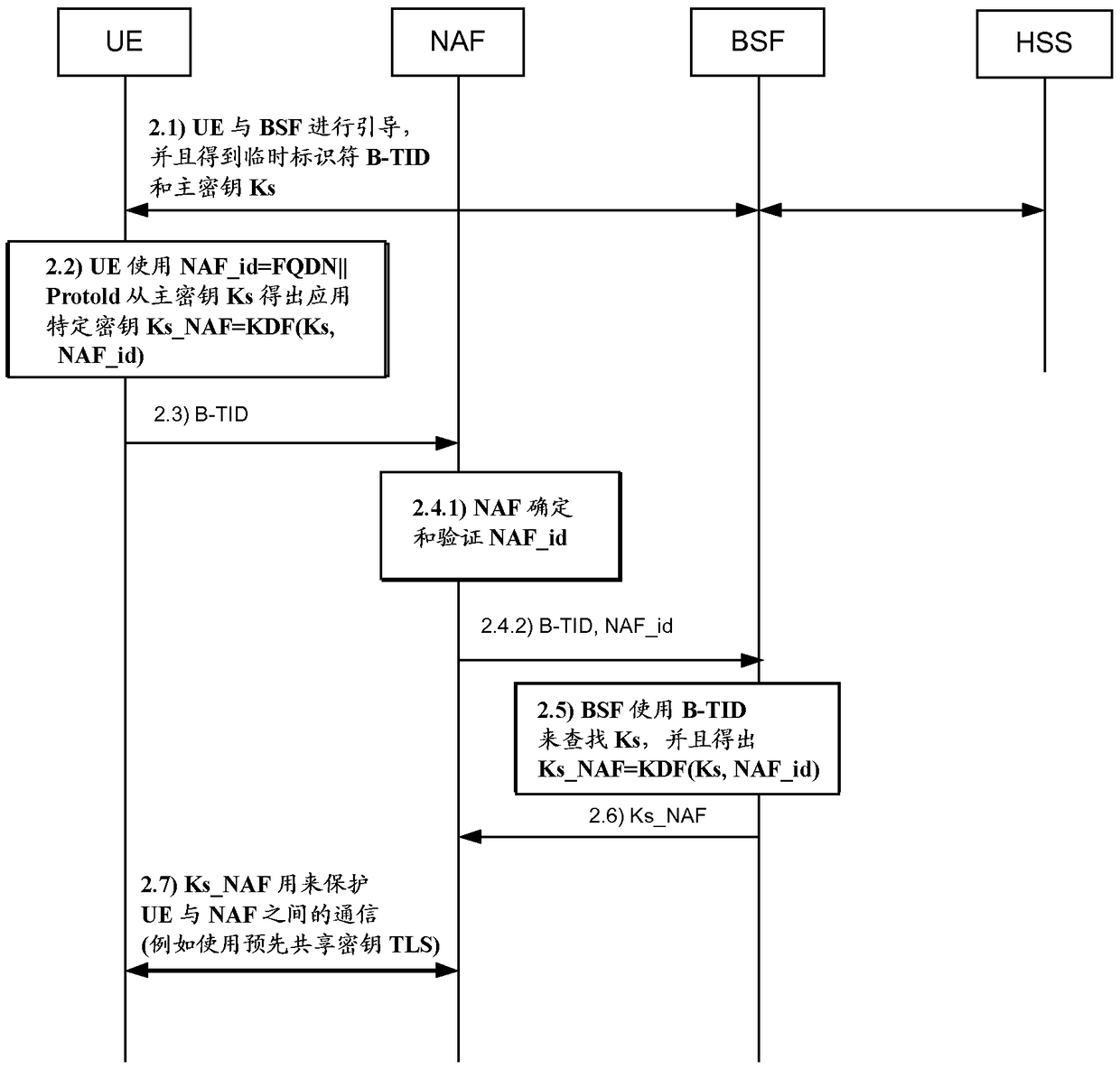
[0043] The Generic Bootstrapping Architecture (GBA) defined in 3GPP Technical Specification TS 33.220 provides a mechanism whereby a client terminal (UE) can be authenticated to a network application function (NAF) and a secure session key can be derived for communication between the UE and the NAF use. like figure 2 As shown, the GBA provides a mechanism whereby the UE bootstraps with the Bootstrap Server Function (BSF) such that the UE is authenticated to the BSF and a master key Ks and a Bootstrap Transaction Identifier (B-TID) are obtained. The UE then derives the application specific key Ks_NAF through a Key Derivation Function (KDF) defined as KDF(Ks, "gba-me", nonce, IMPI, NAF_id). Ks is the previously defined master key; "gba-me" is a fixed value; nonce is a random number used to generate Ks; IMPI is the Internet Protocol Multimedia Private Identity of the UE; and NAF_id is the NAF identifier of the NAF. The NAF_ID is formed by concatenating the Fully Qualified Doma...
PUM
 Login to View More
 Abstract
Description
Claims
Application Information
 Login to View More