A Chinese character pinyin input method and a method for encoding Chinese characters using the input method
A Chinese character pinyin and input method technology, applied in the field of encoding Chinese characters, can solve the problems of low input efficiency and complicated operation, and achieve the effect of encoding Chinese characters efficiently
- Summary
- Abstract
- Description
- Claims
- Application Information
AI Technical Summary
Problems solved by technology
Method used
Image



Examples
Embodiment 1
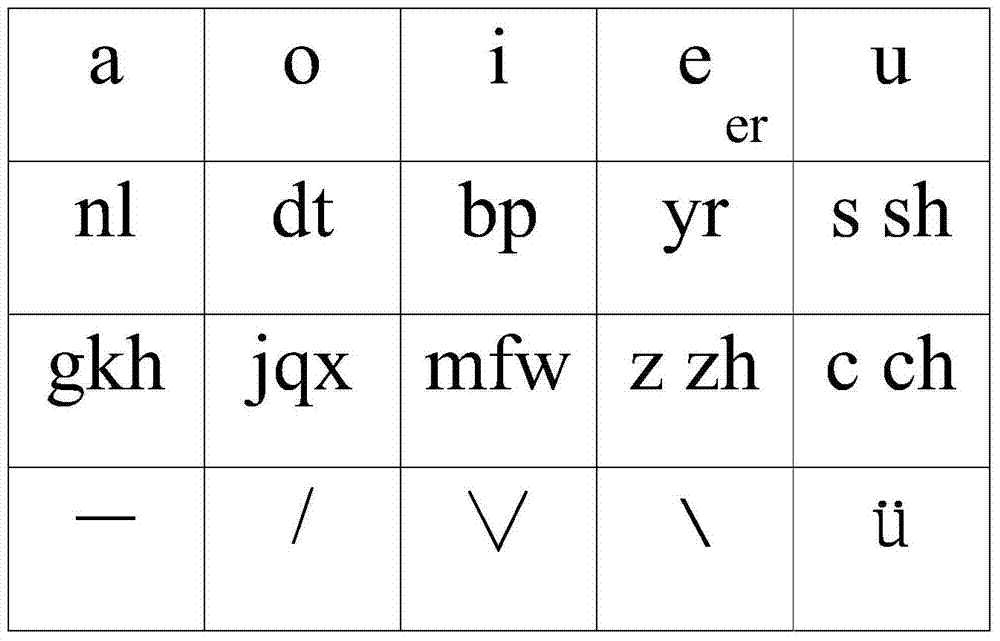
[0050] A Chinese character pinyin input method is suitable for touch screen electronic products, the keyboard of the input method is a touch keyboard, such as figure 1 , figure 2 with image 3 shown.
[0051] When the input method is in the initial state before encoding Chinese characters, the input keyboard is mapped as follows figure 1 The primary mapping interface, the input keyboard includes 20 keys for encoding Chinese characters, and the 20 keys are arranged in 4 rows×5 columns. The keys on the primary mapping interface are respectively mapped to 6 single finals, 23 initials and 4 tones in Chinese Pinyin. The key mapping content of the primary mapping interface is as follows:
[0052] The 5 keys in the first row of the input keyboard are respectively mapped to 5 single finals of a, o, i, e, u, and the keys of the fourth row and fifth column of the input keyboard are mapped to the single final ü. Wherein, the button responsible for mapping the single final e is also...
Embodiment 2
[0063] Such as Figure 6 , the input method of the present embodiment and the input interface are consistent with the input interface of embodiment 1, and the following examples illustrate the Chinese character "love (ai)" with this input method encoding complex final vowel pronunciation: click the single final vowel a key in a mapping interface , and then click the single final i key and the Qusheng tone key in the secondary mapping interface, and finally select the desired Chinese character "love" from the displayed homophones.
Embodiment 3
[0065] Such as Figure 7 , the input method of the present embodiment and the input interface are consistent with the input interface of embodiment 1, and the following examples illustrate the Chinese character "ang (ang)" after the nasal vowel is edited with this input method: click the single vowel a in a mapping interface key, then click the final ang key and Yangping tone key in the secondary mapping interface, and finally select the desired Chinese character "ang" from the displayed homophones.
PUM
 Login to View More
 Abstract
Description
Claims
Application Information
 Login to View More