AI technical title is built by Patsnap AI team. It summarizes the technical point description of the patent document.
A technology of ether compound and compound, which is applied in the field of preparation of ether compound represented by the following formula, can solve problems such as difficulty in use
Active Publication Date: 2018-10-09
SUMITOMO CHEM CO LTD
View PDF5 Cites 0 Cited by
Summary
Abstract
Description
Claims
Application Information
AI Technical Summary
This helps you quickly interpret patents by identifying the three key elements:
Problems solved by technology
Method used
Benefits of technology
Problems solved by technology
However, bis(chloromethyl)ether is a very reactive compound and it is not readily available in industry
Method used
the structure of the environmentally friendly knitted fabric provided by the present invention; figure 2 Flow chart of the yarn wrapping machine for environmentally friendly knitted fabrics and storage devices; image 3 Is the parameter map of the yarn covering machine
View more
Image
Smart Image Click on the blue labels to locate them in the text.
Viewing Examples
Smart Image
Click on the blue label to locate the original text in one second.
Reading with bidirectional positioning of images and text.
Smart Image
Examples
Experimental program
Comparison scheme
Effect test
preparation example Construction
[0048] The preparation of the compound represented by formula (1) is described below.
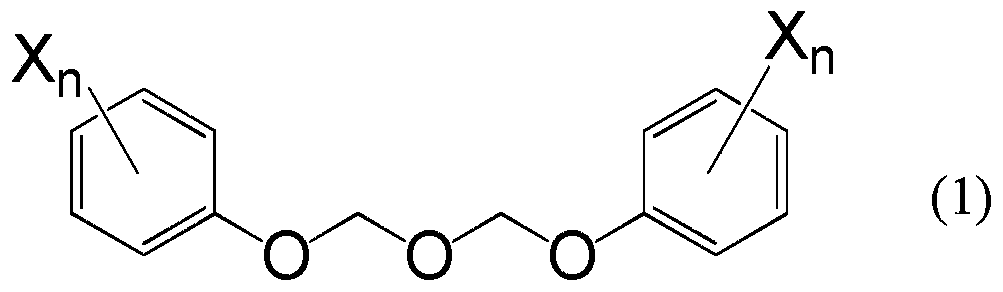
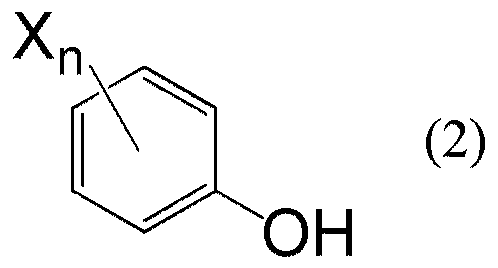
[0049] Compounds represented by formula (1) can be produced by reacting bis(acetoxymethyl) ether with compounds represented by formula (2):
[0050]
[0051] wherein n and X have the same meanings as above.
[0052] The reaction is usually carried out in an organic solvent in the presence of a metal catalyst.
[0053]Examples of the compound represented by the formula (2) include phenol, 4-chlorophenol, 4-nitrophenol, 4-cyanophenol, 2,4-dichlorophenol, 2,4,6-trichlorophenol, 2, 3,6-Trichlorophenol, 2,3,5,6-tetrachlorophenol, 2,3,4,6-tetrachlorophenol, 2,3,4,5,6-pentachlorophenol, 2,6- Dichloro-4-nitrophenol, 2,6-dichloro-4-cyanophenol, 2,4,6-tribromophenol, 2,3,4,5,6-pentabromophenol, 2,6- Dibromo-4-cyanophenol and 2,3,4,5,6-pentafluorophenol.
[0054] Examples of organic solvents include toluene, xylene, mesitylene, dichlorobenzene, and o-dichlorobenzene. Preference is given to usi...
Embodiment
[0064] Hereinafter, the present invention will be further specifically described with reference to Examples and the like.
[0065] First, production examples of ether compounds will be described.
preparation example 1-1
[0066] Preparation Example 1-1 (Steps A to C)
[0067] To 800 ml of 2-methoxyethanol, add 100 g (95.0 g of pure content) of bis(2,4,6-trichlorophenoxymethyl) ether containing 5% by weight of aluminum oxide and 50% of water 91.4 g (pure content 45.7 g, 3.0 equivalents) of sodium methanethiolate, followed by stirring at 100 to 105° C. under a nitrogen atmosphere for 4 hours. The reaction mixture was cooled to room temperature, and filtered. Thereafter, hexane and 10% NaOH aqueous solution were added, followed by stirring. The mixture was left standing, and then separated. The obtained organic solvent layer was dried over anhydrous sodium sulfate, and then the solvent was distilled off under normal pressure, thereby obtaining 32.2 g of bis(methylthiomethyl)ether (referred to as compound Y) as a residue .
the structure of the environmentally friendly knitted fabric provided by the present invention; figure 2 Flow chart of the yarn wrapping machine for environmentally friendly knitted fabrics and storage devices; image 3 Is the parameter map of the yarn covering machine
Login to View More
PUM
Login to View More
Abstract
The ether compound represented by formula (3) (where R represents an alkyl group having 1 to 6 carbon atoms) can be prepared by the following method, which includes: Step A: In 2-methoxyethanol, the formula (1 ) (where n represents an integer from 0 to 5, X represents a halogen atom, an alkyl group with 1 to 3 carbon atoms, cyano, nitro or trifluoromethyl) and a compound with 1 to 6 carbon atoms Metal alkane thiolate reaction; step B: adding water and a hydrocarbon solvent having 5 to 8 carbon atoms to the reaction mixture obtained in step A, and separating the organic layer; step C: from the reaction mixture obtained in step B The solvent is distilled off in the organic layer to prepare bis(alkylthiomethyl) ether; and step D: the bis(alkylthiomethyl) ether obtained in step C is mixed with 2- Cyanoethanol reacts with halogenating agents.
Description
technical field [0001] The present invention relates to a method for producing an ether compound represented by the following formula (3). Background technique [0002] Ether compounds represented by formula (3) are used to prepare phosphoramidites of nucleotides: [0003] [0004] wherein R represents an alkyl group having 1 to 6 carbon atoms. The ether compound represented by formula (3) can be prepared from bis(chloromethyl)ether (see WO 2013 / 027843). However, bis(chloromethyl)ether is a very reactive compound, and it is not easy to use in industry. [0005] For the preparation of α,α'-disaturated dimethyl ethers, it has been proposed to use bis(aryloxymethyl)ether instead of bis(chloromethyl)ether (see USP-3,954,878, JP Hei 04-036269A). Contents of the invention [0006] The present invention provides a method for preparing an ether compound represented by formula (3), the method comprising: [0007] Step A: the compound represented by formula (1): [0008] ...
Claims
the structure of the environmentally friendly knitted fabric provided by the present invention; figure 2 Flow chart of the yarn wrapping machine for environmentally friendly knitted fabrics and storage devices; image 3 Is the parameter map of the yarn covering machine
Login to View More
Application Information
Patent Timeline
Application Date:The date an application was filed.
Publication Date:The date a patent or application was officially published.
First Publication Date:The earliest publication date of a patent with the same application number.
Issue Date:Publication date of the patent grant document.
PCT Entry Date:The Entry date of PCT National Phase.
Estimated Expiry Date:The statutory expiry date of a patent right according to the Patent Law, and it is the longest term of protection that the patent right can achieve without the termination of the patent right due to other reasons(Term extension factor has been taken into account ).
Invalid Date:Actual expiry date is based on effective date or publication date of legal transaction data of invalid patent.



 Login to View More
  Login to View More