
Serratia capable of enriching phosphorus, degrading organic phosphorus and inhibiting plant pathogenic fungi
A technology for phytopathogenic fungi and Serratia, applied in the field of microorganisms, can solve problems such as unreported Serratia, and achieve the effects of high stress resistance, good inhibitory effect and low culture cost
- Summary
- Abstract
- Description
- Claims
- Application Information
AI Technical Summary
Problems solved by technology
Method used
Image

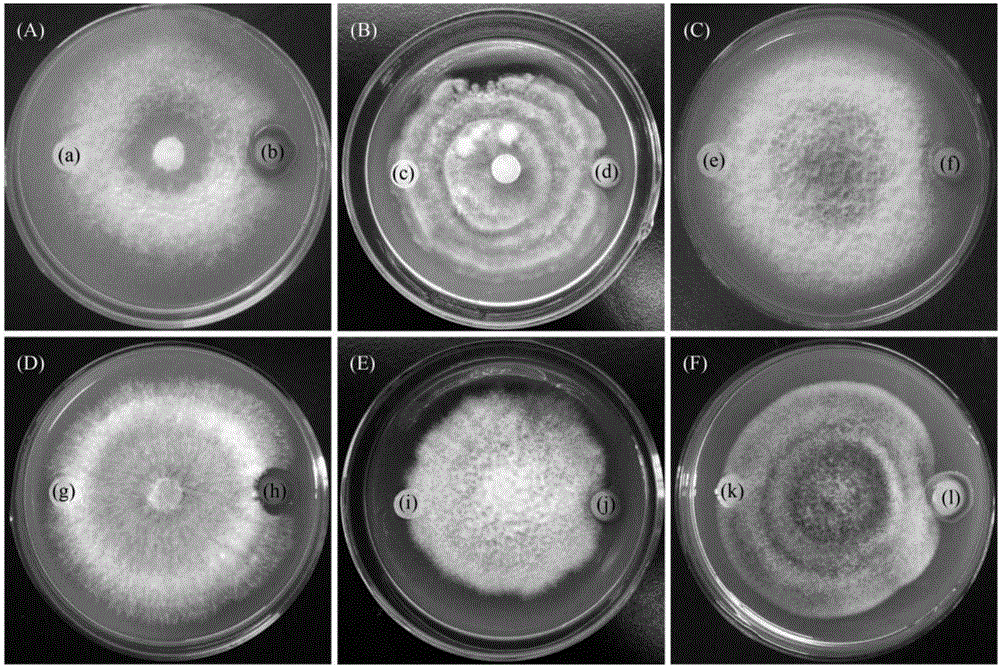
Examples
Embodiment 1
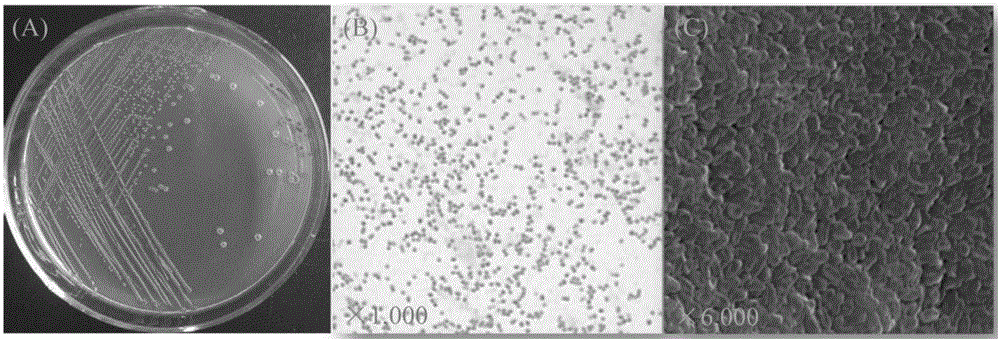
[0026]Water samples from Wuhan Shahu Lake and its surrounding areas were collected and added to LB medium, and enriched at 28°C and 150r / min for 24h. The above bacterial suspension was inoculated into the fermentation medium containing glyphosate 200mg / L according to the inoculum amount of 5%-10%, and after 28°C 150r / min enrichment culture for 3 days, it was transferred to the same medium, under the same conditions Continue to cultivate, and gradually increase the glyphosate content to 1000mg / L during the passage and acclimation process; streak the 5-passage bacterial solution on LB solid medium, culture at 28°C for 24-48h, according to the formation of colonies on the medium , pick well-growing colonies and inoculate them in LB culture solution containing 50mg / L glyphosate (diluted 5 times), culture at 150r / min at 28°C for 72h, and measure by the acetylcholinease inhibition rate method (GB / T5009.199-2003) The content of organophosphorus pesticides was calculated, and the degr...
Embodiment example 2
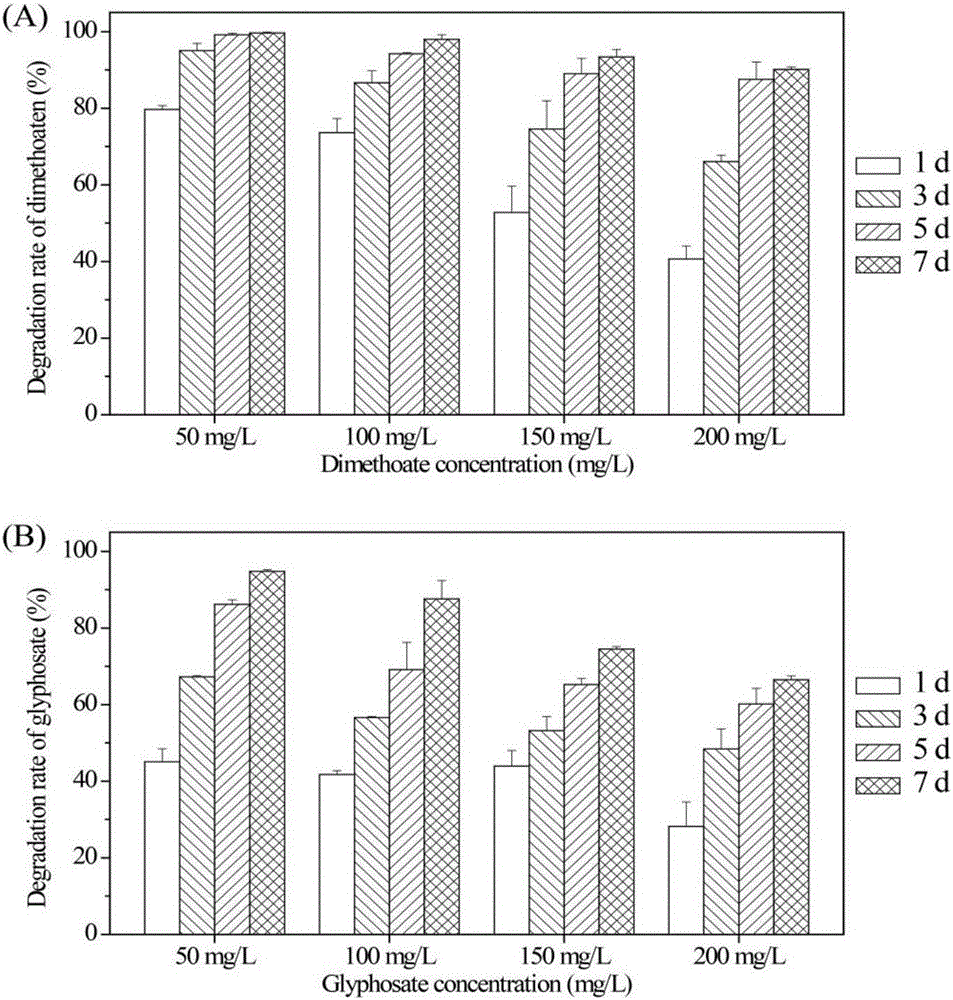
[0029] After the purified Serratia sp.MEW06 strain was activated overnight, adjust the OD of the bacterial solution 600 =1.0, according to the inoculum size of 4%, it is transferred to culture in the fermentation broth containing a certain concentration of glyphosate or dimethoate, and the degradation rate is measured by sampling at 1d, 3d, and 5d. The formulation of the fermentation medium is as follows: peptone 2g / L, yeast extract 1g / L, NaCl 2g / L, pH7.0-7.2. The results showed that Serratia sp.MEW06 had an excellent effect on the degradation of dimethoate. When treated with low concentration of dimethoate (50mg / L), the concentration of dimethoate was almost undetectable in the supernatant after 5 days of culture, and the degradation rate almost reached 100%. After treating high-concentration dimethoate (200mg / L) and culturing for 7 days, the degradation rate was determined to reach 90.12%. The ability of MEW06 to treat glyphosate was weaker than that of dimethoate, but at t...
Embodiment example 3
[0031] Get the single colony of Serratia in Example 1 and inoculate it into LB medium for overnight activation. The formula of LB medium is as follows: peptone 10g / L, yeast extract 5g / L, NaCl 10g / L, pH7.0-7.2, press 2% of the inoculum was inoculated in PAM medium with a phosphorus content (calculated as P) of 10 mg / L and 20 mg / L respectively, and samples were taken at 0, 12, 24, 48, and 72 hours to determine the phosphorus accumulation rate. The PAM medium formula For: CH 3 COONa 5g / L, NH 4 Cl2g / L, KH 2 PO 4 0.022~0.0878g / L, MgSO 4 ·7H 2 O 0.5g / L, CaCl 2 0.2g / L, 1000mL deionized water, pH7.0~7.2. The results are shown in Table 1. When the phosphorus content in the solution was 10 mg / L, after 24 hours of enrichment, the inorganic phosphorus content was basically not detected in the solution, the phosphorus enrichment rate reached 99.94%, and the phosphorus content in the solution was 20 mg / L. After 24 hours of enrichment, the phosphorus enrichment rate reached 63.79%. T...
PUM
 Login to View More
 Abstract
Description
Claims
Application Information
 Login to View More