
Method for mapping two-dimensional projected image to three-dimensional model
A 3D model and 2D projection technology, applied in image data processing, 3D modeling, instruments, etc., can solve the problem of lack of connection between 2D projection and 3D model, and achieve the effect of solving the problem of graphics scaling and 3D model scaling.
- Summary
- Abstract
- Description
- Claims
- Application Information
AI Technical Summary
Problems solved by technology
Method used
Image

Examples
Embodiment 1
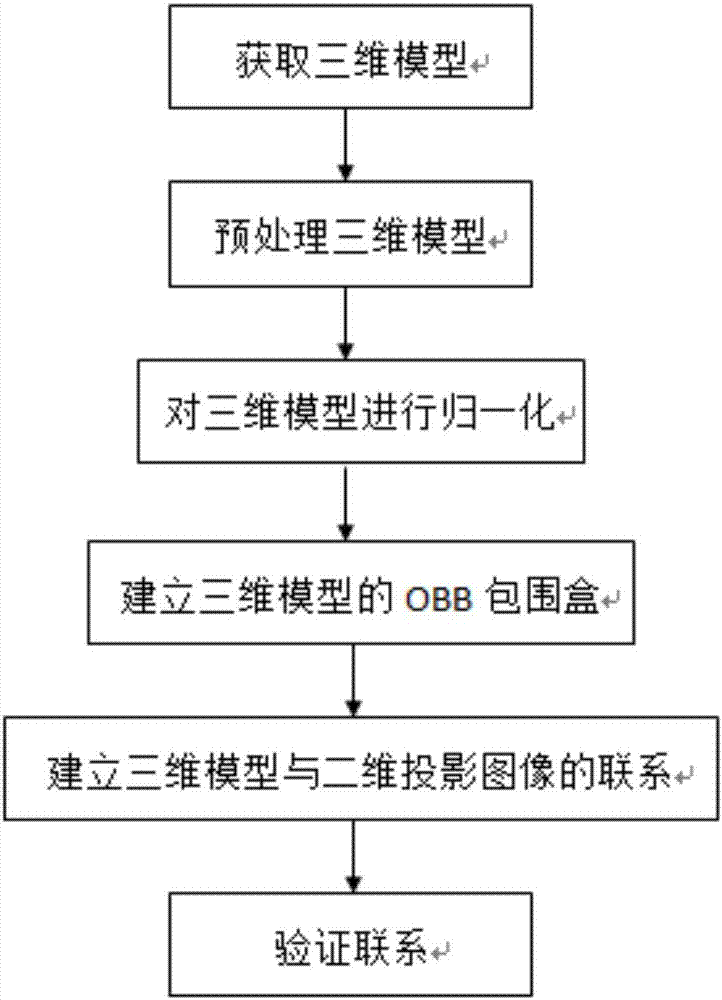
[0046] This embodiment provides a method for mapping a two-dimensional projection image to a three-dimensional model, such as figure 1 As shown, including the following steps:
[0047] Step 1. Obtain a 3D model through a 3D scanner;
[0048] In this embodiment, a handheld three-dimensional laser scanner Handyscan3D is used to scan objects to obtain three-dimensional model information;
[0049] Step 2: Preprocess the 3D model to obtain the preprocessed 3D model;
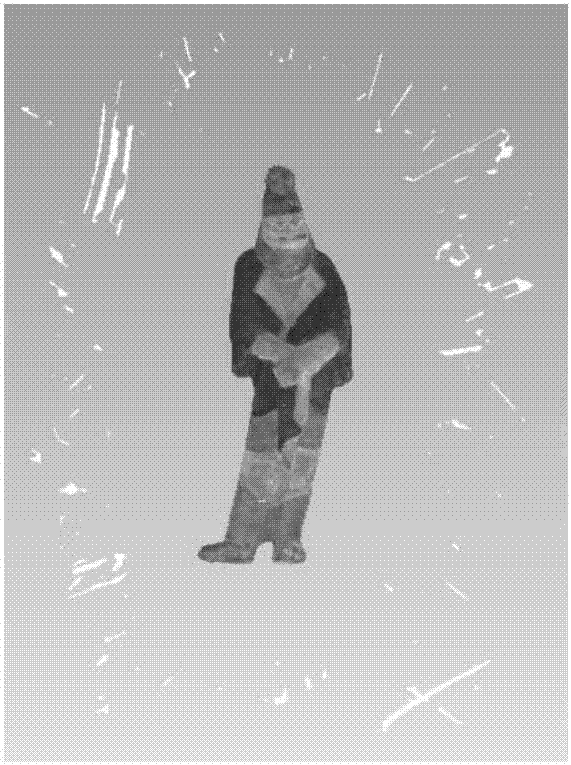
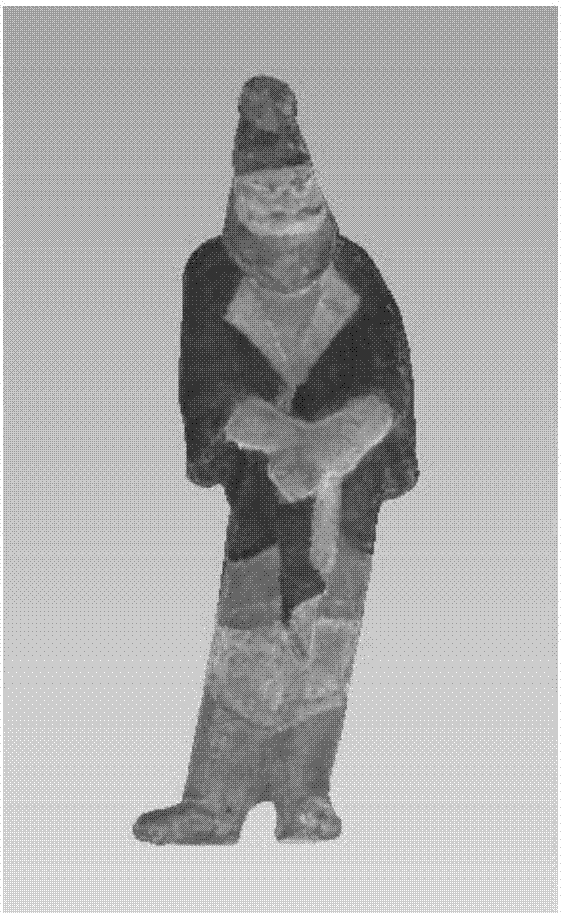
[0050] Denoise the acquired three-dimensional model, as shown in Figure 2(a) and Figure 2(b).
[0051] Step 3: Normalize the preprocessed 3D model to obtain the bounding box of the 3D model; image 3 Shown.
[0052] Assume that the vertex set is V and the normal vector set is N
[0053] Step 31: Obtain the centroid of the 3D model
[0054] The centroid is calculated through the statistics of the model vertex set, and the mean value of the vertices in the three directions is obtained as the centroid.
[0055] Step 32, realization of...
PUM
 Login to View More
 Abstract
Description
Claims
Application Information
 Login to View More