AI technical title is built by Patsnap AI team. It summarizes the technical point description of the patent document.
A technology for dairy cow feed and tea polyphenols, which is applied in the field of animal husbandry and breeding, can solve problems such as the decrease of cell apoptosis rate, and achieve the effects of improving production performance and health status, reducing the incidence of metabolic diseases, and enhancing the expression of antioxidant proteins.
Inactive Publication Date: 2017-11-03
INNER MONGOLIA AUTONOMOUS REGION ACAD OF AGRI & ANIMAL HUSBANDRY SCI
View PDF0 Cites 1 Cited by
Summary
Abstract
Description
Claims
Application Information
AI Technical Summary
This helps you quickly interpret patents by identifying the three key elements:
Problems solved by technology
Method used
Benefits of technology
Problems solved by technology
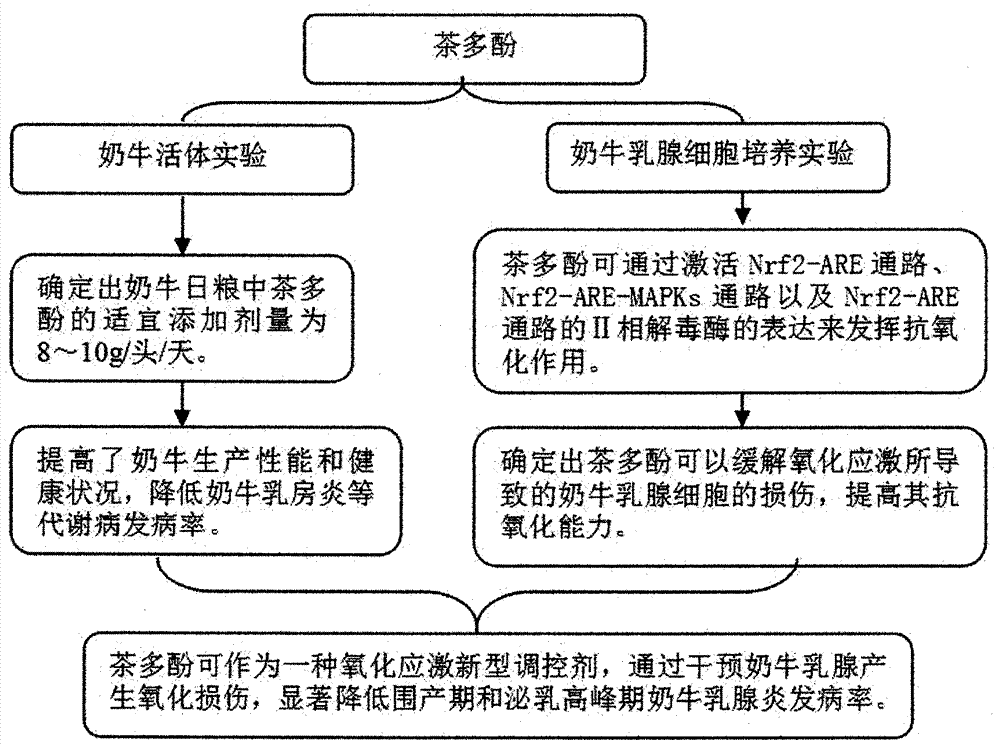
[0003] The application of tea polyphenols at home and abroad is mainly concentrated on humans and mice. There are relatively few reports on goats, chickens, pigs, piglets, and meat ducks. The research reports on dairy cows can only be seen in Wang Zhenyun's (2011) master thesis "Tea Polyphenols Protective Effect on Oxidative Stress Damage of Dairy Cow Mammary Epithelial Cells", but this study only determined that a certain concentration of tea polyphenols can alleviate the damage of dairy cow mammary epithelial cells caused by oxidative stress and improve the antioxidant capacity; the specific mechanism It is only clear that tea polyphenols can reduce the caspase-3 activity of mammary epithelial cells damaged by oxidative stress, and can reduce the cellapoptosis rate. Therefore, we propose a tea polyphenol dairy cow feed
Method used
the structure of the environmentally friendly knitted fabric provided by the present invention; figure 2 Flow chart of the yarn wrapping machine for environmentally friendly knitted fabrics and storage devices; image 3 Is the parameter map of the yarn covering machine
View more
Image
Smart Image Click on the blue labels to locate them in the text.
Viewing Examples
Smart Image
Click on the blue label to locate the original text in one second.
Reading with bidirectional positioning of images and text.
Smart Image
Examples
Experimental program
Comparison scheme
Effect test
Embodiment 1
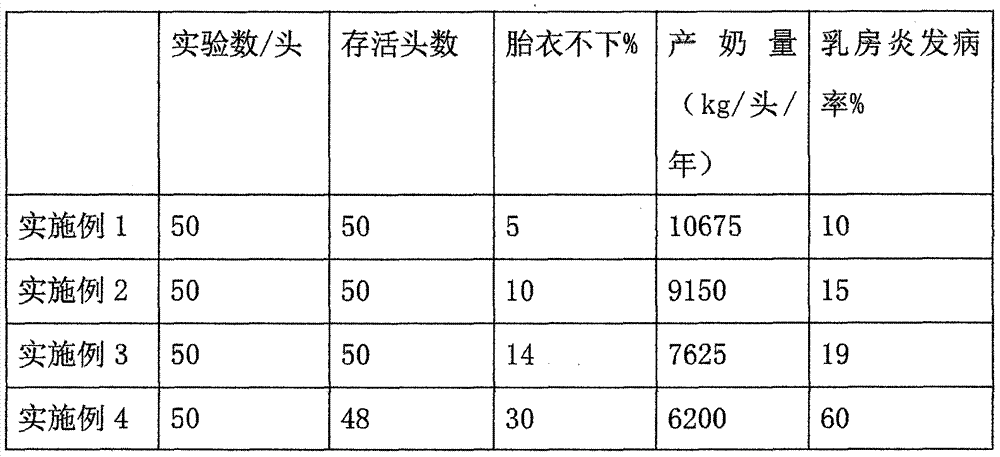
[0015] Embodiment 1: including feed and tea polyphenol additives, the feed and tea polyphenol additives are stirred and mixed, wherein, the addition amount of tea polyphenol additives is 8~10g / head / day, and described feed includes concentrated feed, corn Silage, hay, premix and salt, the proportion of the fine feed, corn silage, hay, premix, salt is 10%-30% of fine feed, 50%-70% of corn silage, 18% of hay %-20%, premix 1.5%-2.0%, salt 0.2%-0.3%.
Embodiment 2
[0016] Embodiment 2: including feed and tea polyphenol additives, the feed and tea polyphenol additives are stirred and mixed, wherein, the addition amount of tea polyphenol additives is 4~7g / head / day, and described feed includes concentrated feed, corn Silage, hay, premix and salt, the proportion of the fine feed, corn silage, hay, premix, salt is 10%-30% of fine feed, 50%-70% of corn silage, 18% of hay %-20%, premix 1.5%-2.0%, salt 0.2%-0.3%.
Embodiment 3
[0017] Embodiment 3: including feed and tea polyphenol additives, the feed and tea polyphenol additives are stirred and mixed, wherein, the addition amount of tea polyphenol additives is 11~17g / head / day, and described feed includes concentrated feed, corn Silage, hay, premix and salt, the proportion of the fine feed, corn silage, hay, premix, salt is 10%-30% of fine feed, 50%-70% of corn silage, 18% of hay %-20%, premix 1.5%-2.0%, salt 0.2%-0.3%.
the structure of the environmentally friendly knitted fabric provided by the present invention; figure 2 Flow chart of the yarn wrapping machine for environmentally friendly knitted fabrics and storage devices; image 3 Is the parameter map of the yarn covering machine
Login to View More
PUM
Login to View More
Abstract
The invention belongs to the technical field of animal husbandry and discloses a tea polyphenol milk cow feed, which comprises feed and a tea polyphenol additive, and the feed and the tea polyphenol additive are stirred and mixed. The invention provides a tea polyphenol dairy cow feed, wherein the tea polyphenol additive can activate the intracellular Nrf2-ARE pathway, enhance the expression of antioxidant proteins, improve the antioxidant capacity of cells, reduce cell damage and mutation, and significantly reduce the risk of oxidative stress. It is a new and effective method to treat oxidative stress-related diseases in dairy cows by reducing the incidence of stress-related metabolic diseases in dairy cows and greatly improving the production performance and health status of dairy cows.
Description
technical field [0001] The invention specifically relates to a tea polyphenol dairy cattle feed, which belongs to the technical field of animal husbandry. Background technique [0002] During the peripartum period, dairy cows exhibited antioxidant dysfunction and immune dysfunction after undergoing drastic physiological changes from mammary glandatrophy to rapid development, from rapid fetal growth to parturition, from dry milk to milk synthesis and secretion, resulting in Low production performance, while increasing the incidence of infectious diseases and metabolic diseases such as mastitis, retained placenta, displaced abomasum, and endometritis. [0003] The application of tea polyphenols at home and abroad is mainly concentrated on humans and mice. There are relatively few reports on goats, chickens, pigs, piglets, and meat ducks. The research reports on dairy cows can only be seen in Wang Zhenyun's (2011) master thesis "Tea Polyphenols Protective Effect on Oxidative ...
Claims
the structure of the environmentally friendly knitted fabric provided by the present invention; figure 2 Flow chart of the yarn wrapping machine for environmentally friendly knitted fabrics and storage devices; image 3 Is the parameter map of the yarn covering machine
Login to View More
Application Information
Patent Timeline
Application Date:The date an application was filed.
Publication Date:The date a patent or application was officially published.
First Publication Date:The earliest publication date of a patent with the same application number.
Issue Date:Publication date of the patent grant document.
PCT Entry Date:The Entry date of PCT National Phase.
Estimated Expiry Date:The statutory expiry date of a patent right according to the Patent Law, and it is the longest term of protection that the patent right can achieve without the termination of the patent right due to other reasons(Term extension factor has been taken into account ).
Invalid Date:Actual expiry date is based on effective date or publication date of legal transaction data of invalid patent.


 Login to View More
  Login to View More