
Solvent-free UV (ultraviolet) resin and application thereof
A solvent-free, resin-free technology, applied in coatings and other directions, can solve problems such as VOC volatile organic compounds, and achieve the effects of reducing workpiece stacking sites, reducing shrinkage, and good adhesion
- Summary
- Abstract
- Description
- Claims
- Application Information
AI Technical Summary
Problems solved by technology
Method used
Image

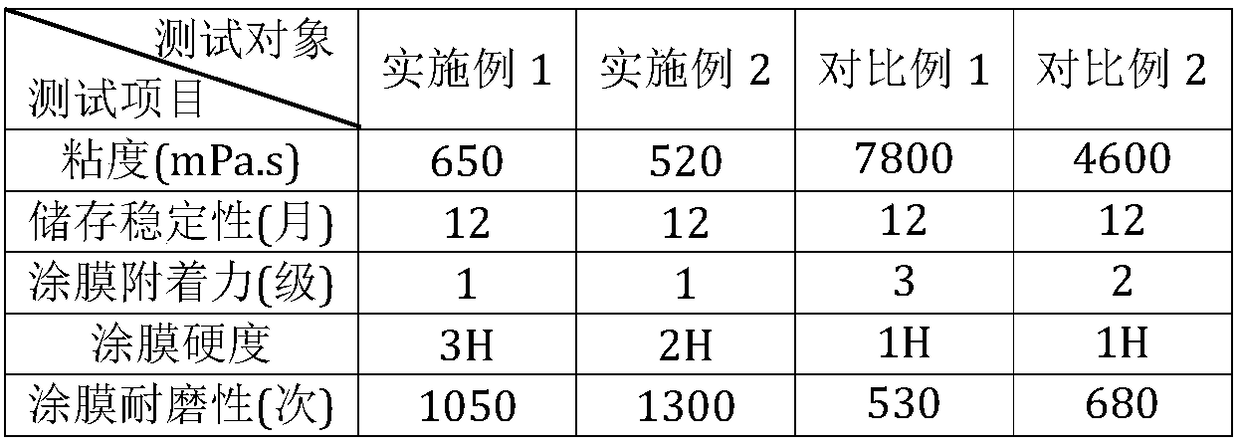
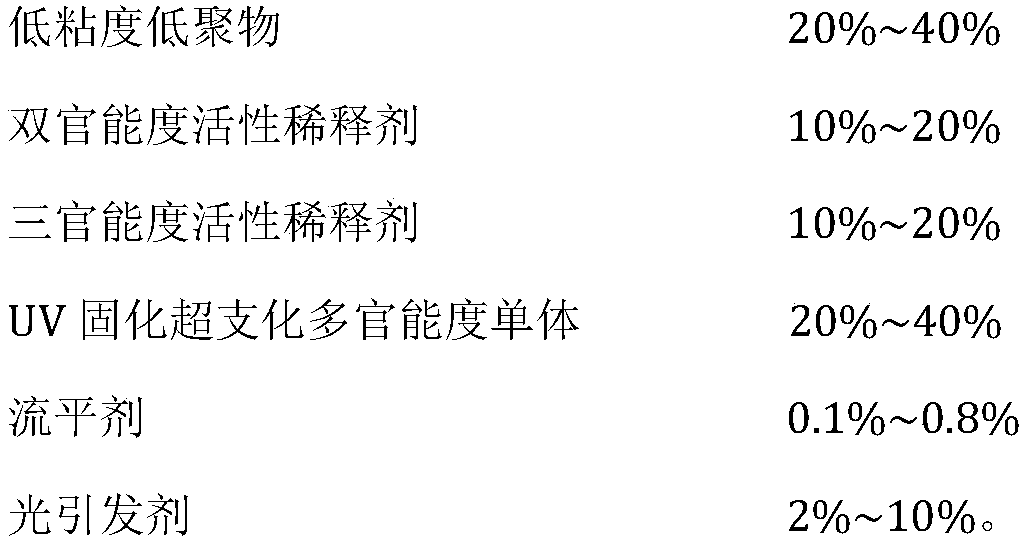
Examples
Embodiment 1
[0034] The low-viscosity oligomer adopts low-viscosity polyacrylate acrylate, and the weight ratio is 30%;
[0035] The bifunctional reactive diluent adopts ethoxylated propoxylated bisphenol A diacrylate, and the weight ratio is 20%;
[0036] The trifunctional reactive diluent adopts tris(2-hydroxyethyl)isocyanurate triacrylate, and the weight ratio is 20%;
[0037] The UV curing hyperbranched multifunctional monomer adopts hyperbranched urethane acrylate, and the weight ratio is 25%;
[0038] The leveling agent adopts BYK-UV-3575 of BYK, and the weight ratio is 0.5%;
[0039] The photoinitiator adopts 1-hydroxycyclohexyl phenyl ketone, and the weight ratio is 4.5%.
Embodiment 2
[0041] The low-viscosity oligomer adopts polyacrylate acrylate, and the weight ratio is 30%;
[0042] The difunctional reactive diluent adopts ethoxypropoxy dimethacrylate, and the weight ratio is 10%;
[0043] The trifunctional reactive diluent adopts propoxylated glycerol triacrylate, and the weight ratio is 20%;
[0044] The UV curing hyperbranched multifunctional monomer adopts hyperbranched polyester acrylate, and the weight ratio is 35%;
[0045] The leveling agent adopts BYK-UV-3575 of BYK, and the weight ratio is 0.5%;
[0046] The photoinitiator is 2-hydroxy-2-methyl-1-phenyl-1-propanone, and the weight ratio is 4.5%.
PUM
 Login to View More
 Abstract
Description
Claims
Application Information
 Login to View More