Moving target tracking method based on scale adaptive block particles
A scale-adaptive, target tracking technology, applied in the field of computer vision, can solve the problems of inability to fully express targets, large differences in tracking performance, and tracking failures
- Summary
- Abstract
- Description
- Claims
- Application Information
AI Technical Summary
Problems solved by technology
Method used
Image



Examples
Embodiment 1
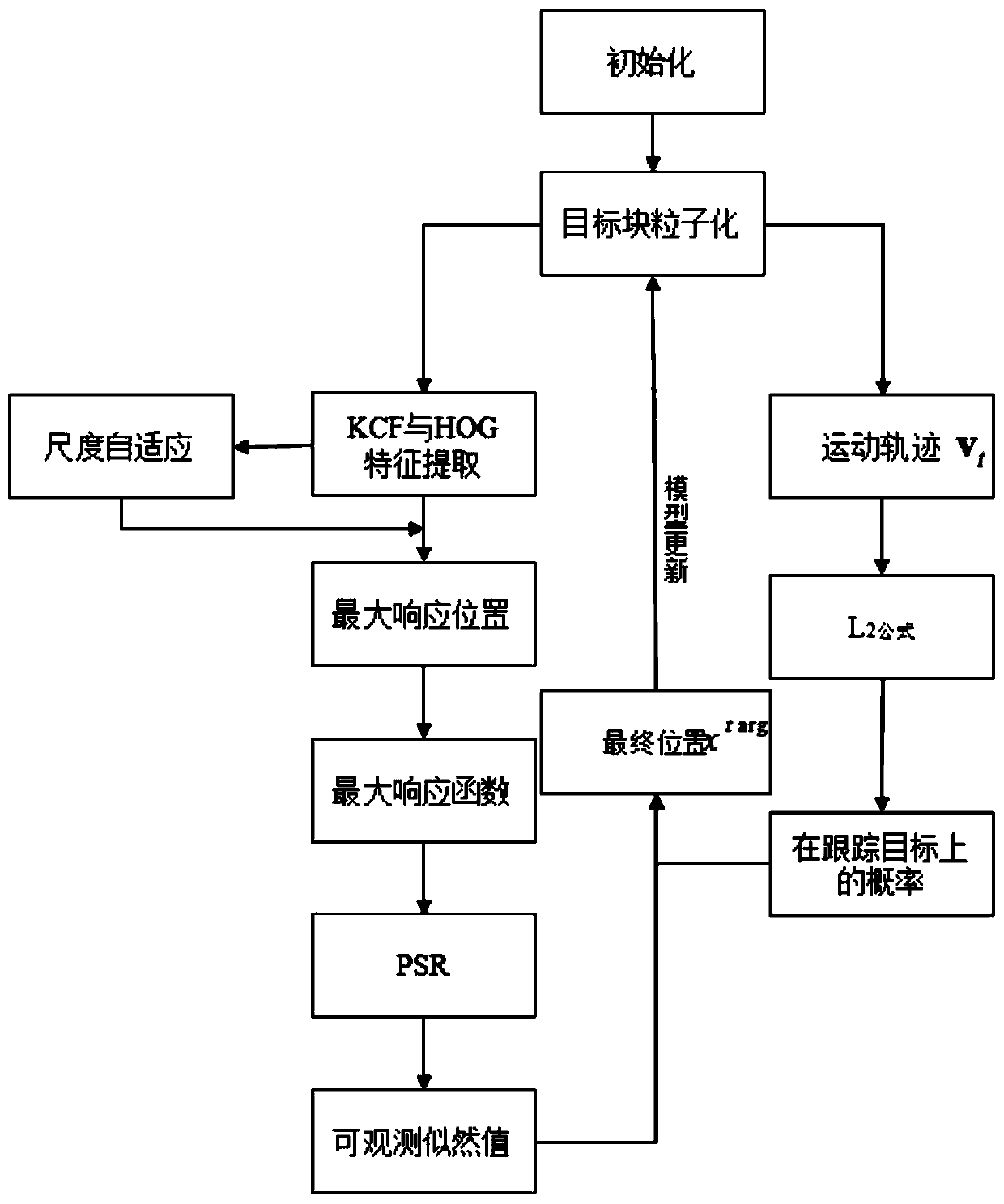
[0045] Embodiment 1: as figure 1 As shown, the moving target tracking method based on scale-adaptive block particles, the specific steps of the method are as follows:
[0046] Step 1. Initialize the target and select the target area; according to the first frame of the input image, with the target position as the center, collect an image block X whose size is twice the size of the target as the target area.
[0047] Step2. According to the Monte Carlo method, the target area, that is, the tracked target, is expressed as a group of block particles:
[0048] Step2.1. From Bayesian theory, it is assumed that the probability density function at time t-1 is known as: p(x t-1 |z 1:t-1 ), then when predicting, the probability density p(x t-1 |z 1:t-1 ) to get p(x t |z 1:t-1 ). Therefore we can take time t as z t medium particle x t The reliability probability density function is expressed as:
[0049] p(x t |z 1:t-1 )=∫p(x t |x 1:t-1 )p(x t-1 |z 1:t-1 ) ⑴
[0050] wh...
Embodiment 2
[0110] Embodiment 2: this method is compared with other methods in this embodiment, and its result is as follows Figure 2-4 And as shown in Table 1-2. figure 2 with image 3 Indicates the factor for the fast moving of the tracked target. When the target moves fast, this algorithm has a better effect than other algorithms; Figure 4 with Figure 5 Indicates the factors for the scale change of the tracked target. When the target changes from far to near or from near to far, the target scale will change. This algorithm has a better effect than other algorithms.
[0111] The present invention uses the average tracking error Center Location Error (CLE) and the overlap rate Pascal VOCOverlap Ratio (VOR) to evaluate this algorithm and other comparison algorithms. CLE refers to the deviation between the center of the object box and the center of the true location of the object. The smaller the center error, the higher the performance of the algorithm, and the larger the overlap ...
PUM
 Login to View More
 Abstract
Description
Claims
Application Information
 Login to View More