Juglans mandshurica bud grafting method

A technology for jujube and bud grafting, which is applied in the field of budding of jujube, can solve the problems of poor lignification, cumbersome process, short growth period and the like, and achieves the effects of good grafting effect, high preservation rate and simple process.

CN110115164APending Publication Date: 2019-08-13JILIN CITY ACADEMY OF FORESTRY
2 Cites 0 Cited by

Patent Information

Authority / Receiving Office
CN · China
Patent Type
Applications(China)
Current Assignee / Owner
Publication Date
2019-08-13

Smart Images

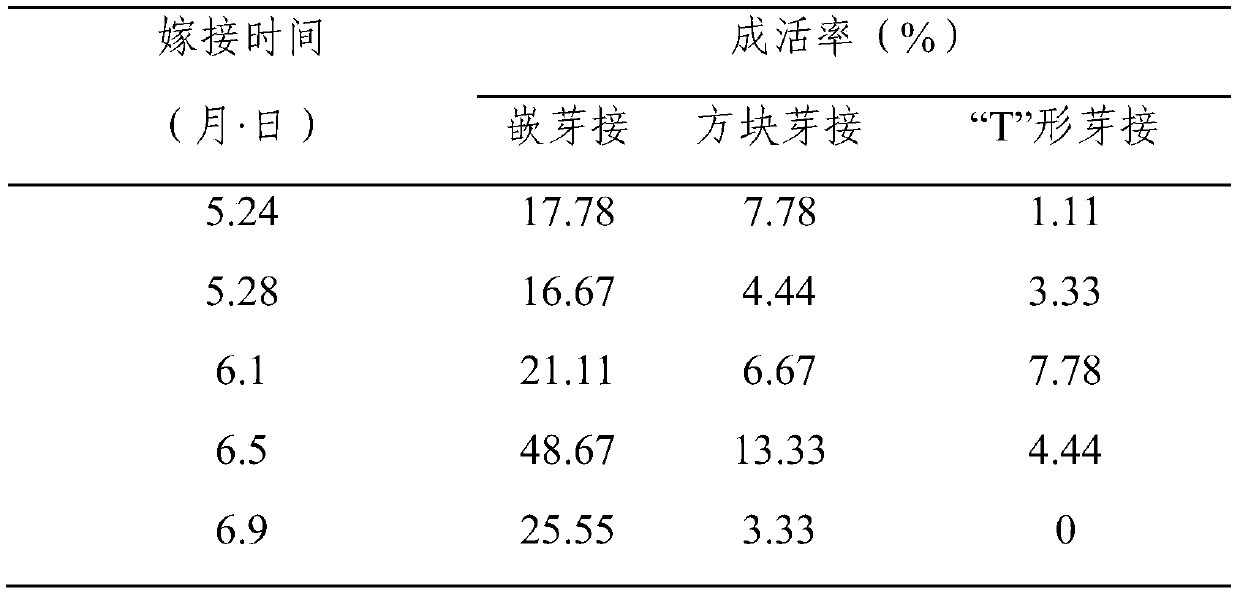
  • Figure 1
    Figure 1
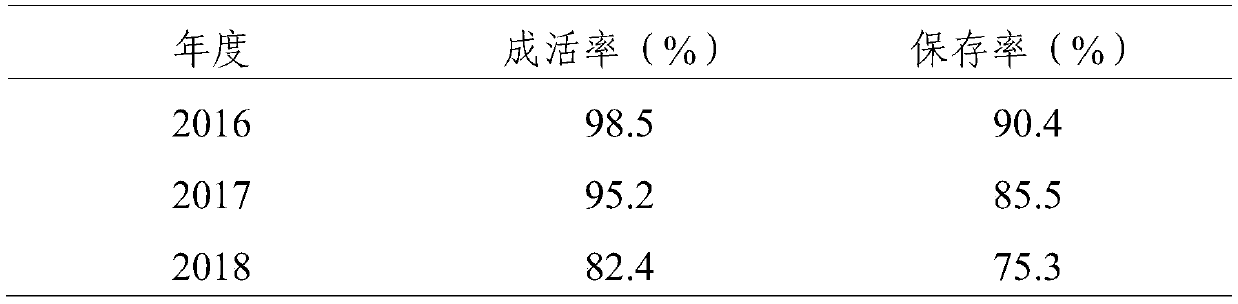
  • Figure 2
    Figure 2
Patent Text Reader

Abstract

The invention provides a juglans mandshurica bud grafting method. The method includes steps: (1) in the middle of April, selecting developmental branches in the same year to serve as scions; (2) picking the scions when needed or keeping the scions for temporary storage; (3) keeping the row spacing of rootstocks larger than 20cm*20cm; (4) lowering a greenhouse before grafting, and arranging shadingnets to surround two sides of the greenhouse; (5) selecting grafting blades; (6) taking polyvinyl chloride films as tying straps, and cutting; (7) selecting grade-1 seedlings as the rootstocks, and keeping bud grafting width not larger than rootstock thickness; (8) grafting by two persons, wherein one person cuts the rootstocks while the other person takes grafting buds, a grafting process is completed by once cutting, the depth is slightly over a ligneous portion, cut smoothness and straightness are guaranteed, and rootstock cutting length is identical to grafting bud cut length; (9) makinga water line below the rootstock cutting position; (10) aligning the grafting bud to a rootstock forming layer, and tightly binding with the plastic films; (11) untying 40 days later after grafting. The method is low in cost, simple in process and high in propagation coefficient, and by double grafting, great grafting effects are achieved, and high grafting success rate and preservation rate are realized.
Need to check novelty before this filing date? Find Prior Art

Description

technical field

[0001] The invention relates to the technical field of budding of seedlings, in particular to a method for budding of walnut bark. Background technique

[0002] In the actual process of forestry production, juglans regia is mostly used for seed propagation, because the seed propagation of juglans regia easily causes variation, and its excellent characters cannot be fixed. Therefore, the breeding method of walnut catalpa is the technical bottleneck for the development of improved varieties and industrialization of juglans regia in Changbai Mountains.

[0003] The existing vegetative propagation methods are mainly cutting propagation. The technical process is as follows: (1) Making the bed matrix: using vermiculite as the matrix. (2) Buckle shed: Use the iron frame to cover the black nylon net to form a shade shed, and cover the 70% shade net. (3) Substrate disinfection: The substrate was sterilized with 5% potassium permanganate 1 day before cutting. After...

Examples

Embodiment 1

[0037] A method for budding of walnut bark, comprising the following steps:

[0038] (1) in mid-April, select 4-5-year-old seedlings that have better lignification in the current year as spikes;

[0039] (2) The scions are collected as needed; if short-term storage is required, protective measures should be taken during transportation, and the storage time should generally not exceed 2-3 days; when storing, wrap them in plastic film and keep them ventilated, and put some wet moss or Wet sawdust, etc., or dipped in water-retaining agent;

[0040] (3) rootstock row spacing>20cm × 20cm of grafted nursery;

[0041] (4) Before grafting, a low shed should be buckled, and the height should not be lower than the height of the seedlings plus the height of the current year, and the two sides should be surrounded by shading nets, which not only ensures the increase of the ground temperature, but also provides ventilation;

[0042] (5) The grafting blade uses a new razor blade, which ne...