

A Sequential Detonation Explosion Network Based on Scale Partitioning
A network and sequential technology, applied in the field of explosive networks, can solve the problems of poor time accuracy, large detonator area, and difficulty in wide application
- Summary
- Abstract
- Description
- Claims
- Application Information
AI Technical Summary
Problems solved by technology
Method used
Image

Examples
Embodiment 1
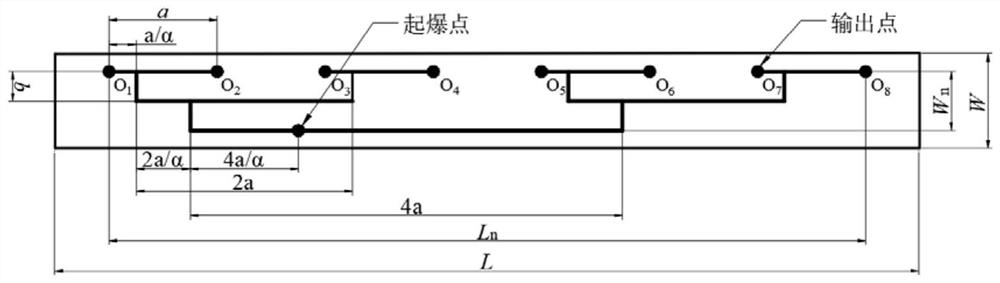
[0047] This embodiment provides a design and calculation method of "one input and eight outputs" sequential detonation network, which can realize from O 1 to O 8 Sequentially output detonation waves.
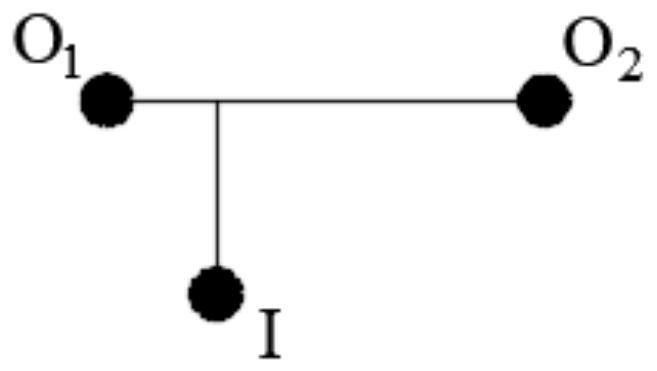
[0048]Given the number of detonation points N=8, calculate the number of network series n=3, calculate the distance a between the detonation points according to the length L of the detonator, the distance c from the first output point of the sequential detonation explosion network to the edge of the network, and calculate the distance a between the detonation points according to Explosion network series first set the output point O when n=3 1 and O 2 , O 3 and O 4 , O 5 and O 6 , O 7 and O 8 Connect two by two to form 4 “one-in, two-out” explosion networks; next, calculate the proportional division coefficient according to the overall given sequential detonation time difference t In this way, the position of the detonation wave input point in each "one-in, two-out" det...
Embodiment 2
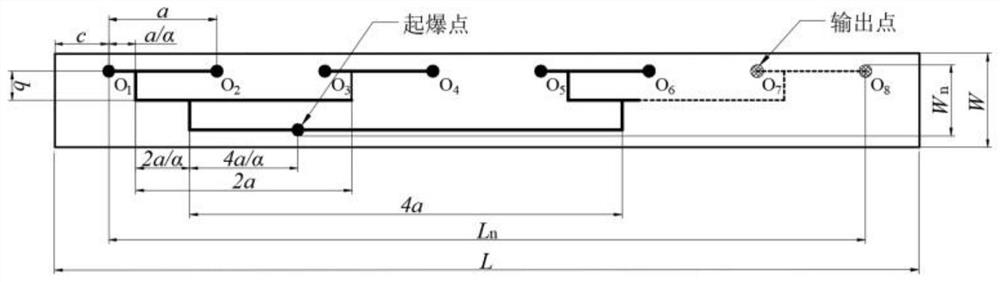
[0050] This embodiment provides a "one input and six output" sequential detonation network, which can realize from O 1 to O 6 Sequentially output detonation waves.
[0051] Given the number of detonation points N=6, calculate the number of network series n=3, calculate the distance a between the detonation points according to the length L of the detonator, the distance c between the first output point of the sequential detonation explosion network and the edge of the network, and calculate the distance a between the detonation points according to Explosion network series first set the output point O when n=3 1 and O 2 , O 3 and O 4 , O 5 and O 6 , forming three "one-in, two-out" explosive networks, while referring to Example 1 to virtually add two output points O 7 and O 8 , to further form four “one-in, two-out” explosion networks; next, calculate the proportional division coefficient according to the overall given sequential detonation time difference t Therefore, ...
Embodiment 3
[0053] This embodiment provides a "one input and four output" sequential detonation network with the input point at the head and the output point at the center line, which can realize from O 1 to O 4 Sequentially output detonation waves.
[0054] Given the number of detonation points N=4, the network series n=2 is calculated, and the distance a between the detonation points is calculated according to the length L of the detonator, the distance c between the first output point of the sequential detonation explosion network and the edge of the network, and according to Explosion network series first set the output point O when n=2 1 and O 2 , O 3 and O 4 Connect two by two to form two "one-in, two-out" explosion networks; next, calculate the proportional division coefficient according to the overall given sequential detonation time difference t Therefore, the position of the detonation wave input point in each "one-in, two-out" detonation network unit is determined to form...
PUM
 Login to View More
 Abstract
Description
Claims
Application Information
 Login to View More