Method for quantitatively detecting alpha-glucosidase in Italian honey by liquid chromatography-tandem mass spectrometry
What is AI technical title?
AI technical title is built by Patsnap AI team. It summarizes the technical point description of the patent document.
A technology of glucosidase and tandem mass spectrometry is applied in the field of quantitative detection of α-glucosidase in Italian honey by liquid chromatography tandem mass spectrometry. high sensitivity and specificity
Inactive Publication Date: 2020-01-31
BEE RES INST CHINESE ACAD OF AGRI SCI
View PDF4 Cites 6 Cited by
Summary
Abstract
Description
Claims
Application Information
AI Technical Summary
This helps you quickly interpret patents by identifying the three key elements:
Problems solved by technology
Method used
Benefits of technology
Problems solved by technology
Compared with Chinese bees, Italian bees are larger and have yellow backs, but they are less adaptable and prone to disease
Method used
the structure of the environmentally friendly knitted fabric provided by the present invention; figure 2 Flow chart of the yarn wrapping machine for environmentally friendly knitted fabrics and storage devices; image 3 Is the parameter map of the yarn covering machine
View more
Image
Smart Image Click on the blue labels to locate them in the text.
Viewing Examples
Smart Image
Click on the blue label to locate the original text in one second.
Reading with bidirectional positioning of images and text.
[0065] 100 mM DTT: Weigh 308.5 mg DTT, 40 mM NH 4 HCO 3 Dilute the solution to 20 mL, dispense 1 mL into each tube, and store in a -20°C refrigerator until use.
[0066] 40 mM NH 4 HCO 3 Solution: weigh 0.316 g NH 4 HCO 3 , dilute to 100 mL with ultrapure water, and store in a 4°C refrigerator until use.
[0067] 100 mM IAA solution: Weigh 0.39 g of IAA, add 40 mM NH 4 HCO 3 The solution was fixed to 20 mL, and stored in a -20°C refrigerator until use.
[0068] Activation solution: 500 μL ACN, 3 μL TFA, dilute to 1 mL with ultrapure water, store at 4°C...
Embodiment 2
[0095] Example 2 Quantitative detection of honey adulteration
[0096] 1. Sample source
[0097] Buy samples of real Italian honey and syrup from the market or beekeepers.
[0098] 2. Experimental steps
[0099] (1) Solution preparation
[0100] With embodiment 1.
[0101] (2) Blending of honey: mix syrup into Italian honey in different proportions.
[0102] The Italian honey is mixed with syrup in proportions of 5%, 10%, and 50%.
[0104] ① Accurately weigh 10 g of honey to be tested evenly into a 50 mL centrifuge tube, add 10 mL of deionized water, and vortex until the honey is fully dissolved. Centrifuge at 12000 rpm for 10 min at 4°C. Collect the supernatant in a new 2 mL centrifuge tube.
[0105] ② Pipette 200 μL of the protein solution and add 4 μL of 100 μg / mL stable isotopeinternal standard peptide SISNNEQVK*, and mix with 800 μL of 40 mM NH 4 HCO 3 mix. Add 100 μL of 30 mM DTT solution to the above mixed solution,...
the structure of the environmentally friendly knitted fabric provided by the present invention; figure 2 Flow chart of the yarn wrapping machine for environmentally friendly knitted fabrics and storage devices; image 3 Is the parameter map of the yarn covering machine
Login to View More
PUM
Login to View More
Abstract
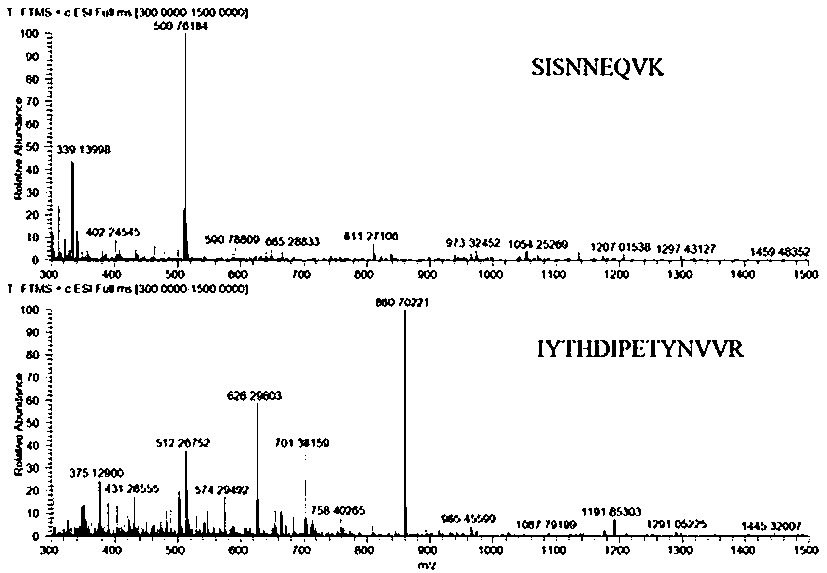
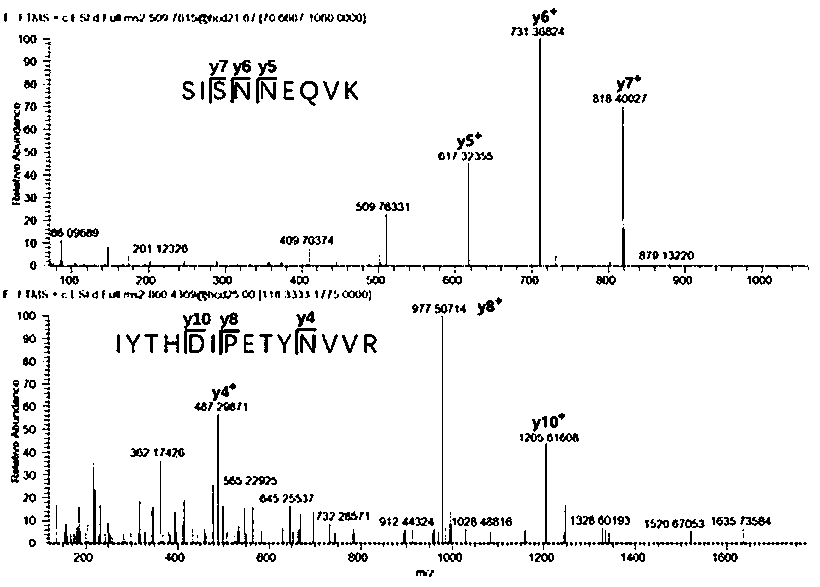
The invention provides a method for quantitatively detecting alpha-glucosidase in Italian honey through liquid chromatography-tandem mass spectrometry. The method comprises the steps of screening characteristic peptide fragments, making a standard curve, pretreating a sample, performing liquid chromatography separation, performing tandem mass spectrometry detection, quantifying the peptide fragments through software and the like. The characteristic peptide fragments comprise a characteristic peptide fragment 1: SISNNEQVK and a characteristic peptide fragment 2: IYTHDIPETYNVVR. The quantitativemethod for alpha-glucosidase in Italian honey provided by the invention has relatively high accuracy, precision and sensitivity and strong stability, is suitable for accurately quantifying alpha-glucosidase in Italian honey, and can be used for assisting authenticity evaluation of Italian honey. The quantitative method has important practical significance for protecting rights and interests of honey consumers and maintaining healthy development of the bee product industry.
Description
technical field [0001] The invention relates to the field of food testing, in particular to a method for quantitatively detecting α-glucosidase in Italian honey by liquid chromatographytandem mass spectrometry, and the method is suitable for identifying and evaluating the authenticity of Italian honey. Background technique [0002] Honey is a kind of sweet food that is formed after bees collect nectar or honeydew from nectar source plants and their secretions, and brew for a period of time. As a traditional natural food, honey has health care functions such as beautifying, nourishing the skin, and calming the nerves. The production of honey has high labor intensity, long cycle, and the output is easily affected by factors such as nectar source and weather, which leads to high production cost of honey and limited total output, resulting in a shortage of honey on the market. In order to pursue huge profits, unscrupulous traders manufacture adulterated honey by mixing sucrose...
Claims
the structure of the environmentally friendly knitted fabric provided by the present invention; figure 2 Flow chart of the yarn wrapping machine for environmentally friendly knitted fabrics and storage devices; image 3 Is the parameter map of the yarn covering machine
Login to View More
Application Information
Patent Timeline
Application Date:The date an application was filed.
Publication Date:The date a patent or application was officially published.
First Publication Date:The earliest publication date of a patent with the same application number.
Issue Date:Publication date of the patent grant document.
PCT Entry Date:The Entry date of PCT National Phase.
Estimated Expiry Date:The statutory expiry date of a patent right according to the Patent Law, and it is the longest term of protection that the patent right can achieve without the termination of the patent right due to other reasons(Term extension factor has been taken into account ).
Invalid Date:Actual expiry date is based on effective date or publication date of legal transaction data of invalid patent.


 Login to View More
  Login to View More