
A method and device for life prediction of a balanced control module based on health indicators
A technology of balanced control and health indicators, applied in general control systems, control/regulation systems, testing/monitoring control systems, etc., and can solve problems such as remaining service life prediction and aging of difficult systems
- Summary
- Abstract
- Description
- Claims
- Application Information
AI Technical Summary
Problems solved by technology
Method used
Image

Examples
Embodiment 1
[0068] This embodiment discloses a method for predicting the life of a balance control module based on health indicators, including the following steps:
[0069] Step S1: Based on the data of the brake balance control module in each action, extract its eigenvalues at each action;
[0070] Step S2: Construct a health index model, determine the model parameters based on the eigenvalues of the samples of the brake balance control module; Health indicators at the time;
[0071] Step S3: Construct a life prediction model, based on the health index sequence and the remaining service life sequence of the samples of the brake equalization control module (marking the remaining service life of each sample in each action = the total action of the sample in the entire life cycle Number of times - the number of actions the sample has performed during this action, such as the sample life cycle, that is, the total number of actions from healthy to fault is 100, then the remaining servic...
Embodiment 2
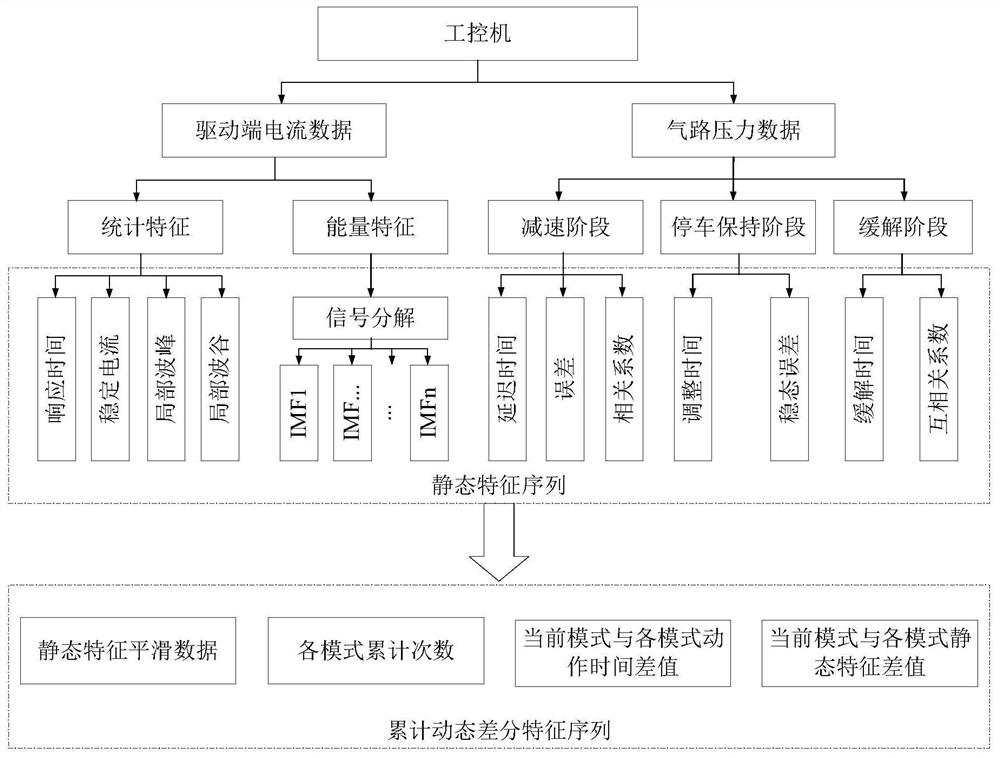
[0074] This embodiment is on the basis of embodiment 1, as figure 1 As shown, the feature extraction in the step S1 specifically includes the following steps:
[0075]Step S1.1, extracting static features:
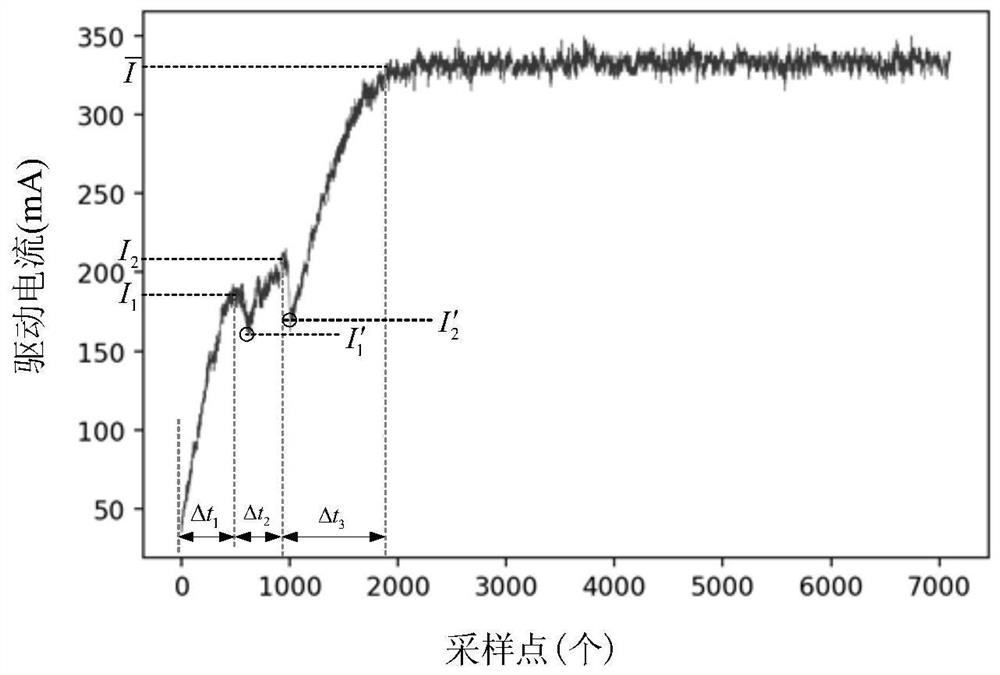
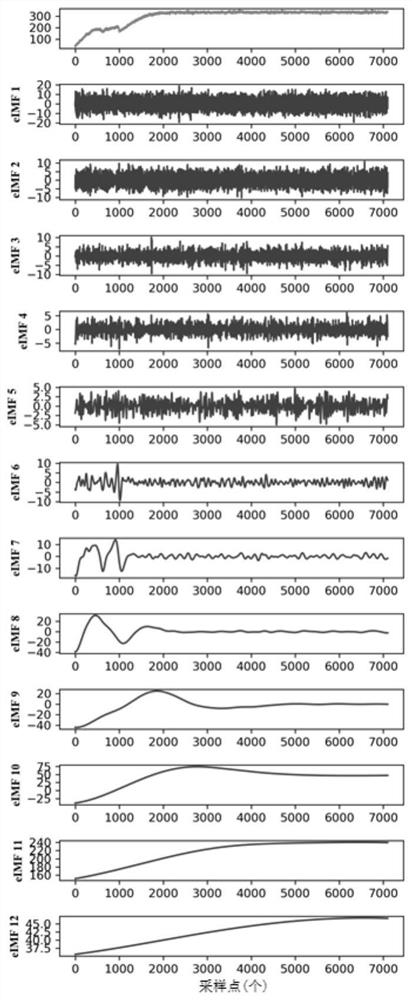
[0076] Based on the driving current curve of each solenoid valve in each action of the brake balance control module, a set of aging characteristics of the solenoid valve is extracted. The aging characteristics of the solenoid valve include the statistical characteristics and energy characteristics of the driving current; the statistical characteristics of the driving current include the response time Δt, local peak value I, local valley value I', stable current value Among them, the energy characteristic is to use the empirical mode decomposition to decompose the driving current curve into Z intrinsic mode function components And the calculated components of each intrinsic mode function energy e z ,Calculated as follows:
[0077]
[0078] Where L is the number o...
Embodiment 3
[0093] In this embodiment, on the basis of Embodiment 1, in the step S2, the purpose of the health index model is to fuse the accumulated dynamic feature sequence to obtain the health index representing the aging state (system degradation trend) of the balance control module. Considering that the cumulative dynamic feature F consists of each part (F 1 , F 2 , F 3 , F 4 ) are multi-dimensional, let K be the total dimension of the cumulative dynamic feature, that is, the number of features it contains, then the cumulative dynamic feature corresponding to the balance control module’s t-time action can be expressed as F(t)=(f 1 (t), f 2 (t),...,f K (t)), the health index is expressed as a linear combination of features, that is, the constructed health index model is:
[0094] H(t)=w 1 f 1 (t)+w 2 f 2 (t)+...w k f k (t)+...+w K f K (t)
[0095] Among them, H(t) is the health index of the balance control module at the tth action, w 1 ,w 2 ,...,w k ,...,w K Indicate...
PUM
 Login to View More
 Abstract
Description
Claims
Application Information
 Login to View More