
Non-aqueous electrolyte considering high-temperature characteristic and normal-temperature cycle, application thereof and lithium ion battery
A non-aqueous electrolyte, lithium-ion battery technology, applied in the fields of lithium-ion batteries and non-aqueous electrolytes, can solve the problems of large growth of storage DCR, high temperature gas production, poor high temperature characteristics, etc., to reduce damage and slow down oxidative decomposition. Good reaction and stability
- Summary
- Abstract
- Description
- Claims
- Application Information
AI Technical Summary
Problems solved by technology
Method used
Image

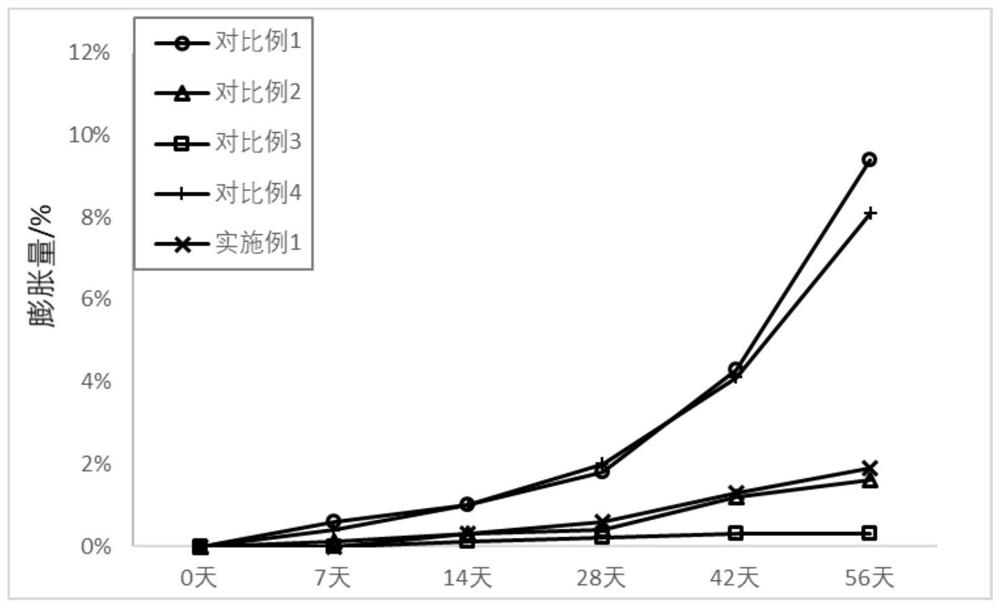
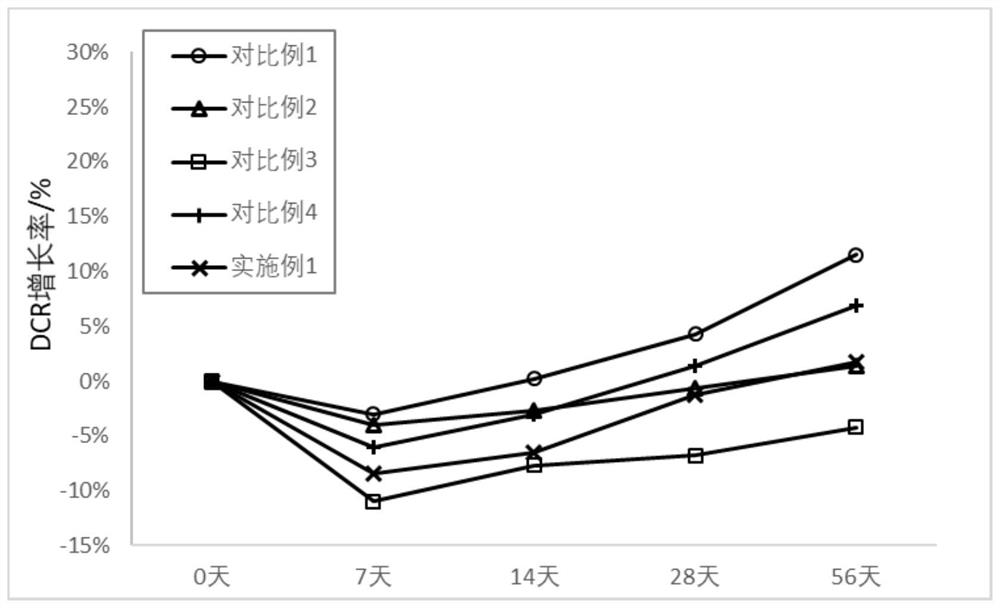
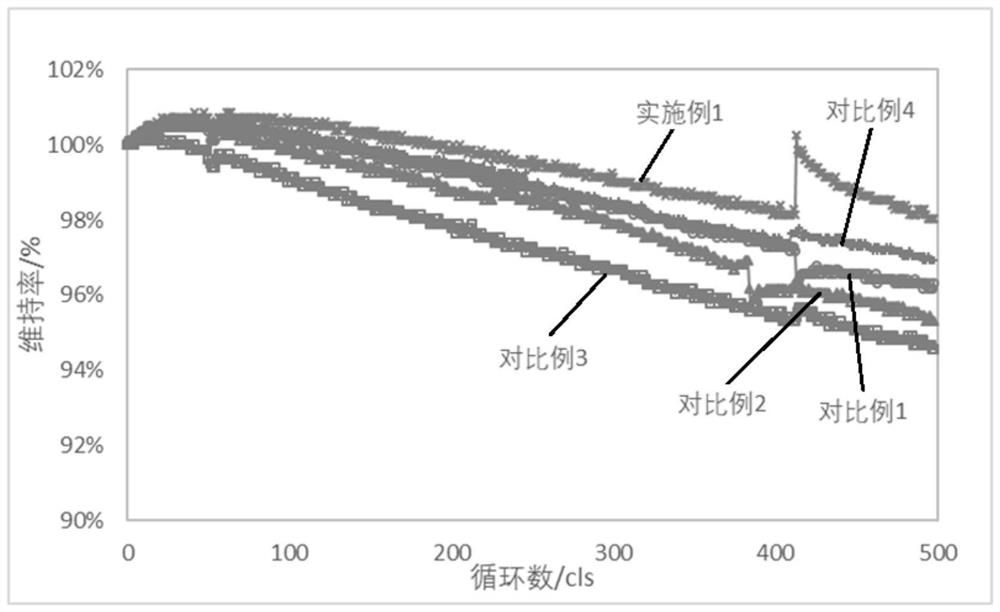
Examples
Embodiment 1
[0039] 1. Preparation of non-aqueous electrolyte:
[0040] Mix EC / EMC / DEC into a non-aqueous organic solvent in a mass ratio of about 3:5:2, and mix the non-aqueous organic solvent with 14wt% LiPF 6 After the non-aqueous solution is mixed, and relative to 100 parts by weight of the non-aqueous electrolytic solution, add 1wt% lithium difluorophosphate, 1wt% LiFSi, 1wt% DTD, 1wt% PS, 0.2wt% VC, 0.2wt% TVS, 0.5 wt ODFP to obtain a non-aqueous electrolyte. In the obtained non-aqueous electrolyte, the mass fraction of non-aqueous organic solvent is 81.1%, LiPF 6 The mass fraction is 14%.
[0041] 2. Preparation of lithium secondary battery:
[0042] Based on the total weight of the positive electrode material, 97wt% NCM (LiNi x co y mn 1-x-y o 2 , x≥0.3, y≤0.3, 1-x-y≤0.5), 2wt% carbon black as a conductive agent, and 1wt% PVDF as a binder were added to the solvent NMP to make a positive electrode mixture slurry. The positive electrode mixture slurry is coated on the positive ...
Embodiment 2
[0066] A kind of nonaqueous electrolytic solution is based on its gross weight, and is made up of the component of following mass fraction:
[0067] Non-aqueous organic solvent 90wt% (EC / EMC / DEC mass ratio is about 3:5:2), LiPF 6 8.7wt%, 0.1wt% lithium difluorophosphate, 0.5wt% LiFSi, 0.1wt% PS, 0.5wt% TVS, 0.1wt% ODFP.
Embodiment 3
[0069] A kind of nonaqueous electrolytic solution is based on its gross weight, and is made up of the component of following mass fraction:
[0070] Non-aqueous organic solvent 70wt% (EC / EMC / DEC is about 3:5:2 by mass ratio), LiPF 6 20wt%, 2.5wt% lithium difluorophosphate, 3wt% LiFSi, 2wt% PS, TVS1wt%, ODFP1.5wt%.
PUM
| Property | Measurement | Unit |
|---|---|---|
| thickness | aaaaa | aaaaa |
Abstract
Description
Claims
Application Information
 Login to View More