Medical instrument for percutaneous release procedures
What is AI technical title?
AI technical title is built by Patsnap AI team. It summarizes the technical point description of the patent document.
A technology of medical devices and procedures, applied in the field of medical devices, can solve problems such as damage to surrounding tissues and structures, complex structures, etc.
Pending Publication Date: 2021-04-09
SWIBRACE SA
View PDF6 Cites 0 Cited by
Summary
Abstract
Description
Claims
Application Information
AI Technical Summary
This helps you quickly interpret patents by identifying the three key elements:
Problems solved by technology
Method used
Benefits of technology
Problems solved by technology
[0011] The disadvantage of the medical device disclosed in US Pat. No. 5,782,850A is that its construction is still relatively complicated
In addition, medical devices are constructed such that the groove-like depressions and the hook-like cutting edges extending therein may cause undesired damage to surrounding tissues and structures, especially during the extraction of the medical device
Method used
the structure of the environmentally friendly knitted fabric provided by the present invention; figure 2 Flow chart of the yarn wrapping machine for environmentally friendly knitted fabrics and storage devices; image 3 Is the parameter map of the yarn covering machine
View more
Image
Smart Image Click on the blue labels to locate them in the text.
Viewing Examples
Smart Image
Click on the blue label to locate the original text in one second.
Reading with bidirectional positioning of images and text.
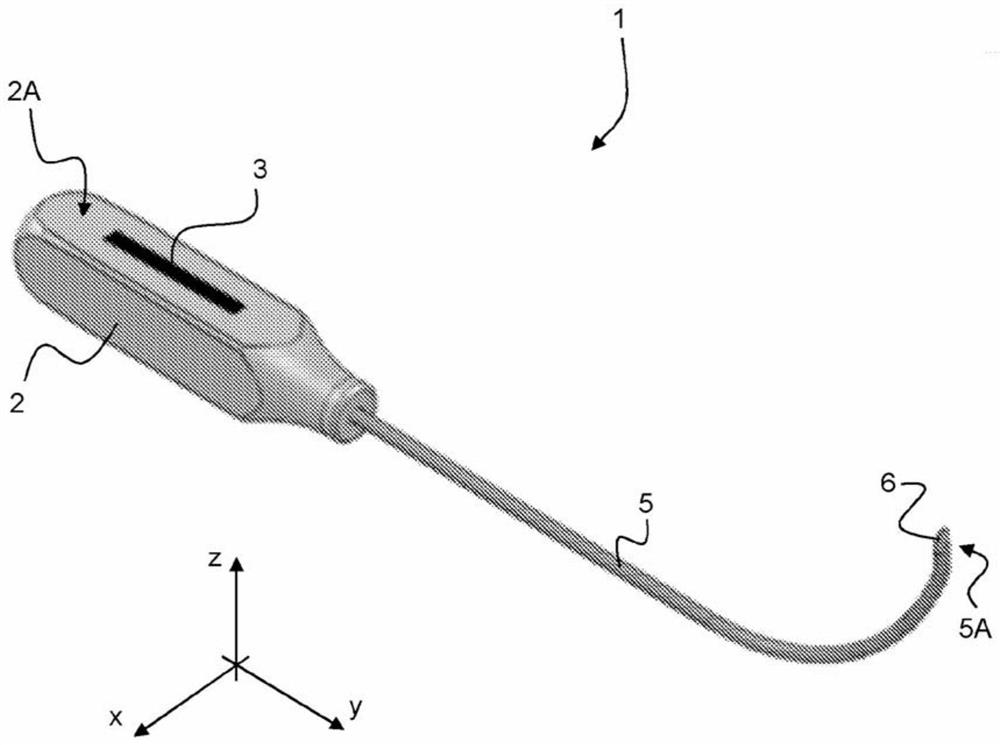
[0189] 2B Mounting hole provided on the handle part 2 for fastening the elongated rod member 5, 5* (e.g. inserted by mechanical pressing and / or glued)
[0190] 3 Marking on inner face 2A of handle part 2 (eg laser marking)
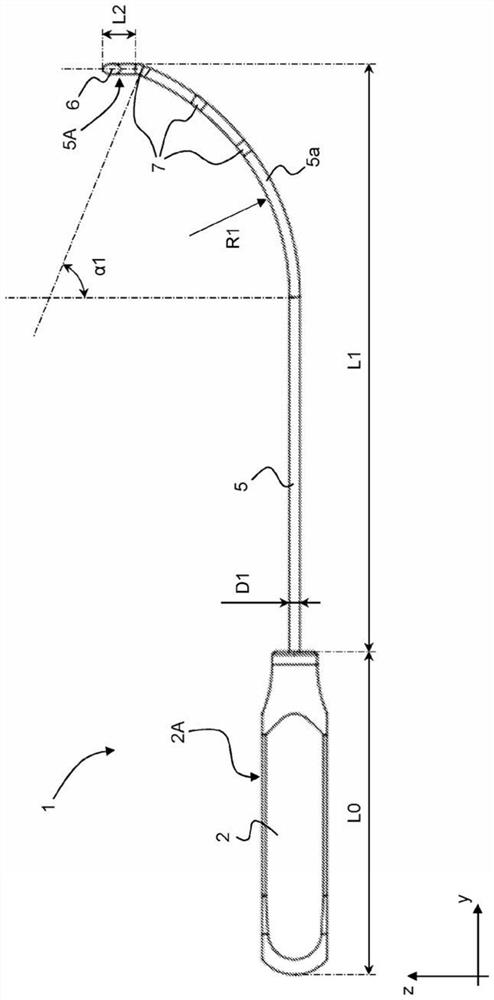
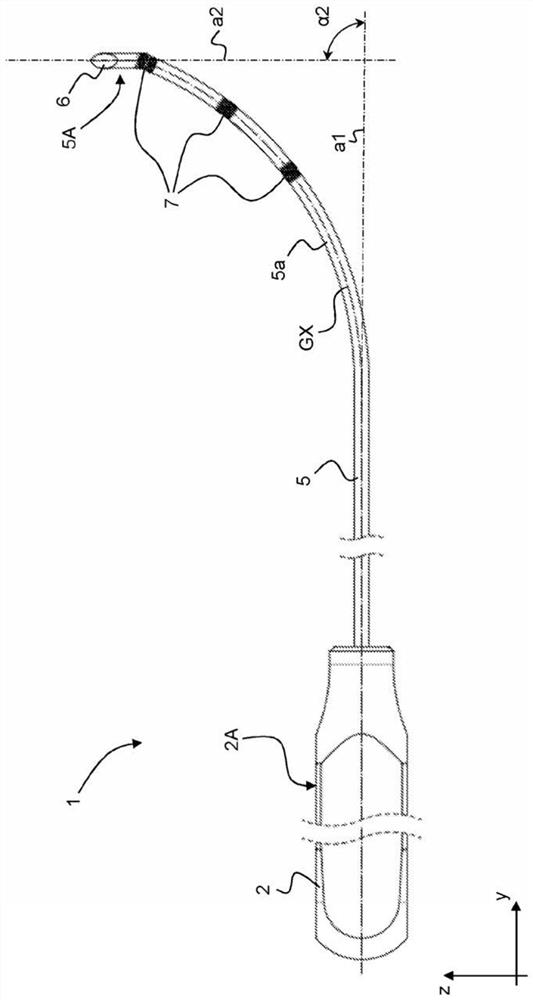
[0191] 5 Elongate rod member of medical device 1 extending in defined plane P0
[0192] 5a (single) curved portion of elongate rod member 5
[0193] 5A End of (second part of) elongate rod member 5
[0194] 6 Angled end, located at the end 5A of the elongated rod member 5, designed as a cutting device for severe tissue
[0195] 6A Inclined surface of inclined end 6
[0196] 7 markings (e.g. embossing) placed along the elongated rod member 5, designed to be discernible under ultrasonic inspection
[0197] 1* Medical device according to the invention (variation of the first embodiment)
[0198] 5* Elongated rod members of medical devices 1* extending in a defined pl...
[0237] 20B Mounting hole provided on handle portion 20 for securing elongated rod member 50, 50* (eg inserted by mechanical press-in and / or glued)
[0238] 50 Elongate rod member of medical device 10 extending in defined plane P0
[0239] 50a (first) curved portion of elongated rod member 50
[0240] 50b (second) curved portion of elongate rod member 50
[0241] 50c (third) curved portion of elongate rod member 50
[0242] 50A End of (second part of) elongate rod member 50
[0243] 60 Angled end, located at the end 50A of the elongated rod member 50, designed as a cutting device for severe tissue
[0244] 60A sloped surface of sloped end 60
[0245] 70 markings (e.g. embossing) placed along the elongated rod member 50, designed to be discernible under ultrasonic inspection
[0246] 10* Medical device according to the invention (variation of the second embodiment)
[0247] 50*...
the structure of the environmentally friendly knitted fabric provided by the present invention; figure 2 Flow chart of the yarn wrapping machine for environmentally friendly knitted fabrics and storage devices; image 3 Is the parameter map of the yarn covering machine
Login to View More
PUM
Login to View More
Abstract
A medical instrument (1) for percutaneous release procedures, especially on upper or lower limbs, such as percutaneouscarpal tunnel release or percutaneous A1 pulley release. The medical instrument (1) comprises a handle portion (2) designed to allow handling, orientation and manipulation of the medical instrument (1) and an elongated rod member (5) secured to the handle portion (2) and extending within a defined plane (P0). A first portion of the elongated rod member (5) extends along a first direction (al) within the defined plane (PO) away from the handle portion (2), and a second portion of the elongated rod member (5), downstream of the first portion, is curved and / or bent within the defined plane (P0). A free end of the elongated rod member (5), at a terminal end (5A) of the second portion, is shaped as a bevelled end (6) exhibiting a bevelled surface (6A), which bevelled end (6) is designed to act as a cutting device to severe tissue, the bevelled surface (6A) being inclined with respect to the defined plane (P0).
Description
technical field [0001] The present invention relates generally to medical devices for use in percutaneous release procedures, particularly for upper or lower extremity release procedures, such as but not limited to percutaneous carpal tunnel release and percutaneous A1 pulley release. Solution. The present invention is also applicable to other release procedures such as, but not limited to, tenolysis, tenotomy, tenotomy-lengthening, aponeurosis, neurolysis, and neurotomy. [0002] Background of the invention [0003] Carpal tunnel syndrome (CTS) and trigger finger syndrome (TFS) can be conveniently treated with surgical release procedures. These surgical release procedures are usually performed using a simple puncture needle or more complex hook knife or push knife. This medical device can also be used for other surgical release procedures on the upper or lower extremities, such as for the treatment of Morton's neuroma, tarsal tunnel release, de Kravin syndrome, epicondylal...
Claims
the structure of the environmentally friendly knitted fabric provided by the present invention; figure 2 Flow chart of the yarn wrapping machine for environmentally friendly knitted fabrics and storage devices; image 3 Is the parameter map of the yarn covering machine
Login to View More
Application Information
Patent Timeline
Application Date:The date an application was filed.
Publication Date:The date a patent or application was officially published.
First Publication Date:The earliest publication date of a patent with the same application number.
Issue Date:Publication date of the patent grant document.
PCT Entry Date:The Entry date of PCT National Phase.
Estimated Expiry Date:The statutory expiry date of a patent right according to the Patent Law, and it is the longest term of protection that the patent right can achieve without the termination of the patent right due to other reasons(Term extension factor has been taken into account ).
Invalid Date:Actual expiry date is based on effective date or publication date of legal transaction data of invalid patent.


 Login to View More
  Login to View More