
A method for evaluating the permeability of non-reactive asphalt regenerant
A technology of asphalt rejuvenator and permeability performance, which is applied in the fields of permeability/surface area analysis, climate change adaptation, suspension and porous material analysis, etc. It can solve the problems of deviation between test results and actual conditions, and unconsidered problems
- Summary
- Abstract
- Description
- Claims
- Application Information
AI Technical Summary
Problems solved by technology
Method used
Image

Examples
Embodiment 1
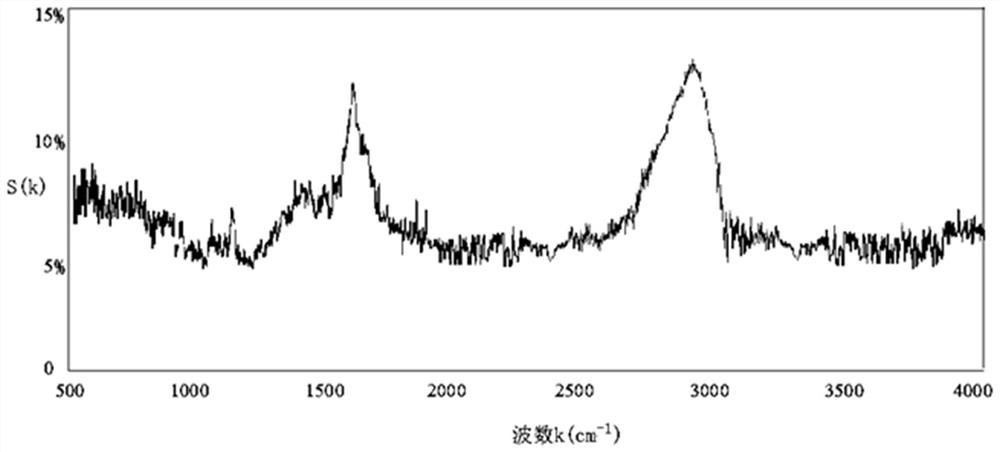
[0090] For a certain non-reactive regenerant, in the fifth step, the mass-to-weight ratio of aged asphalt, regenerated agent, and new asphalt during sample preparation is 100:12:100, and the height of the aged asphalt is 5 cm. 5 paragraphs. Cooling curve T a (t) According to the finite element numerical simulation, the holding time is 2.5 hours until the temperature of the sample drops to the set ambient temperature. Calculate the wave number permeation spectrum S(k)-k curve of the sample taken from the aged asphalt after infiltration of the first section (adjacent to the regeneration agent), and the detection wave number range is 500-4000cm -1 ,like figure 1 shown, from which it can be seen that at 500-4000cm -1 In the permeation spectrum, the wave number permeation spectrum values at each wave number are about 5%-8%, reflecting that the penetration ratio of the regenerant in the aged asphalt in the first section above (adjacent to the regenerant) should be approximately...
Embodiment 2
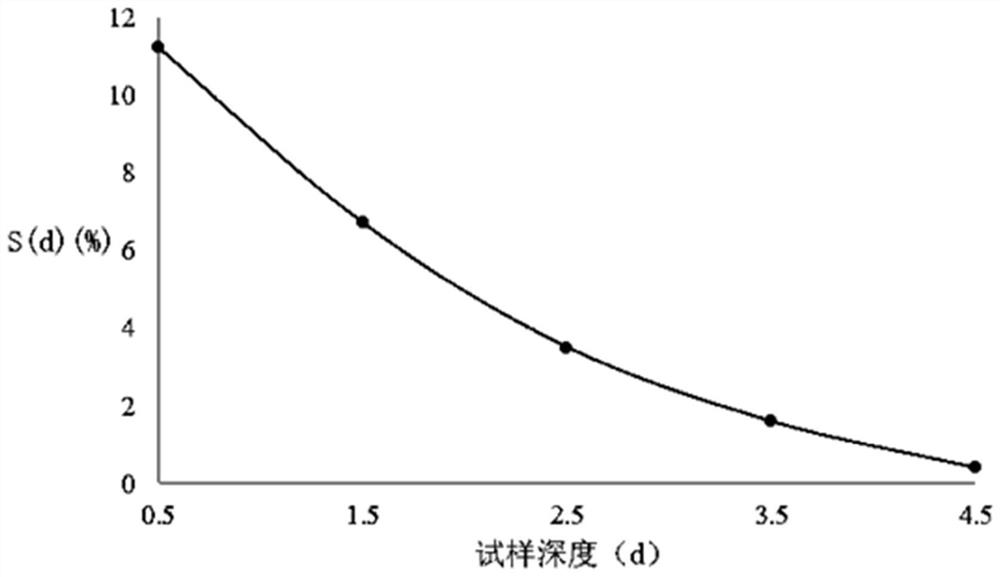
[0092] For a certain non-reactive regenerant, in the fifth step, the mass-to-weight ratio of aged asphalt, regenerated agent, and new asphalt during sample preparation is 100:15:100, and the height of the aged asphalt is 5 cm. 5 paragraphs. Cooling curve T a (t) According to the finite element numerical simulation, the holding time is 2.5 hours until the temperature of the sample drops to the set ambient temperature. The peak wavenumber of the absorption spectrum of a certain functional group is 2919cm -1 , calculate the wave number of the sample taken from the aged asphalt after infiltration from the 1st to the 5th section (the 1st section is the section adjacent to the regeneration agent) from top to bottom to be 2919cm -1 The depth permeation spectrum S(d)-d curve at the position, the FTIR sample taken from the 1st to 5th section from top to bottom is the center of each section of the sample, and the depths are 0.5, 1.5, 2.5, 3.5, 4.5cm, and the depth see permeation spec...
Embodiment 3
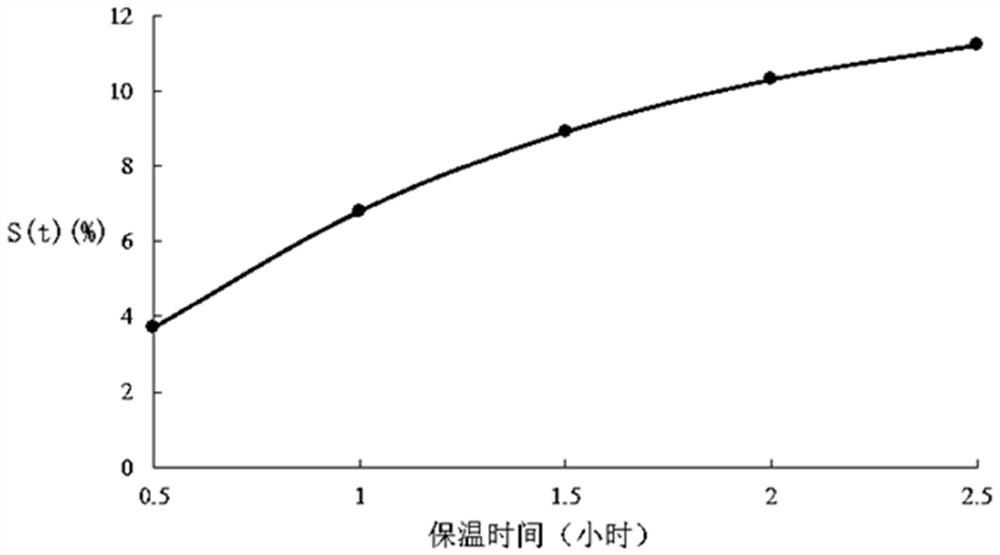
[0094] For a certain non-reactive regenerant, in the fifth step, the mass-to-weight ratio of aged asphalt, regenerated agent, and new asphalt during sample preparation is 100:14:100, and the height of the aged asphalt is 5 cm. 5 paragraphs. Cooling curve T a (t) From the finite element numerical simulation, it can be seen that it takes 2.5 hours for the sample temperature to drop to the set ambient temperature. The peak wavenumber of the absorption spectrum of a certain functional group is 2919cm -1 , calculate the wave number of the sample taken from the aged asphalt after infiltration of the first section (the first section is the section adjacent to the regenerant) to be 2919cm -1 The time permeation spectrum S(t)-t curve at the position, the holding time of each group of samples is taken as 0.5, 1.0, 1.5, 2.0, 2.5 hours respectively, the time permeation spectrum is shown in image 3 As shown, it can be seen that the penetration ratio of regenerant molecules containing t...
PUM
| Property | Measurement | Unit |
|---|---|---|
| diameter | aaaaa | aaaaa |
Abstract
Description
Claims
Application Information
 Login to View More