
Timepiece
A technology of clocks and crowns, applied in the field of clocks, can solve cumbersome problems
- Summary
- Abstract
- Description
- Claims
- Application Information
AI Technical Summary
Problems solved by technology
Method used
Image

Examples
no. 1 Embodiment approach
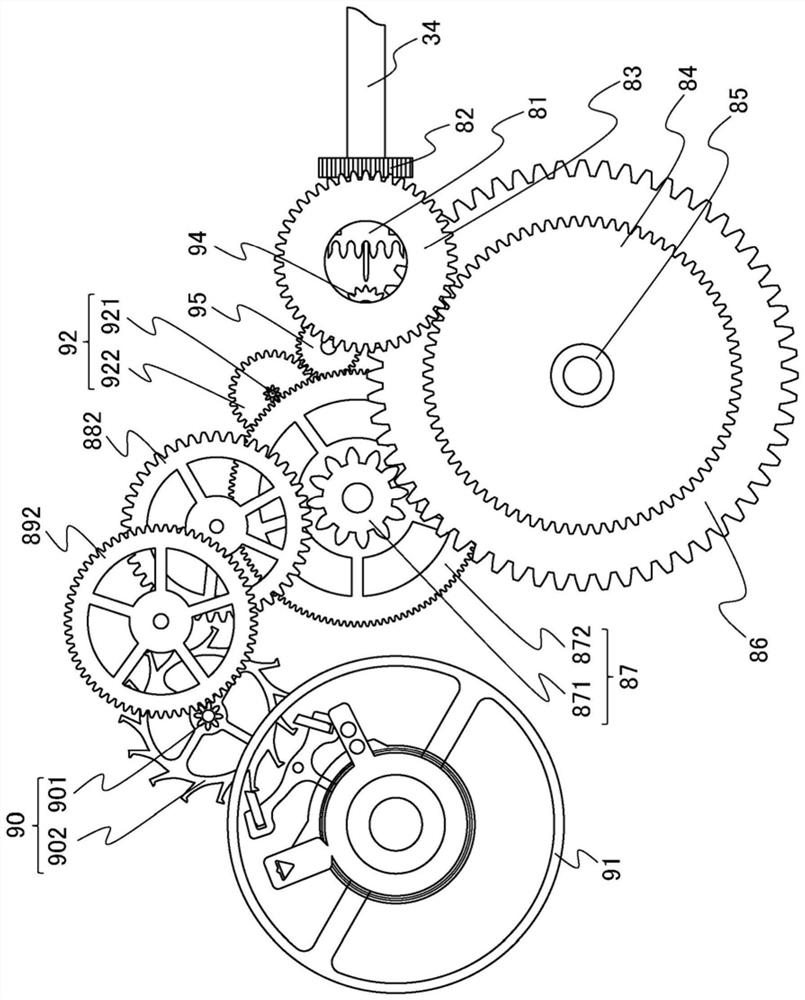
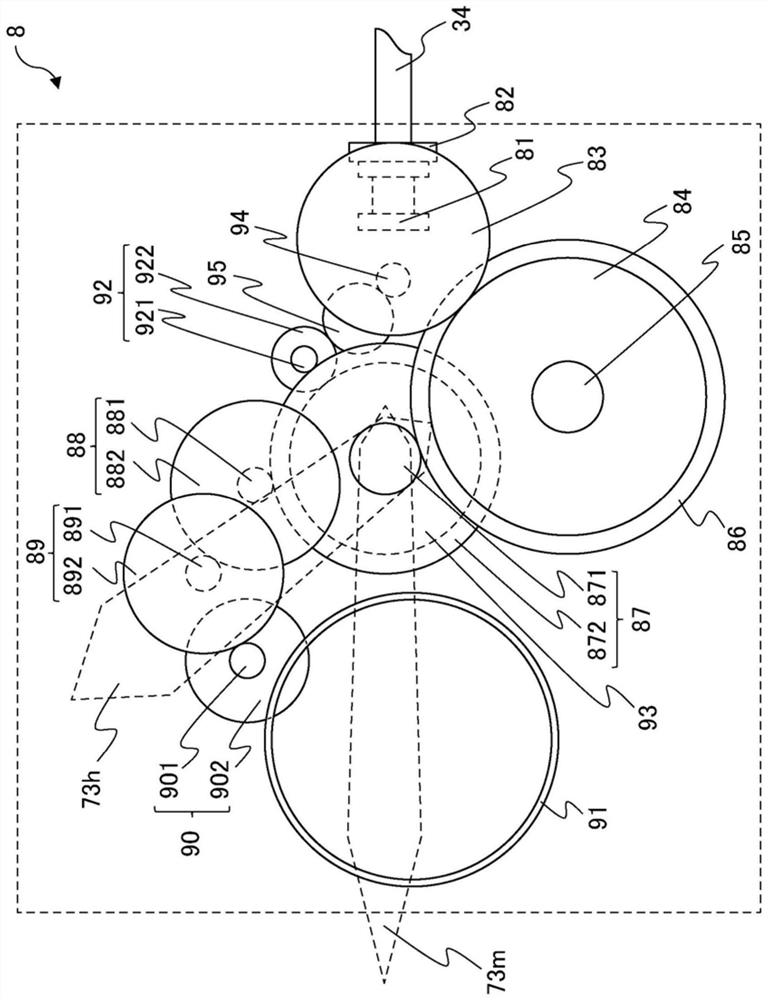
[0031] figure 1 It is a front view of the movement 8 of the watch of the embodiment, figure 2 It is a schematic diagram for explaining the outline of the movement 8 . figure 2 The relationship between the various constituent elements of the movement 8 is schematically shown in . Furthermore, figure 2 The illustration of the teeth of the gears in each constituent element is omitted.
[0032] First, refer to figure 1 and figure 2 , the operation in the state where the crown is not pulled out (hereinafter referred to as "the first state") will be described.
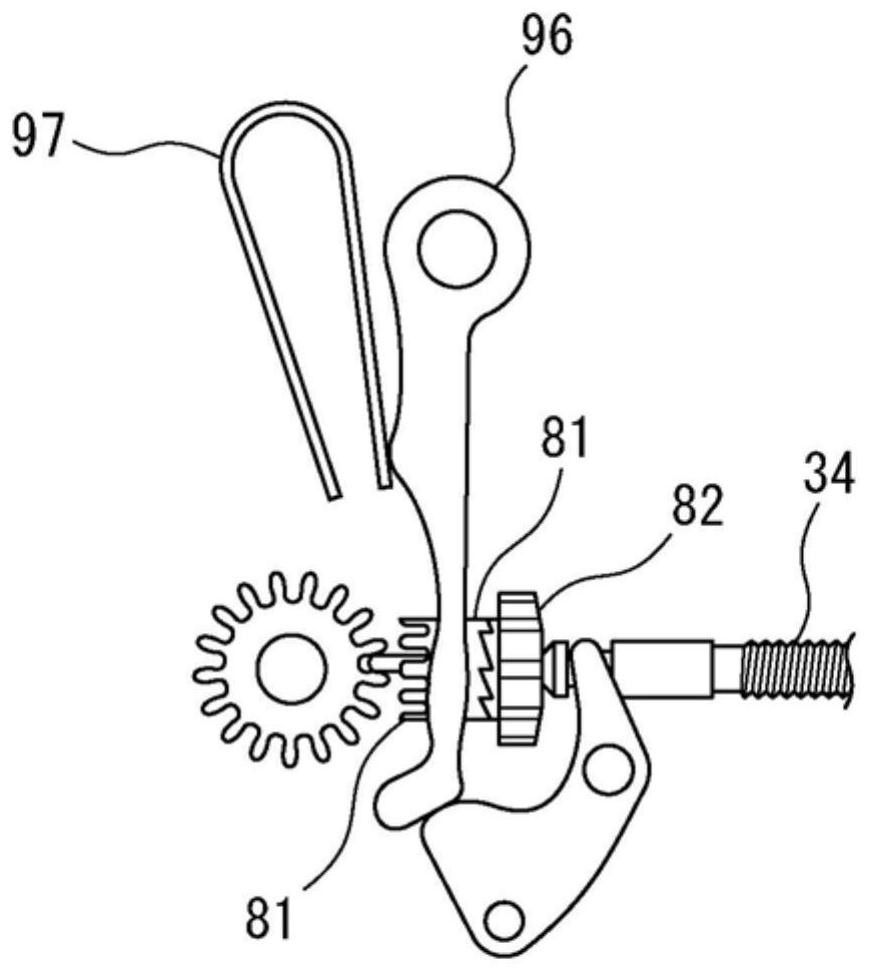
[0033] The stem 34 is a shaft-shaped member screwed to the crown, and rotates in the circumferential direction in conjunction with the rotation of the crown. On the stem 34 , a clutch wheel 81 is fitted so as to be slidable in the axial direction of the stem 34 , and a vertical wheel 82 is fitted so as to be rotatable in the circumferential direction of the stem 34 . In the first state, when the stem 34 rotates in...
no. 2 Embodiment approach
[0053] The timepiece of the second embodiment is different from the timepiece 1 of the first embodiment in the configuration of the operation portion 32 and the engagement portion 33 of the crown 3 . Next, use Figure 10 , the crown 3a of the timepiece of the second embodiment will be described.
[0054] Figure 10 It is a sectional view of the vicinity of the crown 3a of the timepiece of the second embodiment. The crown 3 a of the second embodiment includes a shaft portion 31 , an operation portion 35 , and an engagement portion 36 . Furthermore, Figure 10 The section shown is along the Figure 7-Figure 9 same line as shown in section, but Figure 10 omitted in Figure 7-Figure 9 There are illustrations of the housing 20 , the stem 34 , the back cover holder 62 , and the second bushing 72 as shown. In addition, the same code|symbol is attached|subjected to the same structure as 1st Embodiment, and description is abbreviate|omitted as appropriate.
[0055] The operati...
PUM
 Login to View More
 Abstract
Description
Claims
Application Information
 Login to View More