Check patentability & draft patents in minutes with Patsnap Eureka AI!

Quantized matrix adjusting method for improving quality of video

A technology of quantization matrix and adjustment method, which is applied in image communication, image coding, image data processing, etc., can solve problems such as inability to generate enough bits, increase filling bits, and small quantization scale factor, so as to improve image quality and avoid Estimate the effect of quantization scale factor being too low, avoiding blockiness

Inactive Publication Date: 2007-03-07
SILICON INTEGRATED SYSTEMS
View PDF3 Cites 0 Cited by
  • Summary
  • Abstract
  • Description
  • Claims
  • Application Information

AI Technical Summary

Problems solved by technology

However, when the sequence of video is simple and the target bit rate is high, the quantization scale factor can be made very small to produce more bits
Even when the video is really simple, even if the quantization scale factor Q is set to 1, it cannot generate enough bits, so that it needs to increase the stuffing bits, which wastes the bit rate
In addition, when the average quantization scale factor Avg_Q is 1.5, the most appropriate quantization scale factor for most macroblocks should be 1.5, but 1 or 2 must be selected

Method used

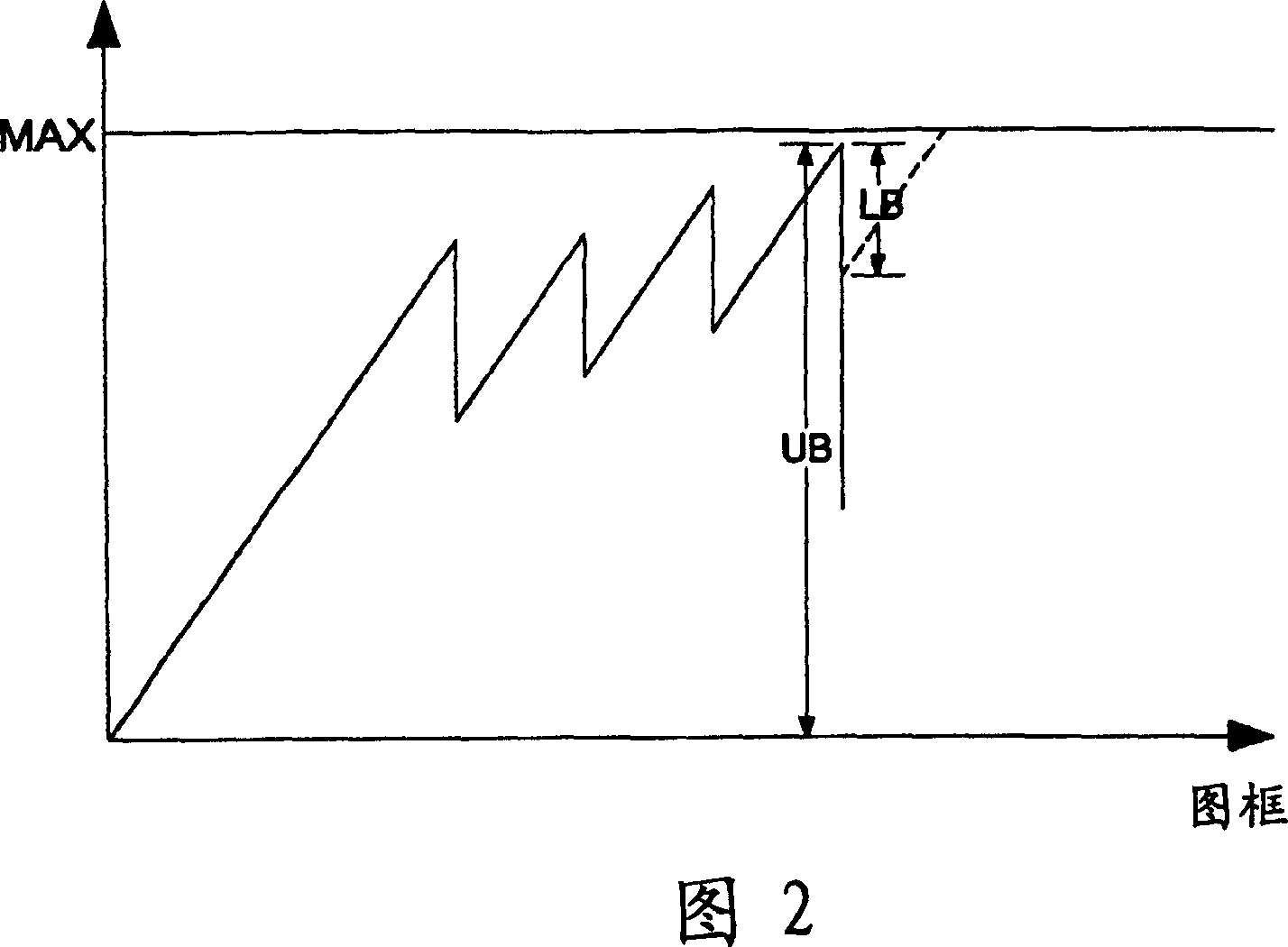
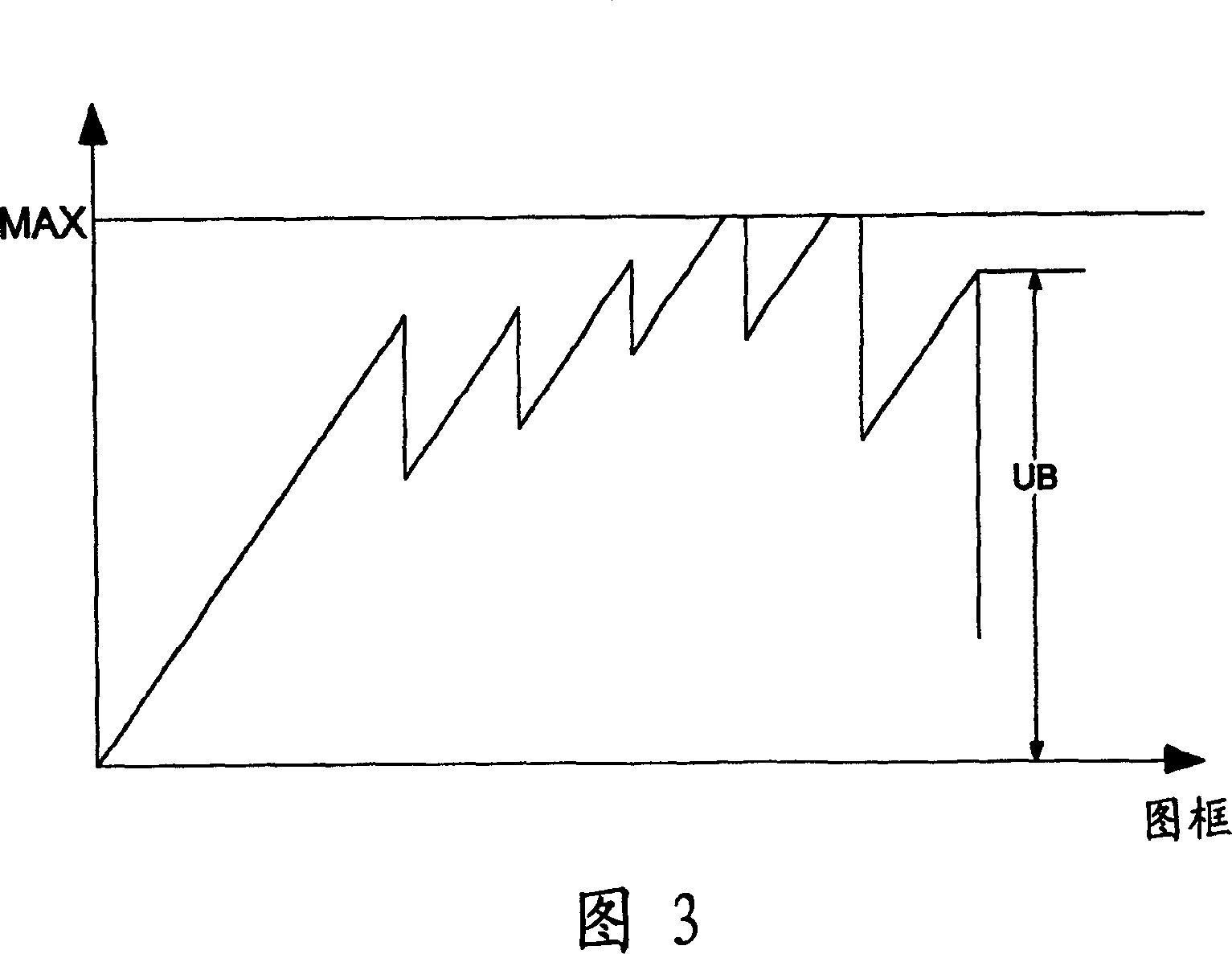
the structure of the environmentally friendly knitted fabric provided by the present invention; figure 2 Flow chart of the yarn wrapping machine for environmentally friendly knitted fabrics and storage devices; image 3 Is the parameter map of the yarn covering machine
View more

Image

Smart Image Click on the blue labels to locate them in the text.
Viewing Examples
Smart Image
  • Quantized matrix adjusting method for improving quality of video
  • Quantized matrix adjusting method for improving quality of video
  • Quantized matrix adjusting method for improving quality of video

Examples

Experimental program
Comparison scheme
Effect test

Embodiment Construction

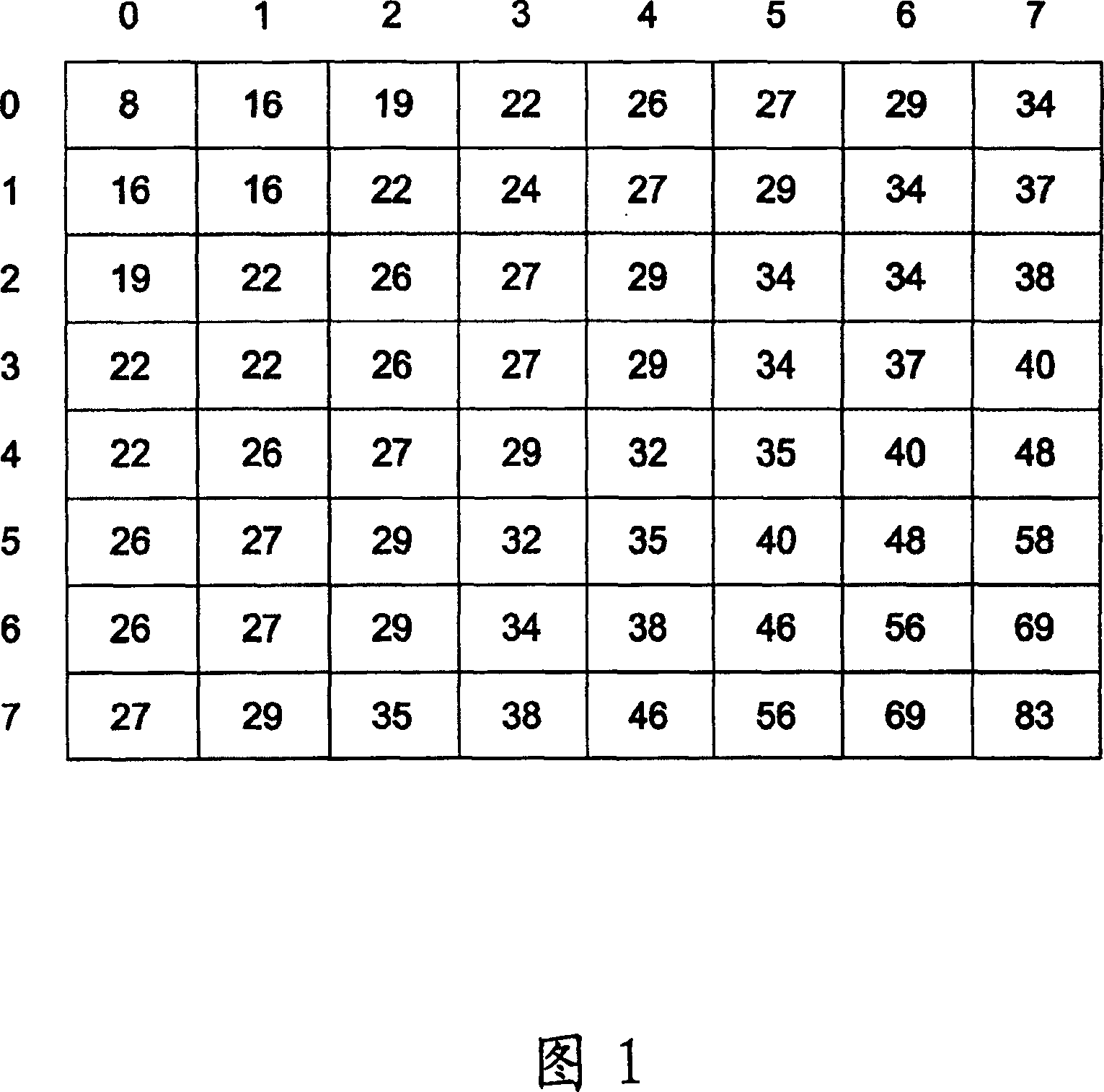
[0052] When the calculated estimated quantization scale factor EstQ_C of the current image becomes very small and the current image is coded with a preset quantization matrix, a slight visible block effect will occur in the flat image area. To solve this problem, the encoder of the present invention reduces the weighting of the quantization matrix to adjust the estimated quantization scale factor EstQ_C to a larger value. For example, as shown in formula (1), when the preset quantization matrix W[v][u] is reduced to 1 / 4, the average quantization scale factor Avg_Q can be enlarged from 1.5 to 6, and the quantization scale factor Q can be increased at this time 7 or 8 to reduce bit rate consumption, or lower to 5 or 4 to increase bit rate consumption. Therefore, the quantization error of adjacent macroblocks can be greatly reduced.

[0053] In the MPEG-1 and MPEG-2 specifications, a sequence header must be configured at the beginning of each coded bitstream, and the sequence he...

the structure of the environmentally friendly knitted fabric provided by the present invention; figure 2 Flow chart of the yarn wrapping machine for environmentally friendly knitted fabrics and storage devices; image 3 Is the parameter map of the yarn covering machine
Login to View More

PUM

No PUM Login to View More

Abstract

It is a kind of quantification matrix adjusting method that can improve the image quality. It comprises the following steps: updating the used bit amount and average quantification ratio factor; appointing the bit precalculating value of the current image; calculating and estimating the quantification ratio factor according to the used bit amount, average quantification ratio factor and bit precalculating value; judging that whether enters the adjustment mode: when the estimated quantification ratio factor less than the threshold value of quantification ratio factor, the encoding mode is set as adjustment mode, otherwise it is general mode; adjusting the Quantize Matrix: when the encoding mode is set as adjustment mode, it reduces the predetermined Quantize Matrix; encoding: if the encoding mode is set as adjustment mode, encoding based on the reduced Quantize Matrix, if the encoding mode is general mode, encoding based on the predetermined Quantize Matrix. For the reduction of predetermined Quantize Matrix in the adjustment mode, it can avoid the underestimation of quantification ratio factor, at the same time boost the image quality.

Description

technical field [0001] The invention relates to a quantization matrix adjustment method for improving image quality. Background technique [0002] In order to reduce the amount of video data, generally the video is compressed, such as video coding in MPEG format. The basic unit of image coding is a macro-block. If the sampling format is 4:2:0, each macroblock has 6 blocks, namely 4 Y blocks, one Cb block, and one Cr block. Each block must first undergo a discrete cosine transform (hereinafter referred to as DCT), and then the DCT coefficients (coefficients) are quantized into integers (integers). A zigzag scan or other alternative scan method is used to arrange the two-dimensional array of quantized coefficients into one-dimensional data. Finally, so-called variable-length coding (variable-length coding, hereinafter referred to as VLC) is used to perform entropy coding. [0003] In general, the quantization of DCT coefficients F[v][u] can be expressed as: [0004] QF[v]...

Claims

the structure of the environmentally friendly knitted fabric provided by the present invention; figure 2 Flow chart of the yarn wrapping machine for environmentally friendly knitted fabrics and storage devices; image 3 Is the parameter map of the yarn covering machine
Login to View More

Application Information

Patent Timeline
no application Login to View More
IPC IPC(8): H04N7/50G06T9/00G06F17/16H04N19/126H04N19/61
Inventor 张永清
Owner SILICON INTEGRATED SYSTEMS
Features
  • R&D
  • Intellectual Property
  • Life Sciences
  • Materials
  • Tech Scout
Why Patsnap Eureka
  • Unparalleled Data Quality
  • Higher Quality Content
  • 60% Fewer Hallucinations
Social media
Patsnap Eureka Blog
Learn More