
Intravenous administration of tramadol
a tramadol and intravenous technology, applied in the direction of pharmaceutical delivery mechanism, medical preparations, etc., can solve the problems of increased incidence of minor adverse events, inability to obtain dosage forms in the usa, and increased consumption of tramadol, so as to improve the safety and tolerability of tramadol, reduce fluctuation, and reduce the effect of at least one side
- Summary
- Abstract
- Description
- Claims
- Application Information
AI Technical Summary
Benefits of technology
Problems solved by technology
Method used
Image

Examples
example 1
[0126]In Example 1, a pharmacokinetic (PK) study in healthy volunteers was conducted to evaluate the relative exposure of two intravenous (IV) dose regimens of tramadol compared to the approved 100 mg Q6 h oral dose regimen of tramadol. The two tramadol IV dosing regimens were based on various pharmacokinetic (PK) simulations done prior to the study, and it was determined that the following were appropriate for evaluation: (1) 75 mg IV REGIMEN: IV tramadol 75 mg administered at Hour 0, followed by 75 mg at Hour 3 and Hour 6, and 75 mg every 6 hours thereafter through Hour 42; (2) 50 mg IV REGIMEN: IV tramadol 50 mg administered at Hour 0, followed by 50 mg at Hour 2, 50 mg at hour 4, and 50 mg every 4 hours thereafter through Hour 44. These two IV dosing regimens were studied in a multiple-dose, randomized, PK 3-way crossover study in 18 healthy volunteers, each of whom also received 100 mg oral tramadol given every 6 hours during one of the periods through Hour 42.
[0127]Examination...
example 2
[0147]This invention is further described below with respect to data prospectively generated as set forth below. Example 2 depicts a 25 mg intravenous dose of tramadol 25 mg at Hour 0, followed by 25 mg tramadol at Hour 2, 25 mg tramadol at hour 4, and 25 mg tramadol every 4 hours thereafter through Hour 44. The 25 mg IV dose plasma concentrations and pharmacokinetic parameters were based on data generated in Example 1, assuming dose proportionality from the 50 mg IV dose and a % CV which independent of magnitude. The software used are plots of plasma-concentration vs. time for both tramadol and o-desmethyltramadol created in Phoenix WinNonlin 6.4. Tables were generated using both Microsoft Word and Excel.
[0148]Table 4 provides plasma pharmacokinetic parameters of intravenous tramadol 25 mg dosing regimen.
[0149]
TABLE 425 mg IVParameternMeanSDCV %Tmax (h)1430.0219.8966.27Cmax (ng / mL)143687620.60C1h (ng / mL)141222318.56T2 (ng / mL)141021615.59T3 (ng / mL)————T6 (ng / mL)————Tmax(0-2) (h)140....
example 3
[0152]This invention is further described below in an alternate embodiment with respect to data prospectively generated as set forth below. Example 3 depicts a 25 mg intravenous dose of tramadol 25 mg at Hour 0, followed by 50 mg tramadol at Hour 2, 25 mg tramadol at hour 4, and 25 mg tramadol every 4 hours thereafter through Hour 44.
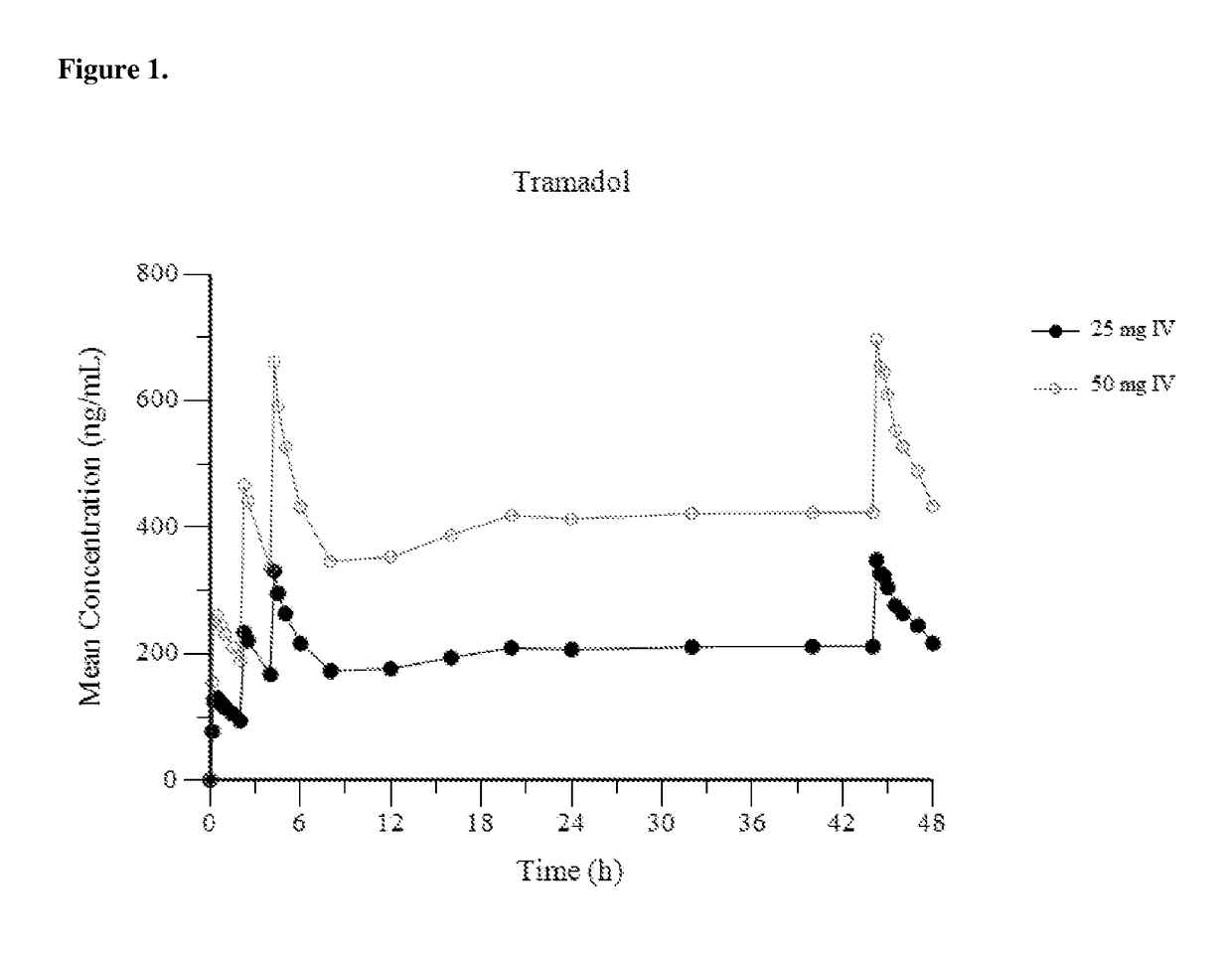
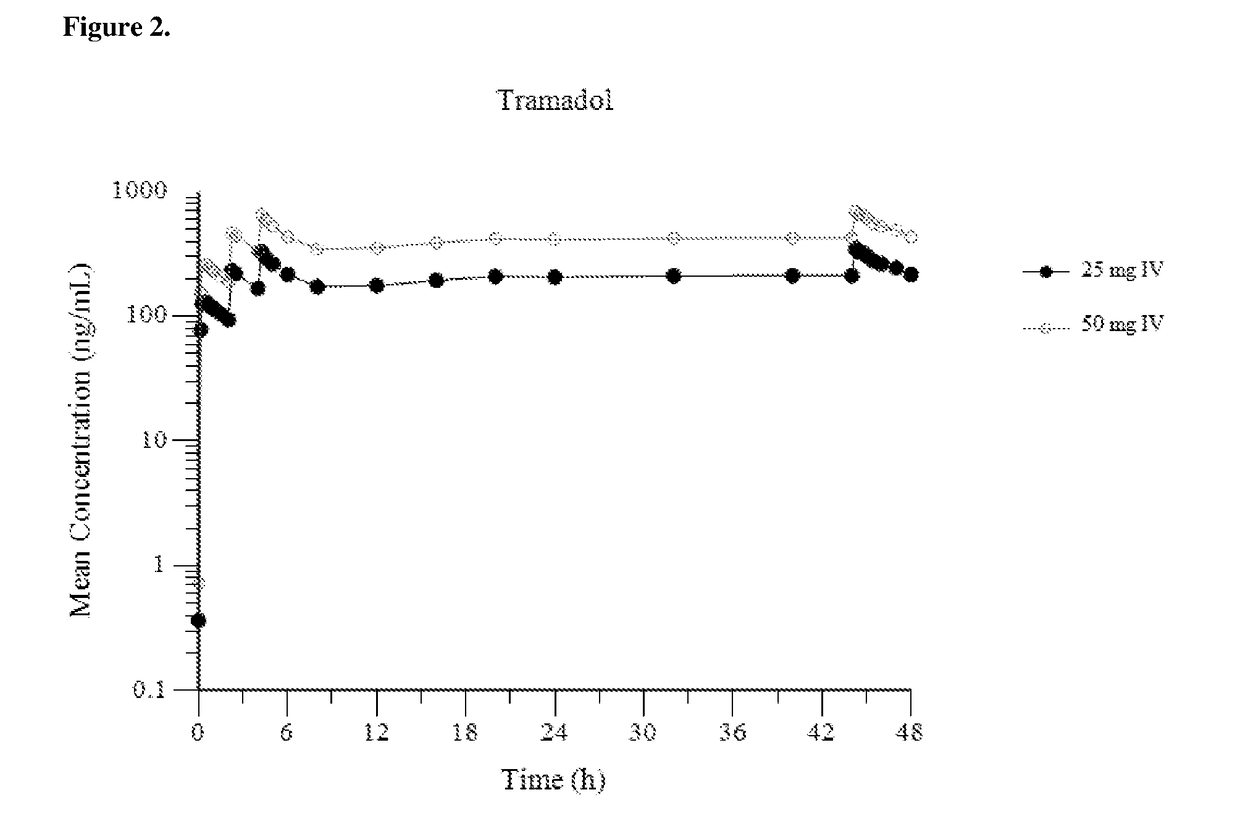
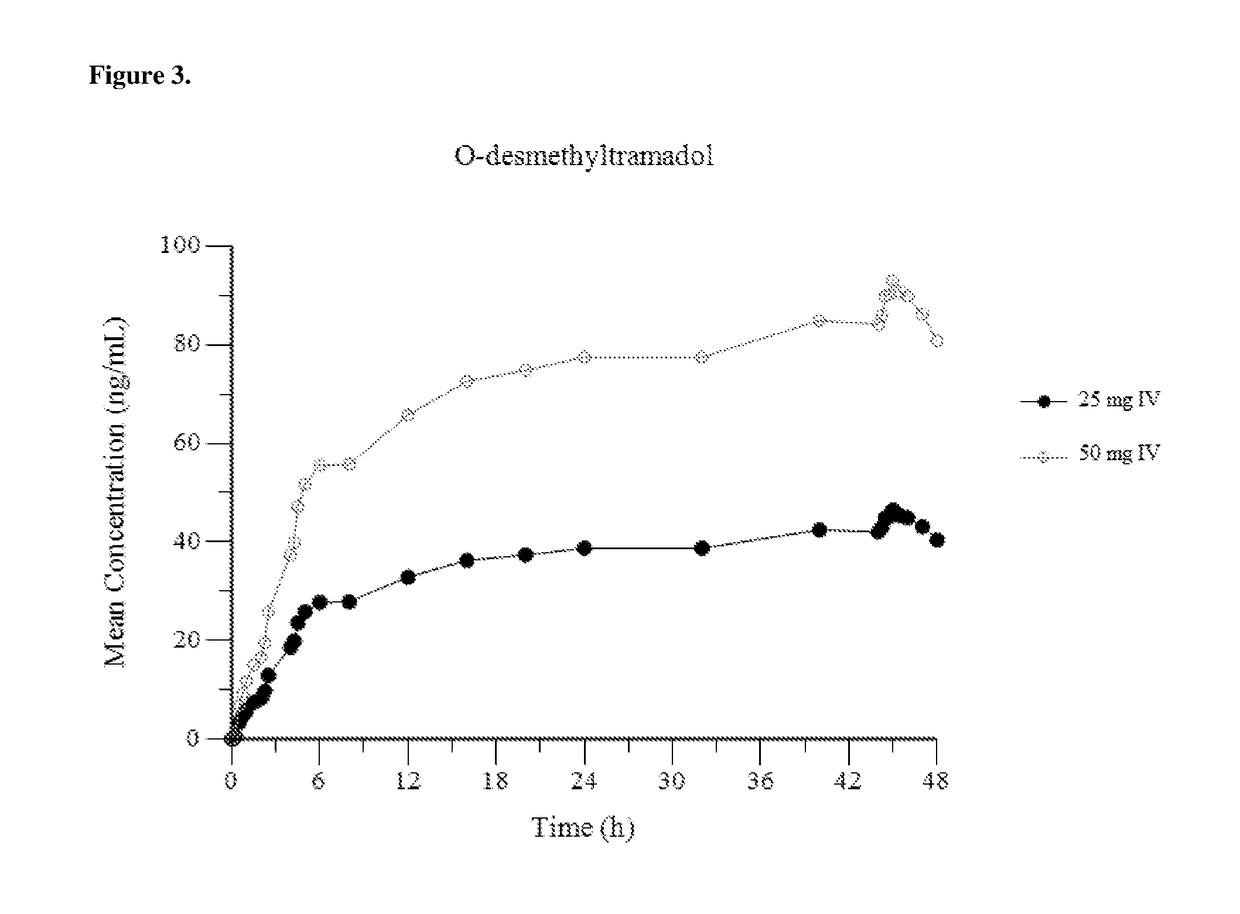
[0153]FIG. 1 provides a mean plasma concentration-time profile (linear scale) for intravenous tramadol administered at a dose of 25 mg at Hour 0, followed by 50 mg at Hour 2, 25 mg at hour 4, and 25 mg every 4 hours thereafter through Hour 44; and comparatively provides a mean plasma concentration-time profile (linear scale) for intravenous tramadol administered at a dose of 50 mg at Hour 0, followed by 50 mg at Hour 2, 50 mg at hour 4, and 50 mg every 4 hours thereafter through Hour 44. FIG. 2 provides a mean plasma concentration-time profile (log scale) for intravenous tramadol administered at a dose of 25 mg at Hour 0, followed by 50 mg at Hour 2, 25...
PUM
| Property | Measurement | Unit |
|---|---|---|
| time | aaaaa | aaaaa |
| concentration | aaaaa | aaaaa |
| volumes | aaaaa | aaaaa |
Abstract
Description
Claims
Application Information
 Login to View More