Unlock instant, AI-driven research and patent intelligence for your innovation.

System and method for inputting images or labels into electronic devices

a technology of electronic devices and labels, applied in the field of systems and methods for inputting images/labels into electronic devices, can solve the problems of difficult to categorize emojis, remain difficult to do, and be more difficult for users to decide in which category

Active Publication Date: 2020-05-26
MICROSOFT TECH LICENSING LLC
View PDF23 Cites 0 Cited by
  • Summary
  • Abstract
  • Description
  • Claims
  • Application Information

AI Technical Summary

Benefits of technology

The present invention offers various systems, methods, and a computer program related to a new technology. The technical effects of the invention are the subject of dependent claims.

Problems solved by technology

Although it is popular to input emojis, it remains difficult to do so, because the user has to discover appropriate emojis and, even knowing the appropriate emoji, has to navigate through a great number of possible emojis to find the one they want to input.
Furthermore, some emojis may not be easily classified, making it more difficult for the user to decide in which category they should search for that emoji.

Method used

the structure of the environmentally friendly knitted fabric provided by the present invention; figure 2 Flow chart of the yarn wrapping machine for environmentally friendly knitted fabrics and storage devices; image 3 Is the parameter map of the yarn covering machine
View more

Image

Smart Image Click on the blue labels to locate them in the text.
Viewing Examples
Smart Image
  • System and method for inputting images or labels into electronic devices
  • System and method for inputting images or labels into electronic devices
  • System and method for inputting images or labels into electronic devices

Examples

Experimental program
Comparison scheme
Effect test

first embodiment

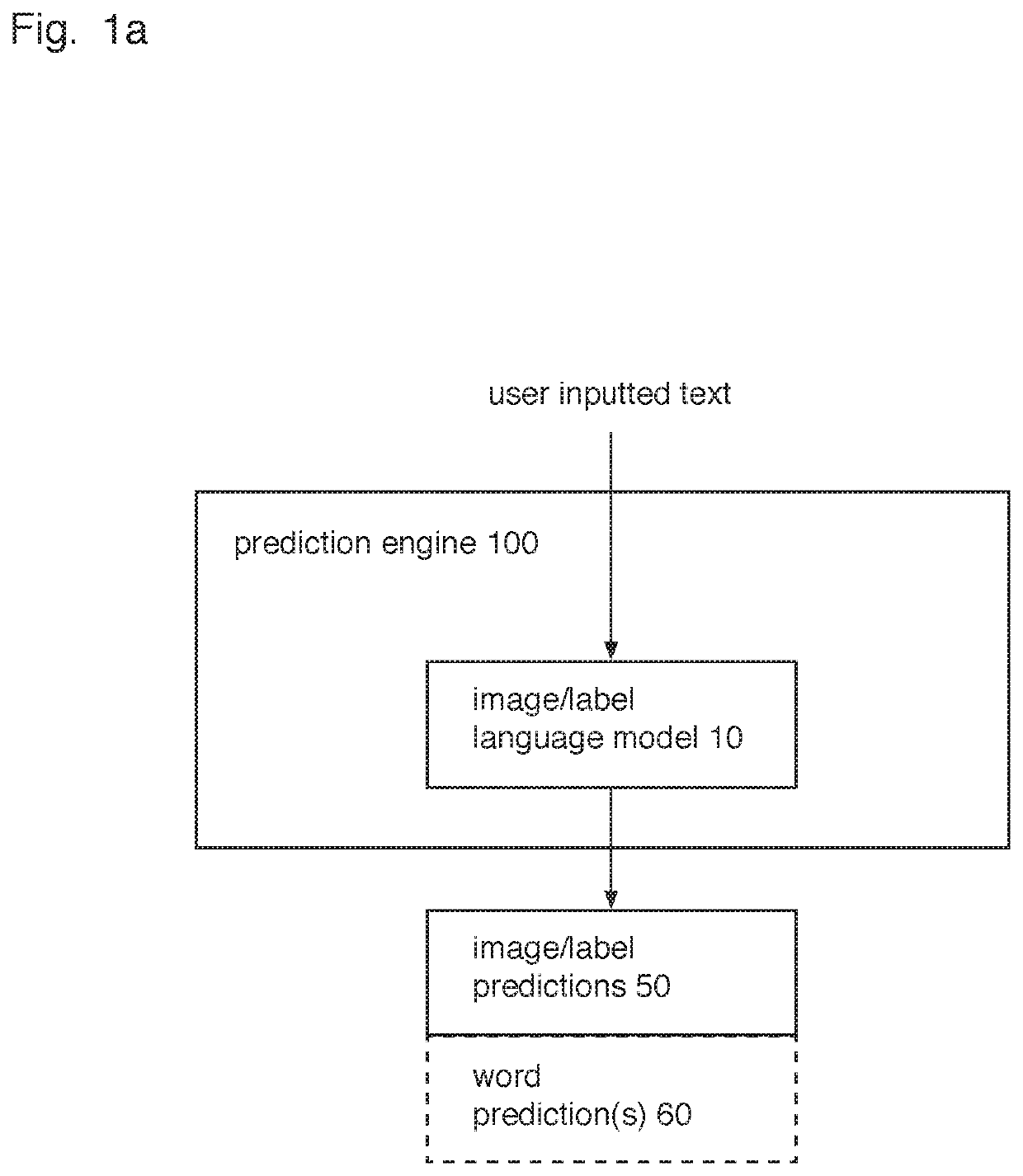
[0037]In a first embodiment illustrated in FIG. 2a, the language model comprises a trie 13 (an example of an input model) and a word-based n-gram map 14 (an example of a context model) to generate word predictions from current input 11 and context 12 respectively. The first part of this language model corresponds to that discussed in detail in WO 2010 / 112841, and in particular as described in relation to FIG. 2a-2d WO 2010 / 112841. The language model of FIG. 2a of the present invention can also include an intersection 15 to compute a final set of word predictions 60 from the predictions generated by the trie 13 and n-gram map 14. As described in detail on line 4 of page 16 to line 14 of page 17 of WO 2010 / 112841, the trie 13 can be a standard trie (see FIG. 3 of WO 2010 / 112841) or an approximate trie (see FIG. 4a of WO 2010 / 112841) which is queried with the direct current word-segment input 11. Alternatively, the trie 13 can be a probabilistic trie which is queried with a KeyPressVec...

second embodiment

[0042]Examples of n-gram maps 14′ of the second embodiment are illustrated schematically in FIGS. 3 and 4, where for illustrative purposes an emoji has been chosen for the image / label.

[0043]The n-gram map 14′ of FIG. 3 has been trained on source data comprising images / labels embedded in sections of text. For example, the language model could be trained on data from twitter, where the tweets have been filtered to collect tweets comprising emojis. In the n-gram map 14′ of FIG. 3, the emojis (which are used merely as an example for the image / label) are treated like words to generate the language model, i.e. the n-gram context map comprises emojis in the context in which they have been identified. For example, if the source data comprises the sentence “I am not happy about this ”, the emoji will only follow its preceding context, e.g. if the n-gram has a depth of four “happy about this ”. The language model will therefore predict the emoji if the context 12 fed into the language model...

third embodiment

[0104]FIG. 6 illustrates a system in accordance with the invention that comprises a classifier 100″ to generate image / label predictions 50 that are relevant to user inputted text 12′. A classifier 100″ for generating text predictions has been described in detail in WO 2011 / 042710, which is hereby incorporated by reference in its entirety. In machine learning and statistics, classification is the problem of identifying to which of a set of categories (sub-populations) a new observation belongs, on the basis of a training set of data containing observations (or instances) whose category membership is known. The classifier 100″ is the feature that implements classification, mapping input data to a category. In the present invention, the classifier 100″ is configured to map user inputted text to image / labels.

[0105]The classifier 100″ is trained on text data that has been pre-labelled with images / labels, and makes real-time image / label predictions 50 for sections of text 12 entered into ...

the structure of the environmentally friendly knitted fabric provided by the present invention; figure 2 Flow chart of the yarn wrapping machine for environmentally friendly knitted fabrics and storage devices; image 3 Is the parameter map of the yarn covering machine
Login to View More

PUM

No PUM Login to View More

Abstract

System and techniques for receiving text input into electronic devices and predicting a relevant image or label. In a first aspect, the system and techniques comprise receiving text input by a user and a prediction function trained on sections of text associated with an image or label. The prediction function is configured to receive the text input by the user, determine the relevance of the text input by the user to the sections of text associated with the image or label, and predict, based on the sections of text associated with the image or label the relevance of the image or label to the text input by the user. The systems and techniques reduce the burden of entering an image or label.

Description

CROSS-REFERENCE TO RELATED APPLICATIONS[0001]This application is a continuation of International Application No. PCT / GB2014 / 053688, filed on Dec. 12, 2014, which claims priority to Great Britain Patent Application No. 1322037.1, filed on Dec. 12, 2013, the disclosures of which are incorporated herein by reference in their entireties.[0002]This application is also a continuation-in-part of U.S. patent application Ser. No. 14 / 758,221, filed on Jun. 26, 2015, which is a U.S. National Stage Entry of International Application No. PCT / GB2013 / 053433, filed on Dec. 27, 2013, which claims priority to Great Britain Patent Application No. 1223450.6, filed on Dec. 27, 2012, the disclosures of which are incorporated herein by reference in their entireties.FIELD OF THE INVENTION[0003]The present invention relates to a system and method for inputting images / labels into an electronic device. In particular, the invention relates to a system and method for offering an image / label to be input into a d...

Claims

the structure of the environmentally friendly knitted fabric provided by the present invention; figure 2 Flow chart of the yarn wrapping machine for environmentally friendly knitted fabrics and storage devices; image 3 Is the parameter map of the yarn covering machine
Login to View More

Application Information

Patent Timeline
no application Login to View More
Patent Type & Authority Patents(United States)
IPC IPC(8): G06F40/274G06F3/023G06F3/0482G06F16/2452G06F3/0481G06F16/332G06F16/335G06F16/242
CPCG06F3/0482G06F3/0237G06F40/274G06F16/3329G06F3/04817G06F16/2448G06F16/335G06F16/243G06F16/24522
Inventor ALEY, JAMESJONES, GARETHHEWITT, LUKE
Owner MICROSOFT TECH LICENSING LLC