
Cosmetic formulations
a formulation and cosmetic technology, applied in the field of hair shampoos, can solve the problems of pearlescence loss, limited formulation possibilities of these products,
- Summary
- Abstract
- Description
- Claims
- Application Information
AI Technical Summary
Benefits of technology
Problems solved by technology
Method used
Image


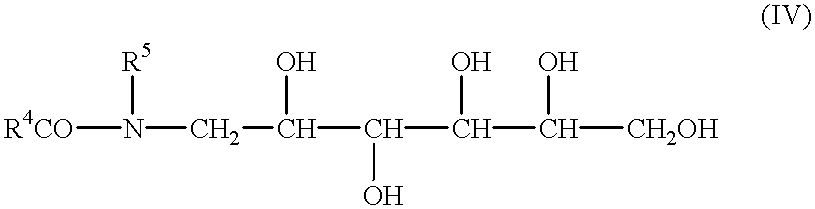
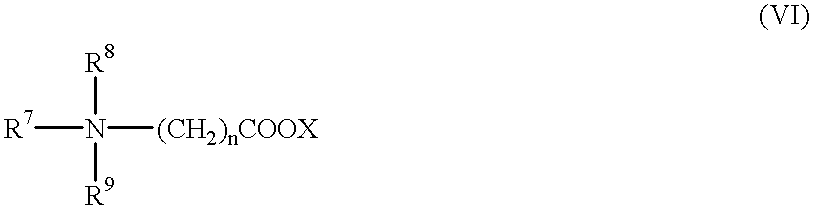
Examples
examples
[0076] The test formulations were stored for 14 days at 20.degree. C. and were then subjectively evaluated for stability in storage and pearlescence. For stability in storage, (+++) means unchanged, (++) means barely noticeable clouding, (+) means distinct clouding and (-) means sedimentation of the cationic polymer. For pearlescence, (+++) means brilliant, (++) means moderately brilliant and (+) means dull. The conditioning effect was determined via the wet combability of hair tresses. To this end, the combing work in mV was measured for an untreated tress of hair and for an identical tress treated with the test solution. The result is expressed as the difference between these two values as the average of three determinations. The greater the difference, the more distinctly combing work is reduced and hence combability is improved. Dermatological compatibility was determined as the total irritation score against a standard formulation. The results are set out in Table 1. Formulatio...
PUM
| Property | Measurement | Unit |
|---|---|---|
| Length | aaaaa | aaaaa |
| Length | aaaaa | aaaaa |
| Percent by mass | aaaaa | aaaaa |
Abstract
Description
Claims
Application Information
 Login to View More