Electronic camera

a technology of electronic cameras and camera bodies, applied in the field of electronic cameras, can solve the problems of inability to easily erase image data from the recording medium, poor usability of electronic cameras, and photographer's tedious operation sequence, etc., and achieve the effect of systematically aborting the recording of image data

Inactive Publication Date: 2005-10-20
OLYMPUS CORP
View PDF5 Cites 10 Cited by
  • Summary
  • Abstract
  • Description
  • Claims
  • Application Information

AI Technical Summary

Benefits of technology

This solution enhances usability by allowing photographers to efficiently manage and record only necessary images, reducing unnecessary data storage and improving the overall handling of image data during capturing sessions.

Problems solved by technology

Therefore, even if it is determined from the confirmation of a captured image through the rec-view function that image data of the captured image need not be stored on a recording medium such as a memory card, the image data cannot be readily erased from the recording medium.
In other words, the photographer is involved in a sequence of tedious operations including once switching the electronic camera to an erasure mode and performing an erasure operation.
Also, when an attempt is made to apply the rec-view function as it is to sequential capturing (continuous capturing) in which a plurality of images are sequentially captured at short regular time intervals, the electronic camera will present significantly poor usability.
Specifically, captured images are sequentially displayed on a one-by-one basis on the screen at short time intervals corresponding to the sequential capturing, so that the photographer cannot sufficiently confirm the respective captured images.
If captured images are displayed in the manner mentioned above, the photographer will experience extreme difficulties in distinguishing images which should be recorded on a recording medium from images which need not be recorded on the recording medium.
The difficulties further lead to difficulties in recording only image data of images, which should be recorded, on a recording medium.
Also, when a plurality of images are sequentially captured at short time intervals in a normal capturing mode (hereinafter referred to as the “quick capturing”), the photographer would suffer from an extremely poor usability of the rec-view function, if it is applied as it is.
Specifically, captured images are sequentially displayed on the screen on one-by-one basis at short time intervals corresponding to the quick capturing, so that the photographer will feel an inconvenience in the inability of sufficiently confirming the respective captured images.
If captured images are displayed in the manner mentioned above, the photographer will experience extreme difficulties in distinguishing images which should be recorded on a recording medium from images which need not be recorded on the recording medium.
Further, unlike the sequential capturing, since the quick capturing is performed in a normal capturing mode, it is indefinite from which image to which image are handled as a set of images taken in a quick capturing sequence, in which case difficulties arise in handling image data for displaying and / or recording the images.

Method used

the structure of the environmentally friendly knitted fabric provided by the present invention; figure 2 Flow chart of the yarn wrapping machine for environmentally friendly knitted fabrics and storage devices; image 3 Is the parameter map of the yarn covering machine
View more

Image

Smart Image Click on the blue labels to locate them in the text.
Viewing Examples
Smart Image
  • Electronic camera
  • Electronic camera
  • Electronic camera

Examples

Experimental program
Comparison scheme
Effect test

embodiment 1

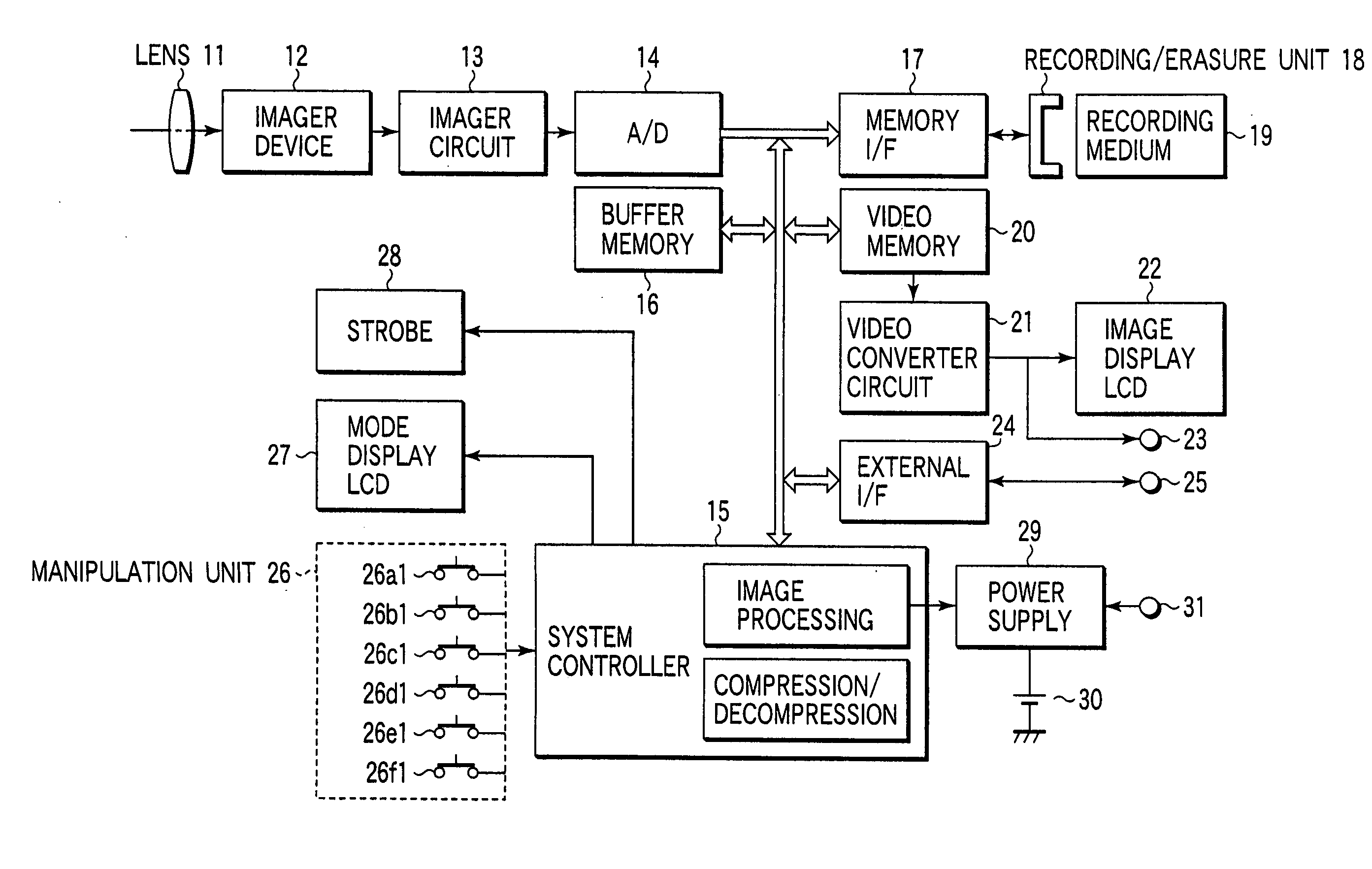
[0076] Embodiment 1 of the present invention will hereinafter be described with reference to the accompanying drawings. FIG. 1 is a block diagram illustrating an exemplary configuration of an electronic camera according to Embodiment 1.

[0077] An imaging unit basically has a similar configuration to that of an ordinary electronic camera, and comprises a lens 11; an imager device 12 comprised of an optoelectronic converting device such as CCD; an imager circuit 13; and an A / D converter circuit 14. More specifically, an object focused by the lens 11 is optoelectrically converted by the imager device 12, and an optoelectrically converted image signal is supplied to the A / D converter circuit 14 through the imager circuit 13 to produce a digitally converted image signal.

[0078] A system controller 15, which is responsible for controlling respective units of the electronic camera, has an image processing function for performing white balance processing, matrix operations, and the like, an...

embodiment 2

[0105] In the following, Embodiment 2 of the present invention will be described with reference to the accompanying drawings. FIG. 8 is a block diagram illustrating an exemplary configuration of an electronic camera according to Embodiment 2.

[0106] An imaging unit basically has a similar configuration to that of an ordinary electronic camera, and comprises a lens 11; an imager device 12 comprised of an optoelectronic converting device such as CCD; an imager circuit 13; and an A / D converter circuit 14. More specifically, an object focused by the lens 11 is optoelectrically converted by the imager device 12, and an optoelectrically converted image signal is supplied to the A / D converter circuit 14 through the imager circuit 13 to produce a digitally converted image signal.

[0107] A system controller 15, which is responsible for controlling respective units of the electronic camera, has an image processing function for performing γ conversion, white balance processing, matrix operatio...

embodiment 3

[0153] In the following, Embodiment 3 of the present invention will be described with reference to the accompanying drawings.

the structure of the environmentally friendly knitted fabric provided by the present invention; figure 2 Flow chart of the yarn wrapping machine for environmentally friendly knitted fabrics and storage devices; image 3 Is the parameter map of the yarn covering machine
Login to View More

PUM

No PUM Login to View More

Abstract

An electronic camera comprises imaging means for optoelectrically converting a subject image to generate electronic image data, temporary storage means for temporarily storing the image data produced by the imaging means, image display means for displaying an image based on the image data stored in the temporary storage means, recording means for recording the image data stored in the temporary storage means on a recording medium, erasing means for erasing the image data recorded on the recording medium, instructing means for instructing the recording means to abort recording on the recording medium of the image data stored in the temporary storage means or for instructing the era-sing means to erase the image data recorded on the recording medium, and control means for controlling the image display means to display thereon the image based on the image data stored in the temporary storage means for a predetermined period of time after capturing, for controlling the recording means to abort recording on the recording medium of the image data stored in the temporary storage means when an instruction is given from the instructing means while the recording means is recording the image data on the recording medium, and for controlling the erasing means to erase the image data recorded on the recording medium when an instruction is given from the instructing means after the recording means has recorded the image data on the recording medium.

Description

CROSS-REFERENCE TO RELATED APPLICATIONS [0001] This application is a divisional of U.S. application Ser. No. 09 / 651,770 filed Aug. 30, 2000, entitled ELECTRONIC CAMERA and is based upon and claims the benefit of priority from the prior Japanese Patent Applications No. 11-247856, Sep. 1, 1999; No. 11-247857, Sep. 1, 1999; and No. 11-247858, Sep. 1, 1999, the entire contents of which are incorporated herein by reference.BACKGROUND OF THE INVENTION [0002] Electronic cameras (digital cameras), unlike silver salt based cameras, feature the ability of confirming an image captured at the site the image has just been captured. There have been proposed electronic cameras which have a function of automatically displaying a captured image on LCD or the like just after the image is captured (hereinafter, referred to as the “rec-view function”), making good use of this feature. [0003] The rec-view function, however, is intended to automatically display captured images. Therefore, even if it is d...

Claims

the structure of the environmentally friendly knitted fabric provided by the present invention; figure 2 Flow chart of the yarn wrapping machine for environmentally friendly knitted fabrics and storage devices; image 3 Is the parameter map of the yarn covering machine
Login to View More

Application Information

Patent Timeline
no application Login to View More
Patent Type & AuthorityApplications(United States)
IPC IPC(8): H04N1/21H04N5/225H04N5/262
CPCH04N1/00925H04N1/2112H04N2201/218H04N1/2158H04N1/2137
InventorHIGUCHI, TATSUJITERANE, AKIO
OwnerOLYMPUS CORP