System and method for off-line multi-view video compression

a multi-view video and compression technology, applied in the field of multi-view video system and multi-view video, can solve the problems of not having the ability to select the viewing angle, not having the ability to exercise camera control, and watching what has been recorded and provided, so as to achieve the effect of broader network bandwidth and stronger computer processing power
US20060023782A1Inactive Publication Date: 2006-02-02MICROSOFT TECH LICENSING LLC

Patent Information

Authority / Receiving Office
US · United States
Patent Type
Applications(United States)
Current Assignee / Owner
MICROSOFT TECH LICENSING LLC
Publication Date
2006-02-02
Estimated Expiration
Not applicable · inactive patent

Smart Images

  • Figure 1
    Figure 1
  • Figure 2
    Figure 2
  • Figure 3
    Figure 3
Patent Text Reader

Abstract

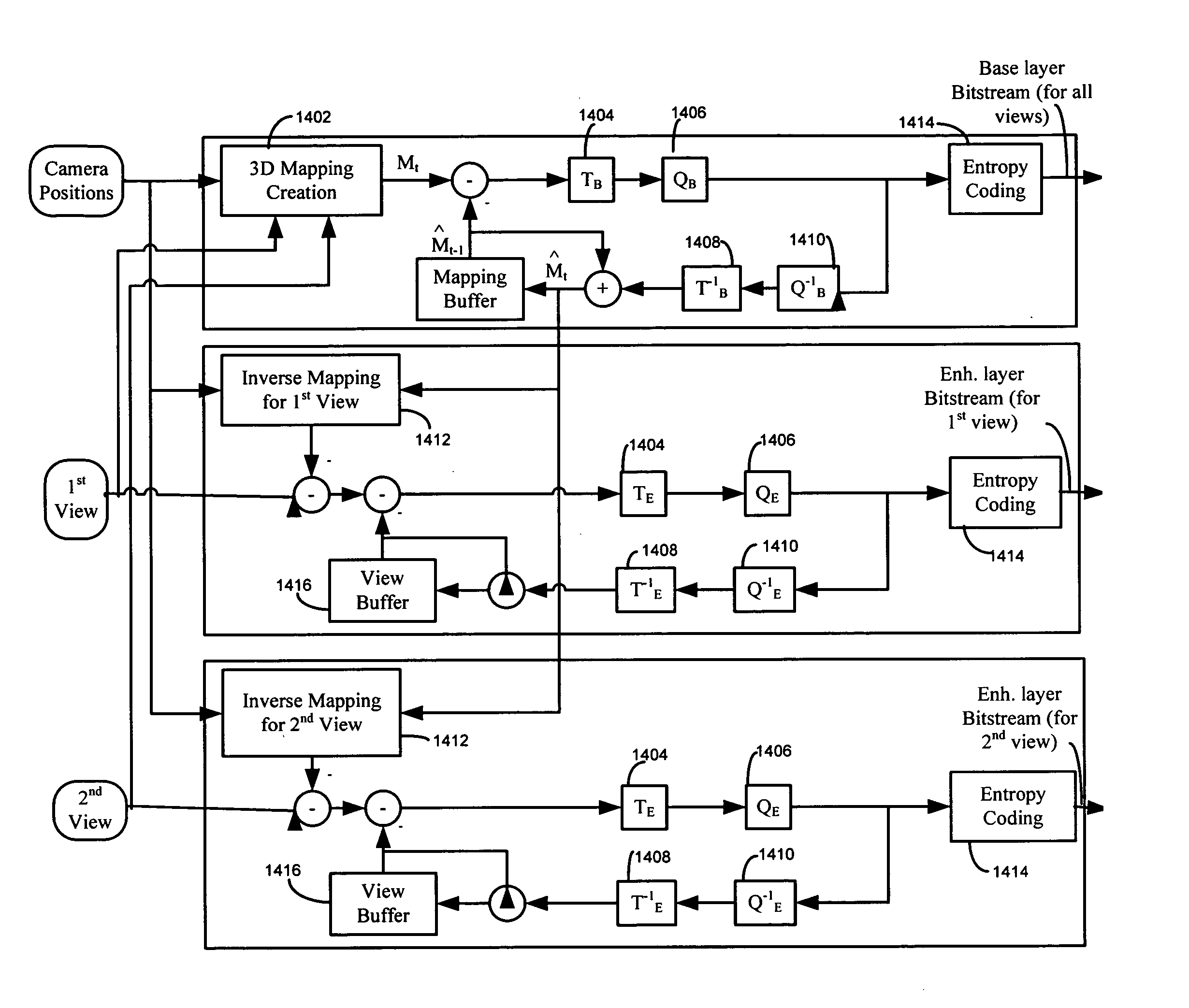
Interactive multi-view video presents new types of video capture systems, video formats, video compression algorithms, and services. Many video cameras are allocated to capture an event from various related locations and directions. The captured videos are compressed and are sent to a server in real-time. The compressed video can also be transcoded through an off-line compression approach to further reduce the data amount. A key idea of off-line compression is to decompose all views into a 3D mapping, which consists of a group of feature points in the 3D environment. Each feature point is represented by its 3D coordinates (x, y, z) and the corresponding color components (Y, U, V). The created mapping is the minimum set of feature points that can reconstruct all of the pixels in each view. After the 3D mapping creation, the obtained feature points are predicted and transformed to further decompose the correlations among them. The transformed results are quantized and encoded as a ‘base layer’ bit stream. The dequantized feature points are mapped back onto each view to form a predicted view image. The predicted image is close to the original one; however, there are still some differences between them. The difference is encoded independently as an ‘enhancement layer’ of each view image.
Need to check novelty before this filing date? Find Prior Art

Description

[0001] This is a continuation-in-part of application of application Ser. No. 10 / 901,477, filed Jul. 27, 2004.BACKGROUND

[0002] 1. Technical Field

[0003] This invention is directed toward a system and method for interactive multi-view video which includes a new type off-line video compression.

[0004] 2. Background Art

[0005] The current popularly used video form is so-called single-view video. It consists of one video clip that is captured from one video camera or multiple video clips that are concatenated using sequential time periods. For any time instance, there is only one view of an event. This kind of video form is widely used in video streaming, broadcasting and communication in televisions (TVs), personal computers (PCs) and other devices.

[0006] When reviewing conventional multimedia services (like traditional TV, video-on-demand, video streaming, digital video disc (DVD), and so on), there exist several limitations. For example, in conventional multimedia services, there is...

Claims

the structure of the environmentally friendly knitted fabric provided by the present invention; figure 2 Flow chart of the yarn wrapping machine for environmentally friendly knitted fabrics and storage devices; image 3 Is the parameter map of the yarn covering machine
Login to View More