
Tax attenuation and financing
- Summary
- Abstract
- Description
- Claims
- Application Information
AI Technical Summary
Benefits of technology
Problems solved by technology
Method used
Image

Examples
example 1
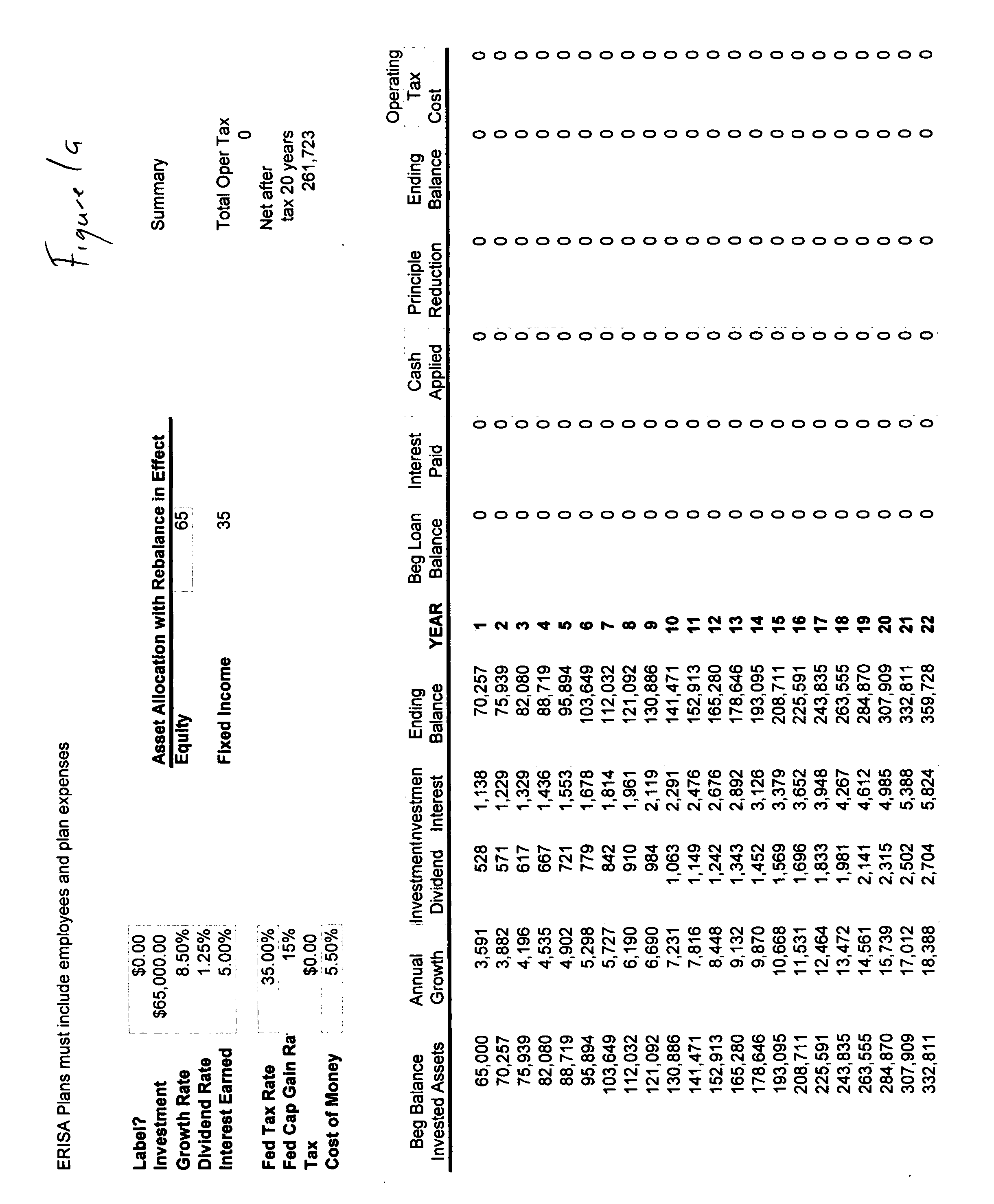
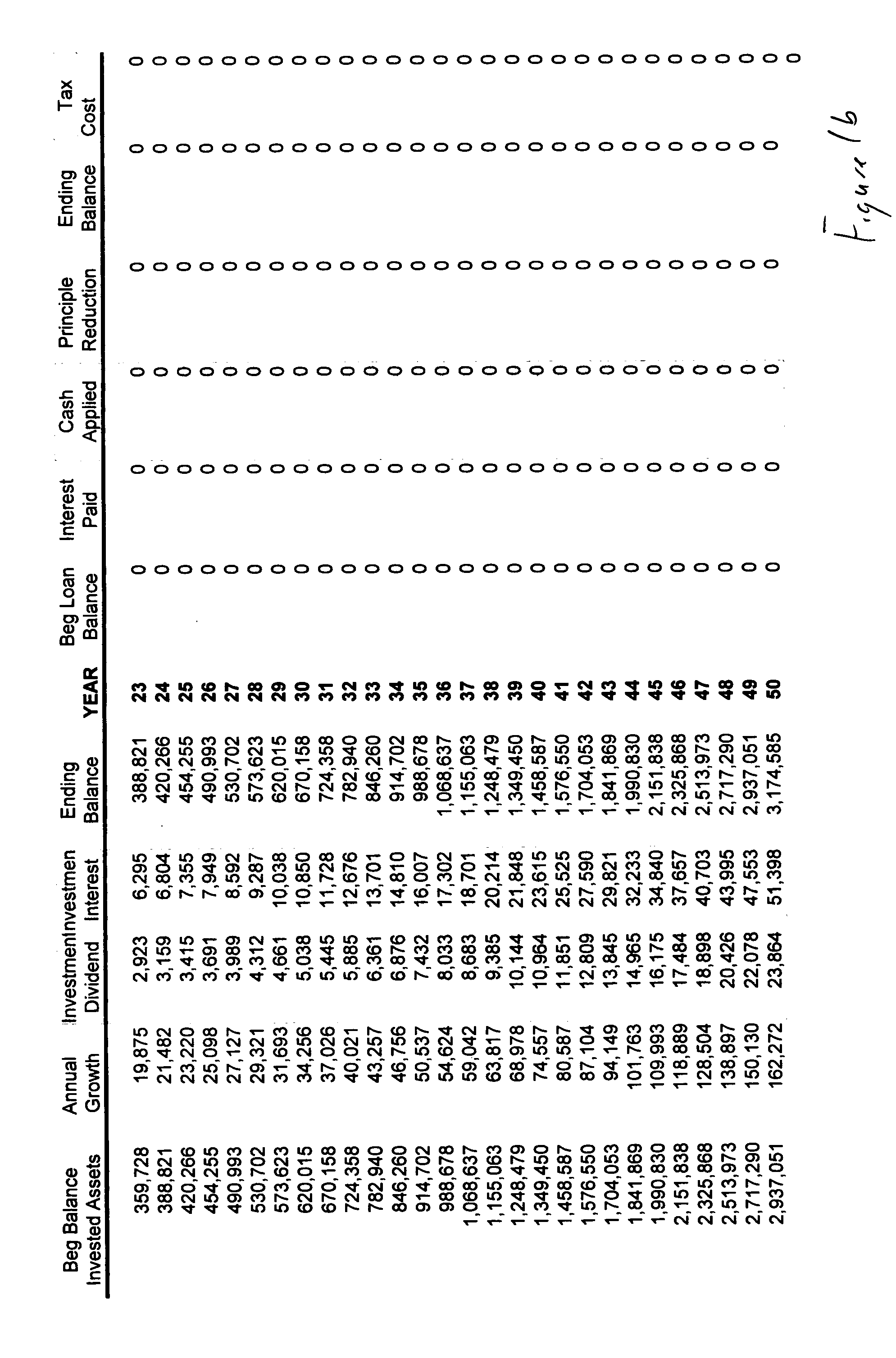
[0066] Referring to FIG. 1, a taxpayer pays the full ordinary federal income tax and, after paying the tax, the taxpayer has only 65% of his original wage left over to invest. More particularly, assume that the top dollars earned are in the 35% tax bracket and that the investor desires to save $100,000. In accordance with the tax liability, approximately 35% or $35,000 of tax liability is paid, leaving $65,000 to be invested. Assume that 65% is invested in equity and 35% in fixed income. Assuming an equity growth rate of 8.50%, a dividend rate of 1.25%, and a bond interest rate of 5.00%. It is seen that at the end of the tenth year, the $65,000 investment has grown to $141,471; at the end of the 20th year $307,090; and at the end of the 50th year $3,174,585.
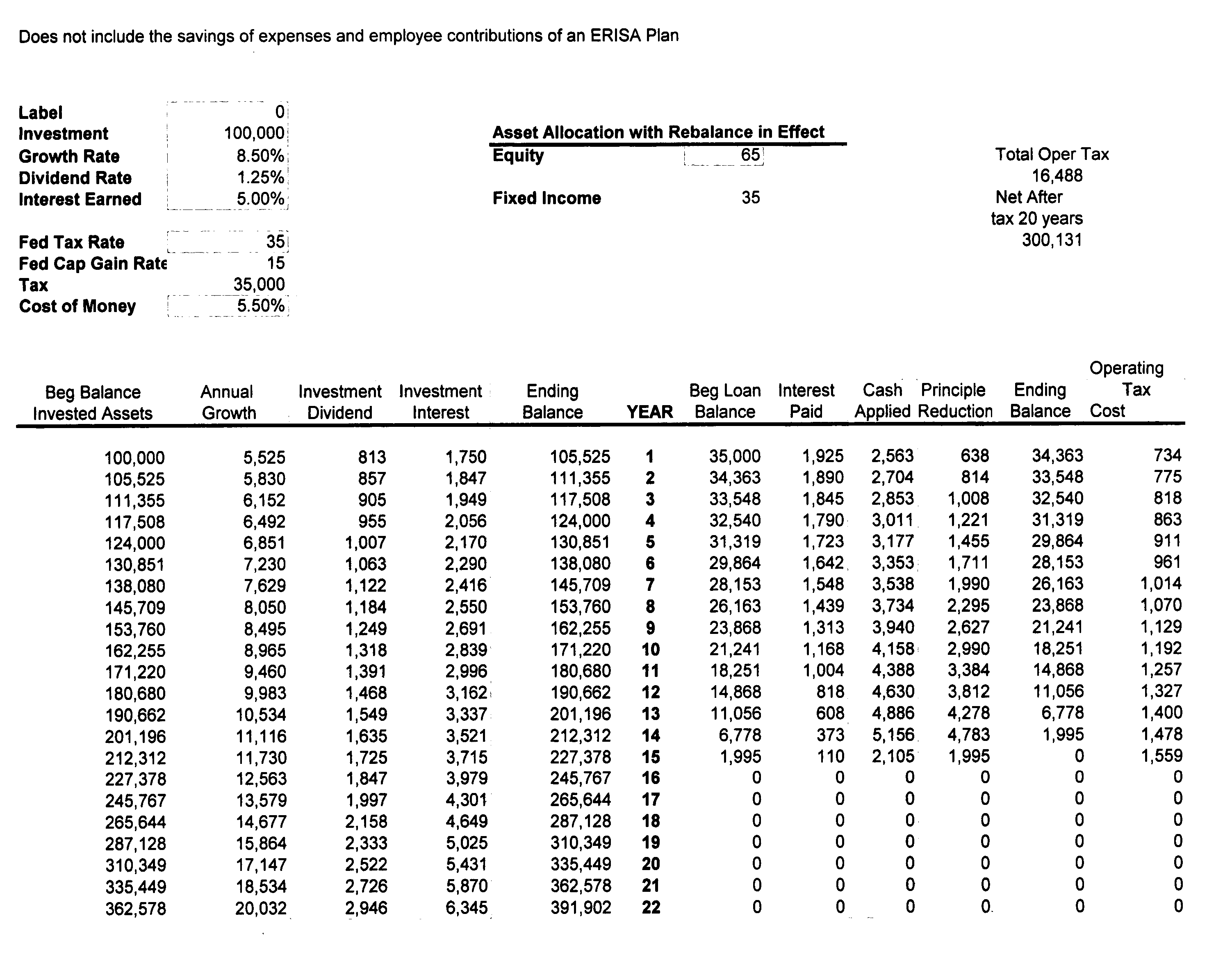
[0067] In FIG. 2, instead of paying the federal income tax from the earned wage the entire amount of the wage is invested and the amount of the tax is borrowed, with the investment account serving as collateral for the loan. Aga...
example 2
[0070] Referring to FIG. 3, a taxpayer has an event causing the recognition of a large capital gain and must suffer the attendant federal tax on capital gain. After paying the tax, the taxpayer has only 85% of his original gain left over to invest. More particularly, assume a capital gain of $100,000 is realized. In accordance with the tax liability, approximately 15% or $15,000 of tax liability is paid, leaving $85,000 to be invested. Assume that 65% is invested in equity and 35% in fixed income. Assume an equity growth rate of 8.50%, a dividend rate of 1.25%, and an interest rate of 5.00%. It is seen that at the end of the tenth year, the $85,000 investment has grown to $185,001; at the end of the 20th year $402,651; and at the end of the 50th year $4,151,380.
[0071] In FIG. 4, instead of paying the federal capital gains tax from the capital gains the entire amount of proceeds is invested and the amount of the tax is borrowed, with the investment account serving as collateral for ...
example 3
[0074] Many parents fret about how much money they must save or allocate for payment of college expenses. When the kids get to college, the parents simply brace themselves and pay it—either out of finds that they set up in the kids name or out of their own funds. A method in accordance with the present invention allows the user to set ratios as savings targets that can serve dual purposes. Through a method in accordance with the present invention funds can be used to meet college-funding needs and retirement independence needs at the same time.
[0075] Referring to FIG. 5, a taxpayer asks the question, how much money must I have on hand to use a method in accordance with the present invention as a device from which to pay college expenses for one year if the tuition is $20,000? The taxpayer borrows the $20,000 at 5.50% and invests $100,000. Assume that 60% is invested in equity and 40% in fixed income. Assume an equity growth rate of 8.50%, a dividend rate of 1.25%, and an interest r...
PUM
 Login to View More
 Abstract
Description
Claims
Application Information
 Login to View More