[0011] It is an object of the present invention to provide an approach that makes it possible to avoid an increase in the number of digits of the sub-address as well as a complication of the sub-address configuration when there is an increase in types of content or number of content items, in the case that the content to be distributed to a
mobile phone is specified through use of a sub-address used by appending it to a
telephone number.
[0012] In order to attain this object, in accordance with an aspect of the present invention, a
content distribution method in a
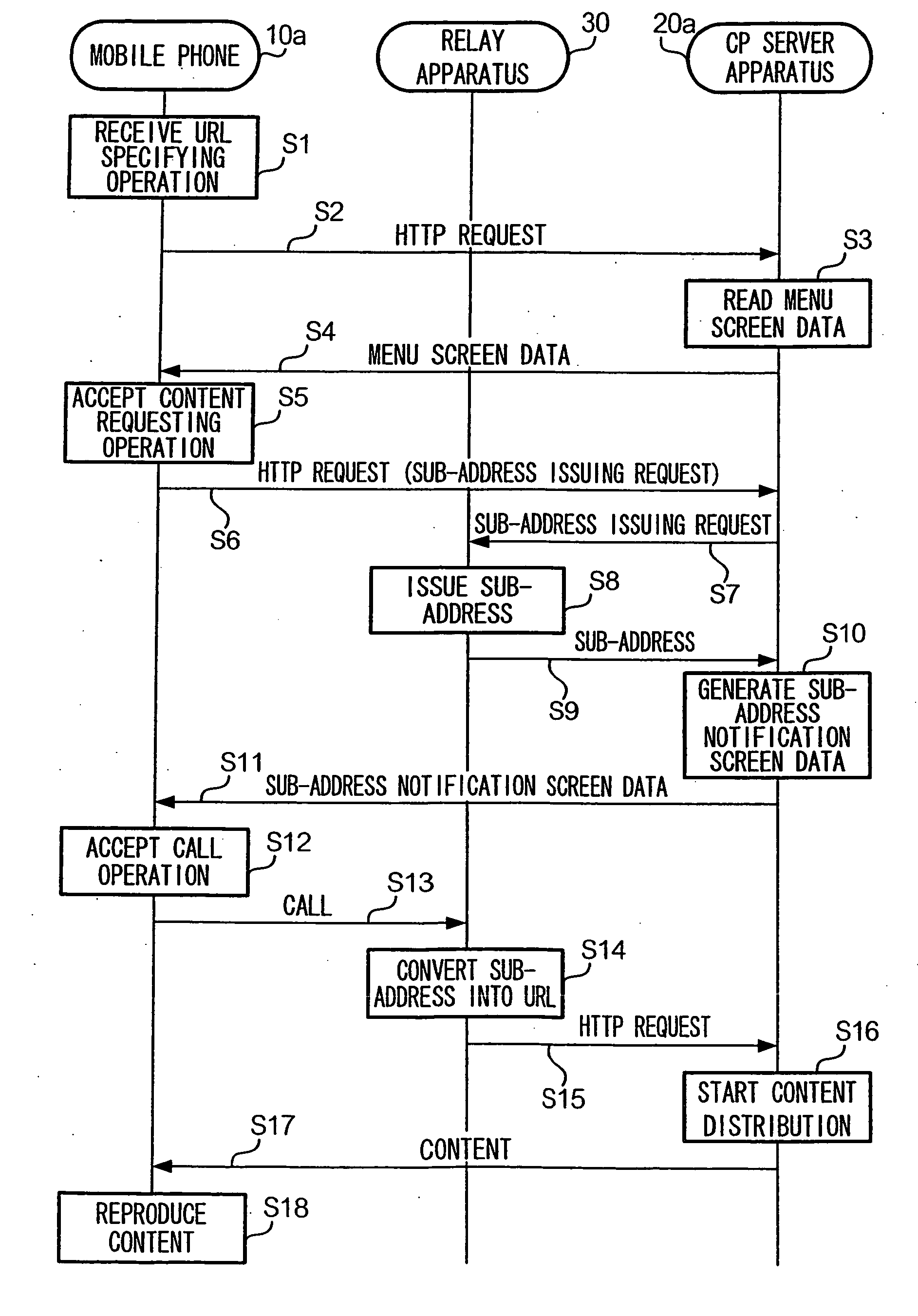
system provided with a telephone, a relay apparatus and a server apparatus, includes a step in which the telephone requests content comprising at least one of video and audio from the server apparatus; a step in which the server apparatus notifies the relay apparatus of a communication address indicating a storage location of the content; a step in which the relay apparatus issues a sub-address for specifying the content and stores that sub-address in association with the notified communication address; a step in which the relay apparatus notifies the server apparatus of the issued sub-address; a step in which the server apparatus notifies the telephone of the sub-address that has been notified by the relay apparatus; a step in which the telephone sends a call-connection
signal including a
telephone number assigned to the relay apparatus and the sub-address notified by the server apparatus, using a
videophone protocol for sending and receiving video and audio in synchronization; a step in which the relay apparatus receives the call-connection
signal and obtains a content from the server apparatus using the communication address stored in association with the sub-address included in that call-connection
signal; and a step in which the relay apparatus sends the obtained content by
videophone protocol to the telephone. With this
content distribution method, a
content distribution service can be implemented in which a new sub-address is issued and the content specified by this sub-address is distributed at a timing when the telephone requests a content from the server apparatus, that is, at a timing when the sub-address becomes necessary. Thus, the sub-addresses are not assigned in a fixed manner in advance to the all content items, but the sub-addresses are only issued every time that a content is requested, so that it is possible to process only the content that seems to have a high priority for the user of the telephone. Thus, it is possible to utilize all sub-addresses effectively, and to avoid an increase in the number of digits of the sub-address as well as a complication of the configuration of sub-addresses, even when there is an increase in types of content or number of content items.
[0013] In accordance with another aspect of the present invention, a content
distribution method in a
system provided with a telephone, a relay apparatus and a server apparatus, includes a step in which the telephone requests a content comprising at least one of video and audio; a step in which the relay apparatus issues a sub-address for specifying the content and stores that sub-address in association with a communication address indicating a storage location of the content; a step in which the relay apparatus notifies the telephone of the issued sub-address; a step in which the telephone sends a call-connection signal including a
telephone number assigned to the relay apparatus and the sub-address notified by the relay apparatus, using a
videophone protocol for sending and receiving video and audio in synchronization; a step in which the relay apparatus receives the call-connection signal and obtains a content from the server apparatus using the communication address stored in association with the sub-address included in that call-connection signal; and a step in which the relay apparatus sends the obtained content by videophone protocol to the telephone. With this content
distribution method, a content distribution service can be implemented in which a new sub-address is issued and the content specified by this sub-address is distributed at a timing when the telephone requests content from the server apparatus, that is, at a timing when the sub-address becomes necessary. Thus, the sub-addresses are not assigned in a fixed manner in advance to the all content items, but the sub-addresses are only issued every time that a content is requested, so that it is possible to process only the content that seems to have a high priority for the user of the telephone. Thus, it is possible to utilize all sub-addresses effectively, and to avoid an increase in the number of digits of the sub-address as well as a complication of the configuration, even when there is an increase in types of content or number of content items.
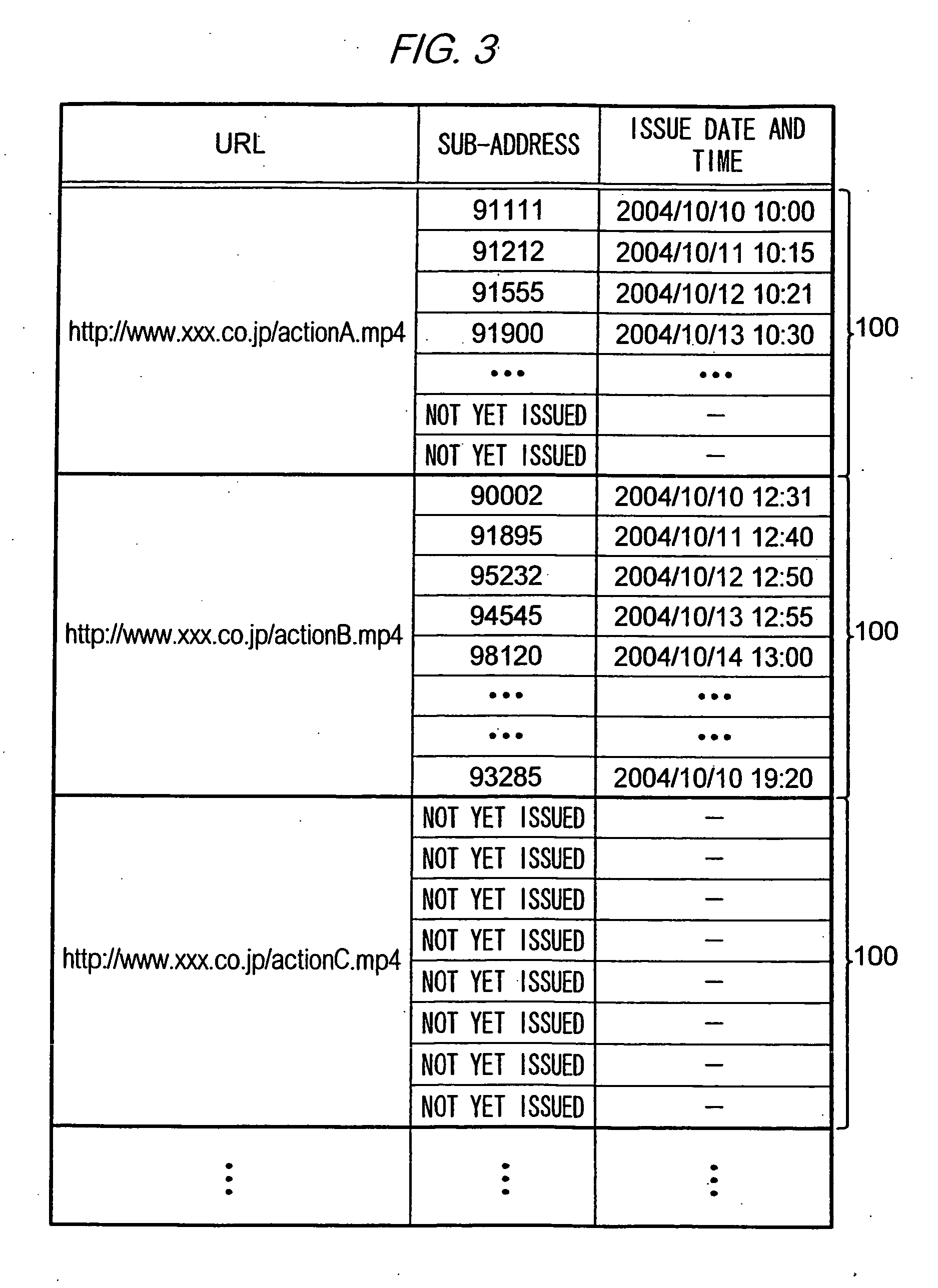
[0016] In a preferable embodiment of the present invention, the relay apparatus further includes a judgment unit for judging whether the sub-address included in the call-connection signal received by the videophone unit is within a period of validity or not; wherein, if the sub-address is within the period of validity, the
access control unit causes the
communication unit access the server apparatus using the communication address stored in association with that sub-address. In this embodiment, it is possible to utilize the same sub-address multiple times for different content items. Thus, it is possible to avoid increasing the number of digits of the sub-address or complicating the configuration, even when the number of content types or content items increases.
[0018] It is also possible to further provide a count unit for counting the number of accesses to each of the communication addresses; and an upper limit changing unit for changing, in accordance with the number of accesses that are counted, the upper limit stored for each of the communication addresses by the upper limit storage unit. In this embodiment, it becomes possible to issue sub-addresses in accordance with the access situation, such as to raise the upper limit for communication addresses with a high number of accesses and to lower the upper limit for communication addresses with a low number of accesses.


 Login to View More
  Login to View More