

Depth and lateral size control of three-dimensional images in projection integral imaging
a technology of integral imaging and depth and lateral size, applied in optics, instruments, electrical equipment, etc., can solve the problems of large amount of computation time and capacity, visual fatigue, and difficulty in recording full-color holograms for outdoor scenes, etc., to improve image quality and increase viewing angles
- Summary
- Abstract
- Description
- Claims
- Application Information
AI Technical Summary
Benefits of technology
Problems solved by technology
Method used
Image

Examples
Embodiment Construction
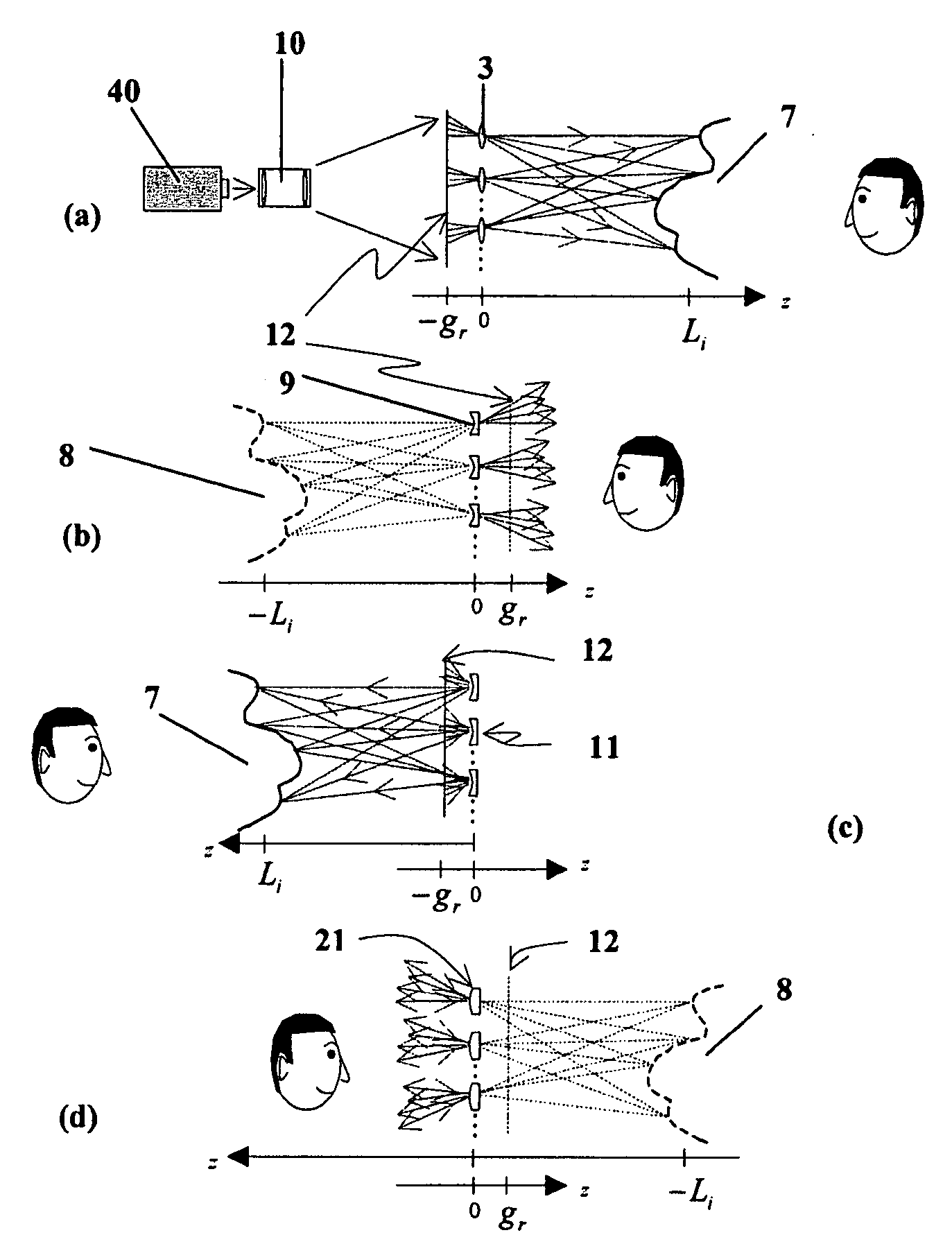
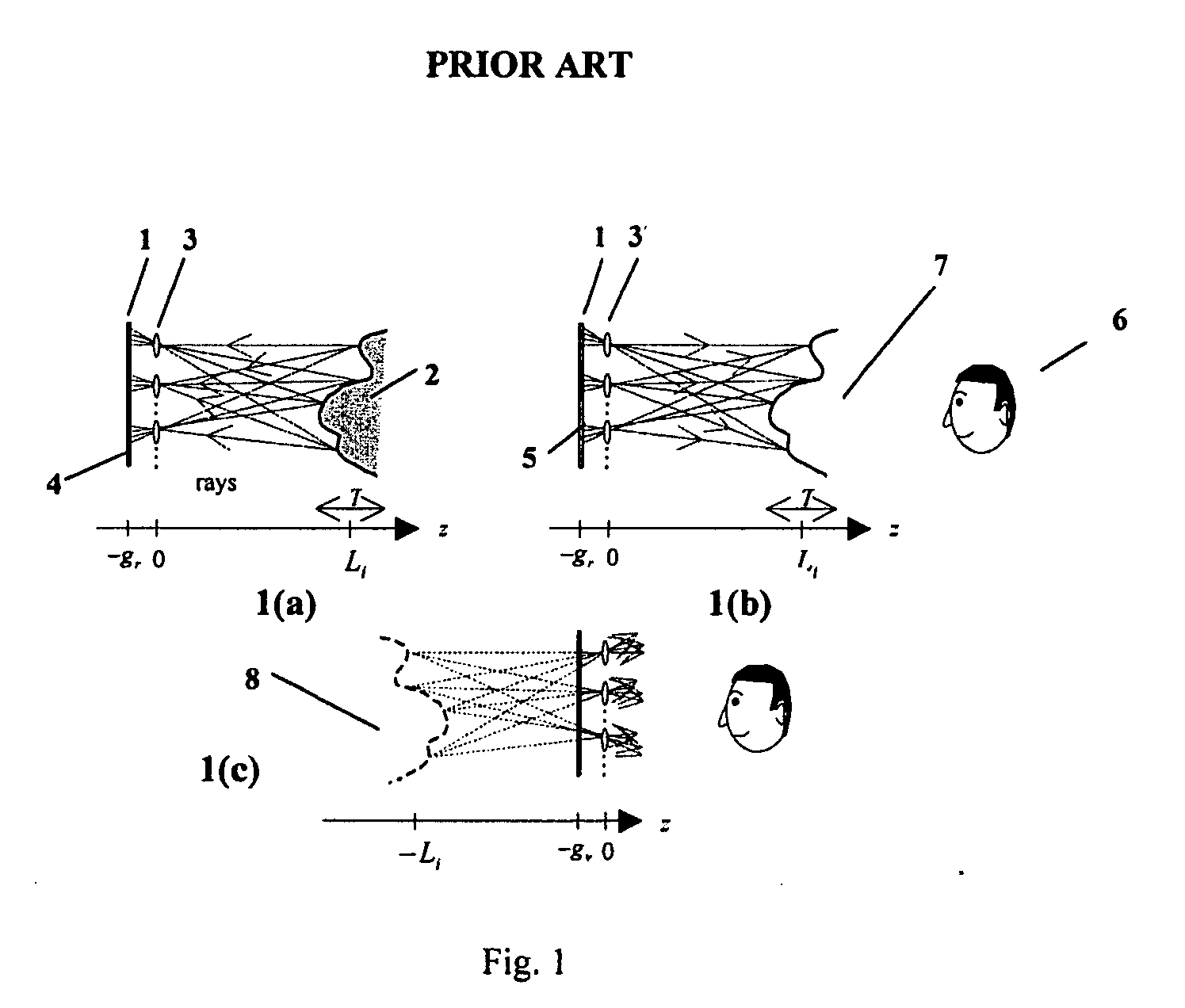
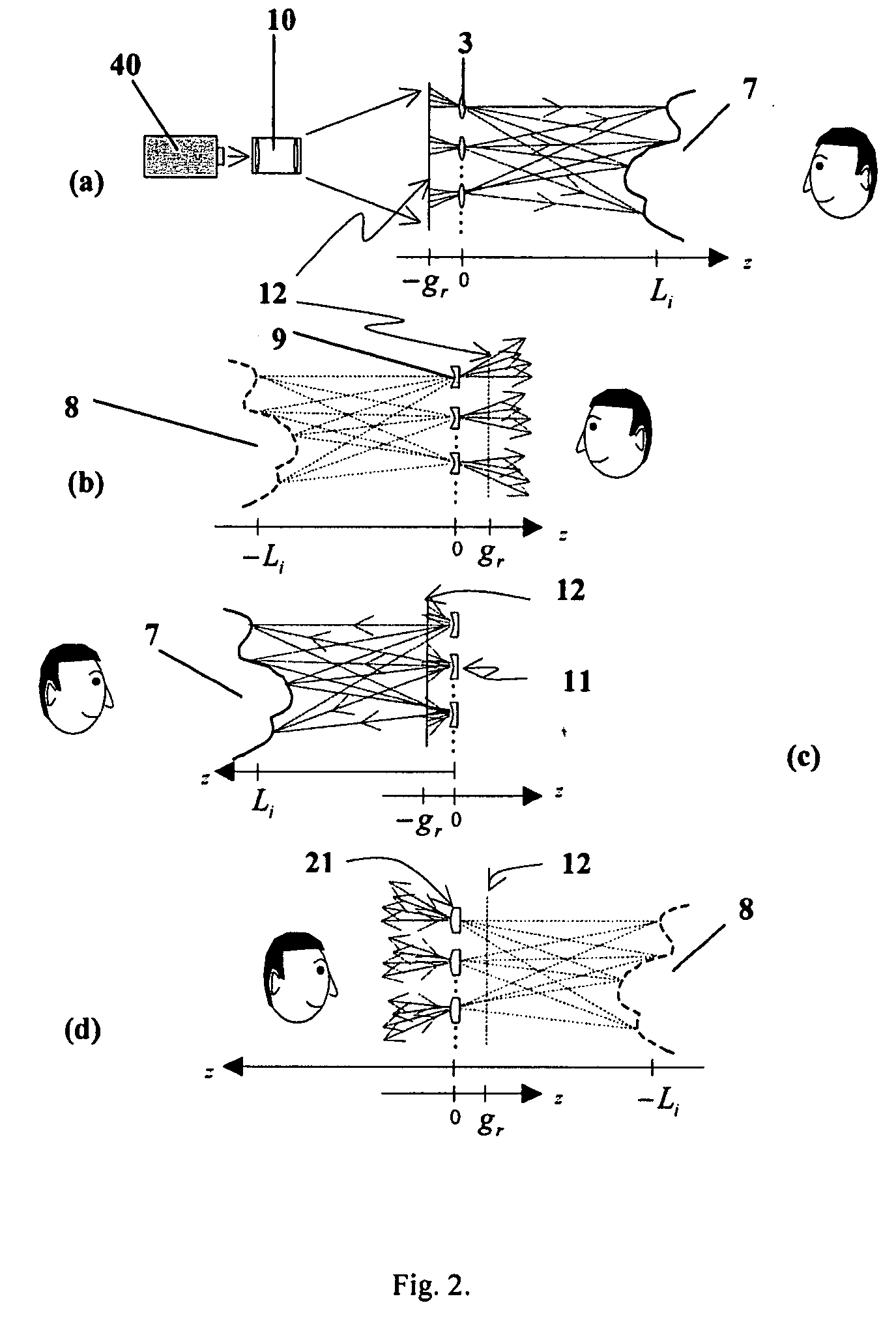
[0025] Methods and devices to control the depth and lateral size of reconstructed 3-D images are disclosed. These methods and devices may be used with a novel “Projection” Integral Imaging (PII) system for example.
[0026] One described technique allows pick up of large 3-D objects that may be far away, and also allows the display of their demagnified 3-D images within the depth-of-focus of II systems. It is shown that curved pickup devices (i.e., a curved 2-D image sensor and a curved lenslet array) or curved display devices or both may be used for this purpose. When the lenslets in the curved array have a zooming capability, a linear depth control is additionally possible.
[0027] Two exemplary methods are discussed below alone and also when they are used together. In experiments to demonstrate the feasibility of our method, planar pickup devices may be used (lenslet array, sensor, and display). An additional large aperture negative lens, also referred to herein as an optical path-l...
PUM
 Login to View More
 Abstract
Description
Claims
Application Information
 Login to View More