
LDPC (low density parity check) code size adjustment by shortening and puncturing
a low density parity and code size technology, applied in the field of communication systems, can solve the problems of preventing their use in very high data rate communication system application areas, requiring more hardware in implementation, and proving to be very expensive in terms of a variety of cost factors
- Summary
- Abstract
- Description
- Claims
- Application Information
AI Technical Summary
Problems solved by technology
Method used
Image

Examples
example 1
[0042] Consider rate 1 / 2 block size 1944 LDPC code in the [a] reference. Let q=81. Then N=24, q=1944, K=12, q=972, i.e. n=24 and k=12. Let t=27, then by shortening kt=324 bits and by puncturing (n−k)t=324 bits from a block size 1944 codeword, one can obtain a block size 1296 rate 1 / 2 codeword. Let t=54, then shortening kt=648 bits and puncturing (n−k)t=648 bits from a block size 1944 codeword, one can obtain a block size 1296 rate 1 / 2 codeword.
example 2
[0043] Consider rate 5 / 6 block size 1944 LDPC code in the [a] reference. Let q=81. Then N=24, q=1944, K=4, q=324, i.e. n=24 and k=20. Let t=27, then by shortening kt=540 bits and by puncturing (n−k)t=108 bits from a block size 1944 codeword, one can obtain a block size 1296 rate 5 / 6 codeword. Let t=54, then shortening kt=1080 bits and puncturing (n−k)t=216 bits from a block size 1944 codeword, one can obtain a block size 648 rate 5 / 6 codeword.
[0044] A novel and improved approach to shortening and puncturing is presented below which allows for a greater flexibility in the LDPC codes that can be selected, allows for a singular functional block and / or circuitry portion to perform encoding processing (or decoding processing) according to a variety of LDPC codes.
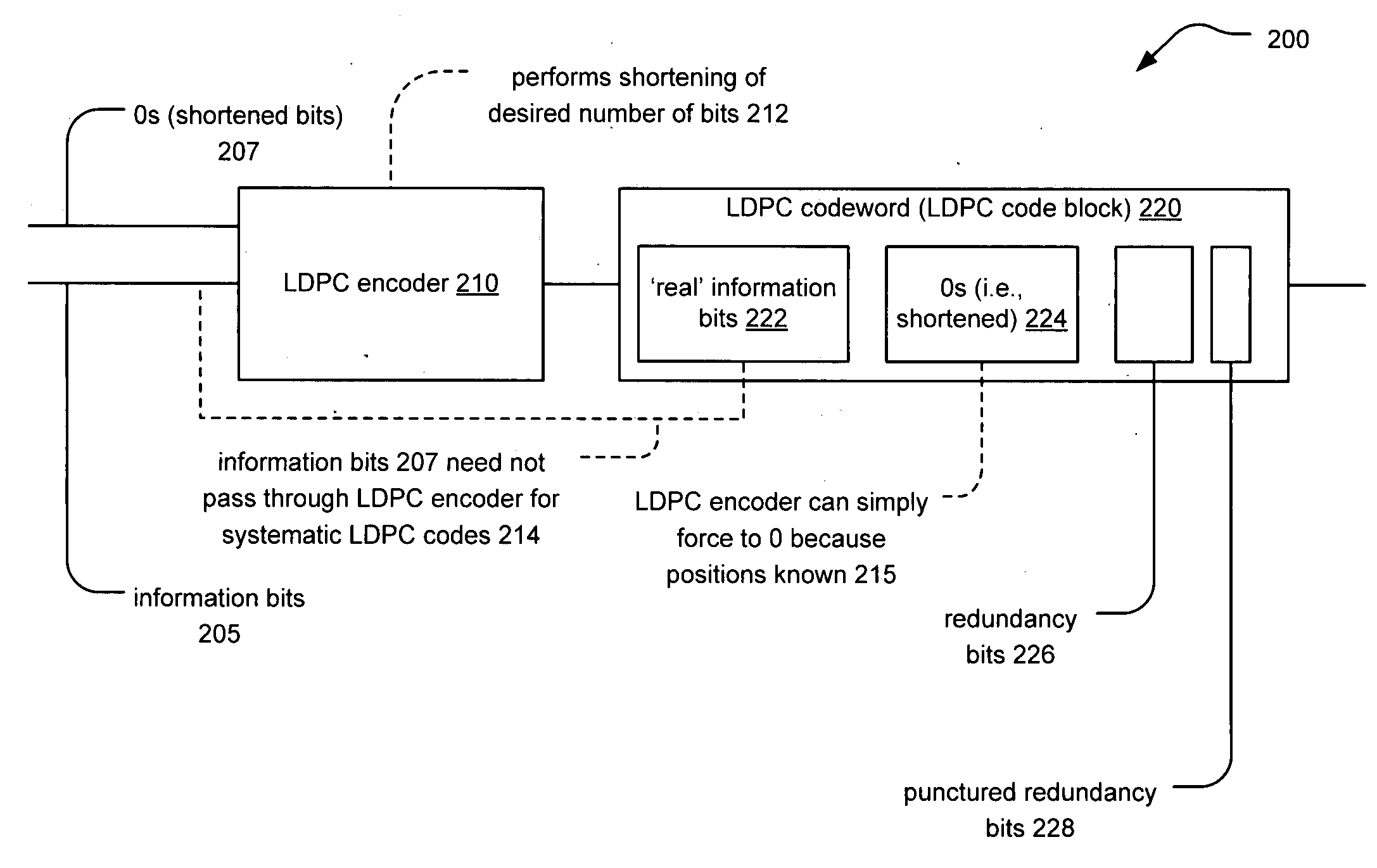
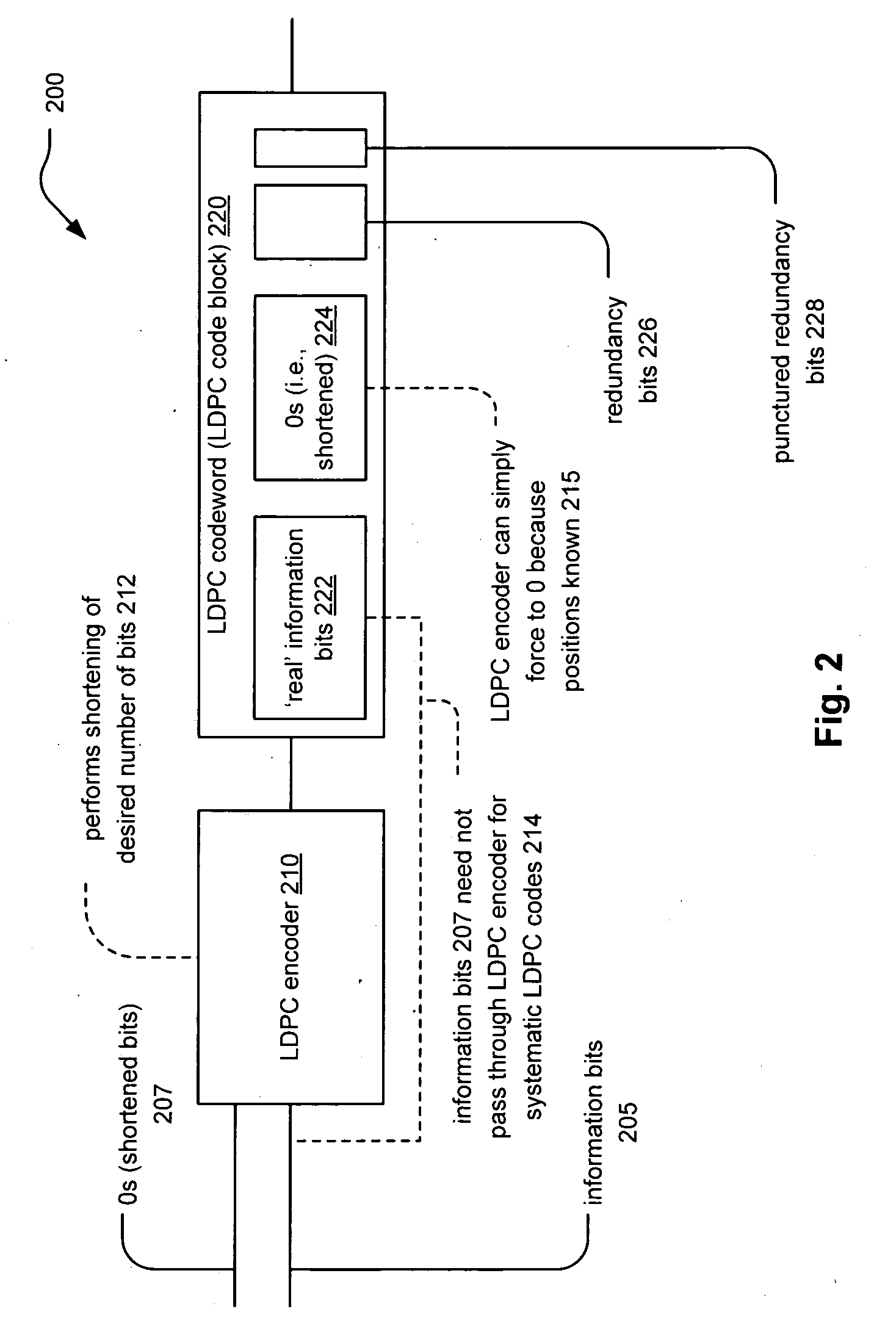
[0045]FIG. 2 illustrates an embodiment of an LDPC encoding system 200. Information bits 205 and zero valued bits (i.e., shortened bits or 0s) 207 are provided to an LDPC encoder 210 that is operable to generate an LDPC codeword...
example 3
[0104] Consider rate 1 / 2 block size 1944 LDPC code in the [a] reference depicted above, where the low density parity check matrix, H, is defined below.
[0105] The following table consists of a plurality of entries such that every entry represents a 81×81 sub-matrix, where an actual number in the entry location indicates the shift position that is used to construct the CSI sub-matrix (e.g., right cyclic shifting of the identity matrix by that number of positions), and an empty space indicates an all zero-valued (i.e., all elements are 0) 81×81 sub-matrix. The table is depicted using two paragraphs because of its width. The entire Table includes 12 rows and 24 columns. The first Table portion includes columns 1-12 and the second Table portion includes columns 13-24.
Rows 1-12, Columns 1-125750115079328055730243756146253533354020662228084250869797956526538577227641452303245700779256573512246160275116Rows 1-12, Columns 13-241000000000000000000000010
[0106] As can be seen, there are 24 c...
PUM
 Login to View More
 Abstract
Description
Claims
Application Information
 Login to View More