Novel phenol derivatives and antitrypanosoma preventive/therapeutic agent comprising the same as active ingredient
Inactive Publication Date: 2007-09-06
ARIGEN PHARMA INC +1
View PDF1 Cites 5 Cited by
Summary
Abstract
Description
Claims
Application Information
AI Technical Summary
This helps you quickly interpret patents by identifying the three key elements:
Problems solved by technology
Method used
Benefits of technology
Benefits of technology
[0049] The compounds of the present inventions have such an advantage that they exhibit the same degree of the above described inhibition effect as ascofuranone at a lower concentration than ascofuranone and the addition of glycerin exhibits at least the same degree of effect as ascofuranone at a lower concentration than ascofuranone.
Problems solved by technology
At present the number of patients of African sleeping sickness cannot be confirmed due to the low reliability of the investigative data.
Beyond that, enormous is the damage to domestic animals caused by a disease called as nagana, and several hundred thousands of cattle which are to be protein sources for people die every year.
Further, in the area of about 10,000,000 km2 of savanna equal to the United States of America, cattle-breeding is impossible due to Trypanosoma.
Thus, African sleeping sickness remarkably damages the health and the economical development of African people, and this is the reason why the WHO adopts the trypanosomiasis as one of the infectious diseases that should be controlled.
Particularly, the loss of cattle and horses is greatest and almost fetal, and they are led to anemia, edema, weakening and the like and fall dead in one month after infection.
However, these drugs are old and are gradually losing their efficacy.
Particularly, the resistance to melarsoprol of an arsenic agent causes a big problem and the situation is so dire that patients with no efficacy only await death and the development of novel antitrypanosoma agents are strongly desired.
Then, many researchers centered around Western countries have tried to develop drugs targeting this cyanide resistant oxidase but effective drugs having a selective toxicity have not been obtained.
Method used
the structure of the environmentally friendly knitted fabric provided by the present invention; figure 2 Flow chart of the yarn wrapping machine for environmentally friendly knitted fabrics and storage devices; image 3 Is the parameter map of the yarn covering machine
View more
Image
Smart Image Click on the blue labels to locate them in the text.
Viewing Examples
Smart Image
Click on the blue label to locate the original text in one second.
Reading with bidirectional positioning of images and text.
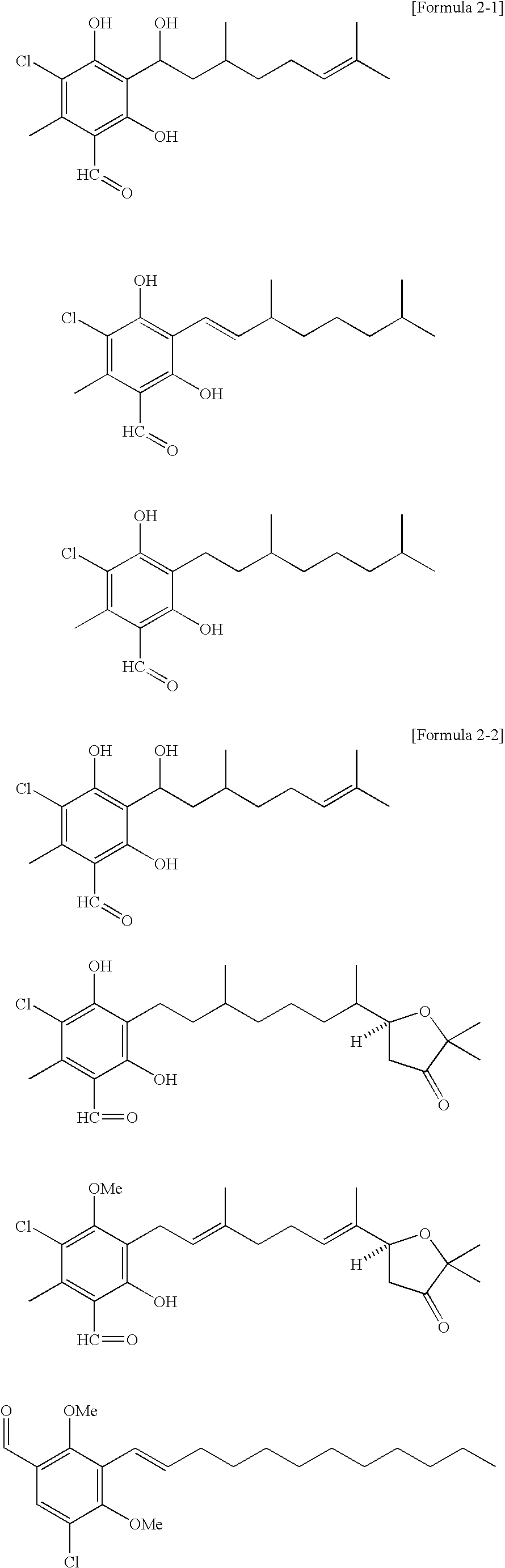
[0069] 2,4-Dihydroxy-6-methylbenzaldehyde (91 mg, 0.60 mmol) described in M. M. Joullie et al., J. Org. Chem., 50, 3997 (1985), dodecanal (133 mg, 0.72 mmol) and calciumchloride dihydrate (59 mg, 0.40 mmol) were stirred in a 0.4 M potassiumhydroxidemethanol solution (2 ml) at 0° C. for 24 hours. The reaction mixture was made acidic with 1 M hydrochloric acid. After extractive workup with ethyl acetate, the crude product was purified by silica gel thin-layer chromatography (hexane:ethyl acetate=3:1) to obtain 2,4-dihydroxy-3-(1-hydroxydodecyl)-6-methylbenzaldehyde (58 mg, yield 28%).
the structure of the environmentally friendly knitted fabric provided by the present invention; figure 2 Flow chart of the yarn wrapping machine for environmentally friendly knitted fabrics and storage devices; image 3 Is the parameter map of the yarn covering machine
Login to View More
PUM
Property
Measurement
Unit
Composition
aaaaa
aaaaa
Pharmaceutically acceptable
aaaaa
aaaaa
Optical properties
aaaaa
aaaaa
Login to View More
Abstract
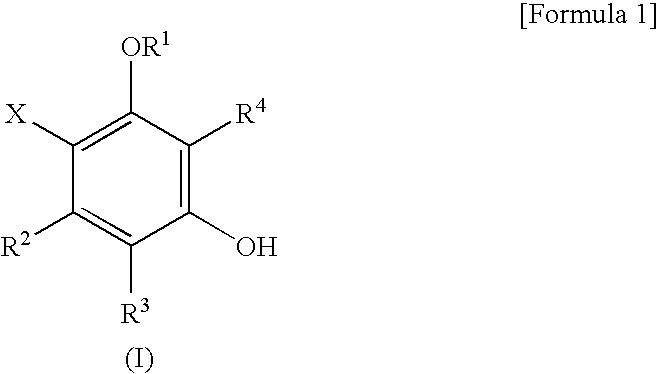
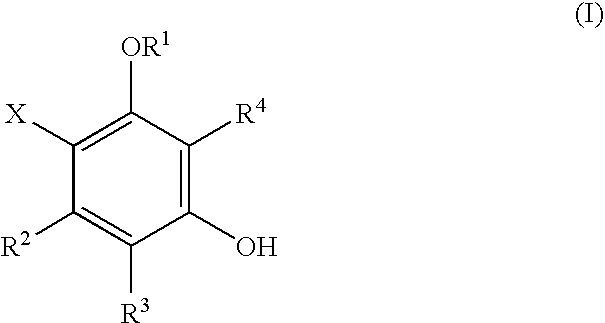
A compound represented by formula (I): [wherein, for example, X is a hydrogen atom or a halogen atom; R1 is a hydrogen atom; R2 is a hydrogen atom or a C1-4 alkyl group; R3 is —CHO or —COOH; and R4 is —CH═CH—(CH2)p—CH3 (wherein p is an integer of 1 to 12), —CH(OH)—(CH2)q—CH3 (wherein q is an integer of 1 to 13), —CH(OH)—CH2—CH(CH3)—(CH2)2—CH═C(CH3)2, —CH═CH—CH(CH3)—(CH2)3—CH(CH3)2, —(CH2)2—CH(CH3)—(CH2)3—CH(CH3)2 or —(CH2)8—CH3], an optical isomer thereof and a pharmaceutically acceptable salt thereof. These compounds have antitrypanosoma activity, and accordingly are useful as drugs for preventing or treating the diseases caused by trypanosoma.
Description
TECHNICAL FIELD [0001] The present invention relates to a novel halogen-containing phenol derivative having an alkylside chain, an antitrypanosoma preventing / treating pharmaceutical composition having the same as an active ingredient, use of these components in producing a pharmaceutical composition for preventing or treating trypanosomiasis and a method of preventing or treating the diseases caused by Trypanosoma. BACKGROUND ART [0002] Onset of trypanosomiasis is caused by Trypanosomaprotozoa and it is said that every year 200,000 to 300,000 of new patients of African sleeping sickness fall sick. At present the number of patients of African sleeping sickness cannot be confirmed due to the low reliability of the investigative data. According to the WHO, at least 150,000 people died of African sleeping sickness in 1996 and it is said that its aftereffect remains in not less than 100,000 people. Beyond that, enormous is the damage to domestic animals caused by a disease called as na...
Claims
the structure of the environmentally friendly knitted fabric provided by the present invention; figure 2 Flow chart of the yarn wrapping machine for environmentally friendly knitted fabrics and storage devices; image 3 Is the parameter map of the yarn covering machine
Login to View More
Application Information
Patent Timeline
Application Date:The date an application was filed.
Publication Date:The date a patent or application was officially published.
First Publication Date:The earliest publication date of a patent with the same application number.
Issue Date:Publication date of the patent grant document.
PCT Entry Date:The Entry date of PCT National Phase.
Estimated Expiry Date:The statutory expiry date of a patent right according to the Patent Law, and it is the longest term of protection that the patent right can achieve without the termination of the patent right due to other reasons(Term extension factor has been taken into account ).
Invalid Date:Actual expiry date is based on effective date or publication date of legal transaction data of invalid patent.


 Login to View More