
Process for producing acrylic ester
a technology of acrylic acid and ester, which is applied in the preparation of carboxylic acid esters, chemistry apparatus and processes, and organic chemistry, etc. it can solve the problems of increasing the unit consumption of acrylic acid or an alcohol, increasing the cost of waste liquid treatment to make harmless inorganic acid contained in waste liquid, and increasing the cost of acrylic acid or alcohol treatment. , to achieve the effect of improving the yield of acrylic acid, increasing the amount of wastewater, and broadening the accepted range of raw
- Summary
- Abstract
- Description
- Claims
- Application Information
AI Technical Summary
Benefits of technology
Problems solved by technology
Method used
Image

Examples
example 1
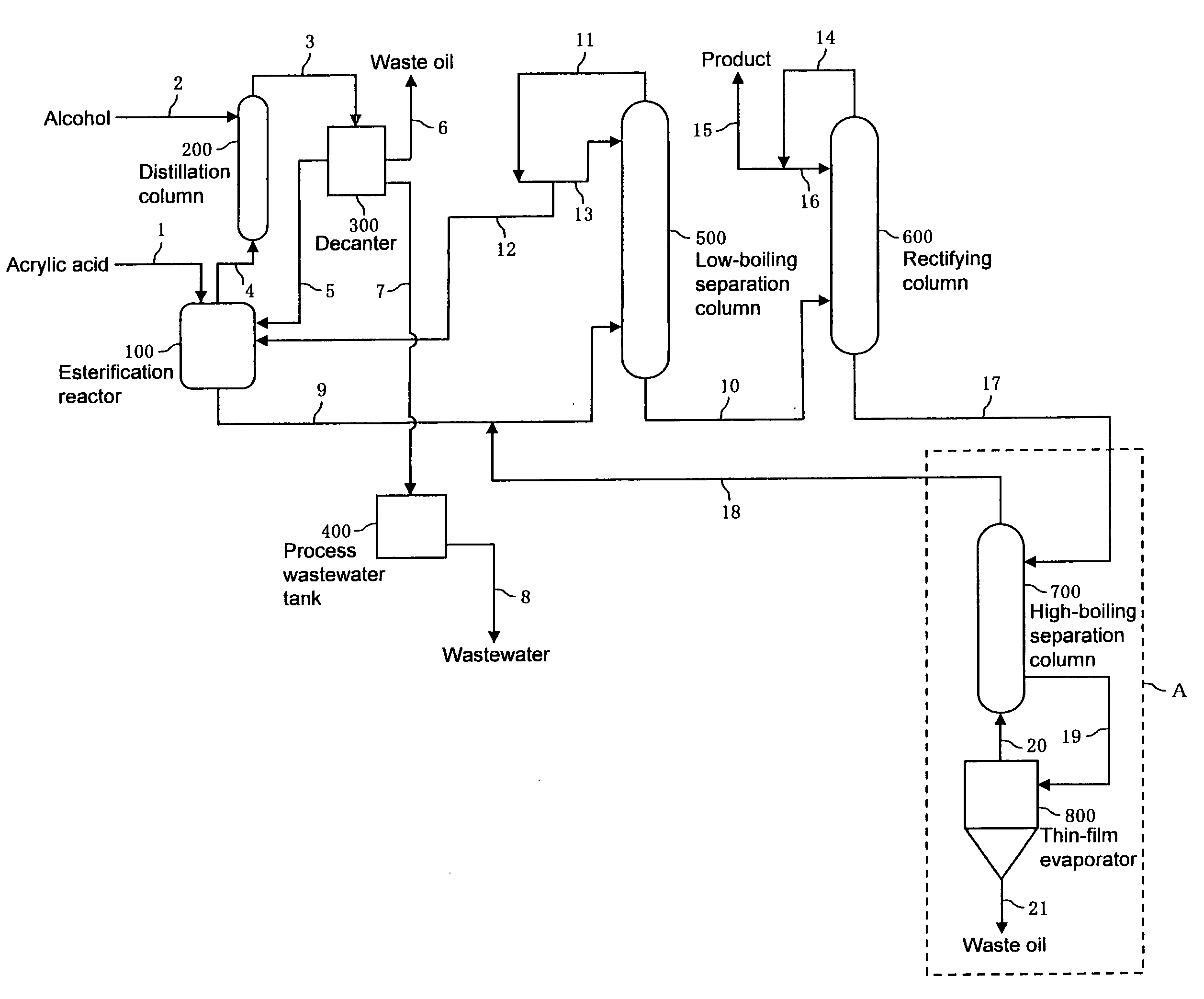
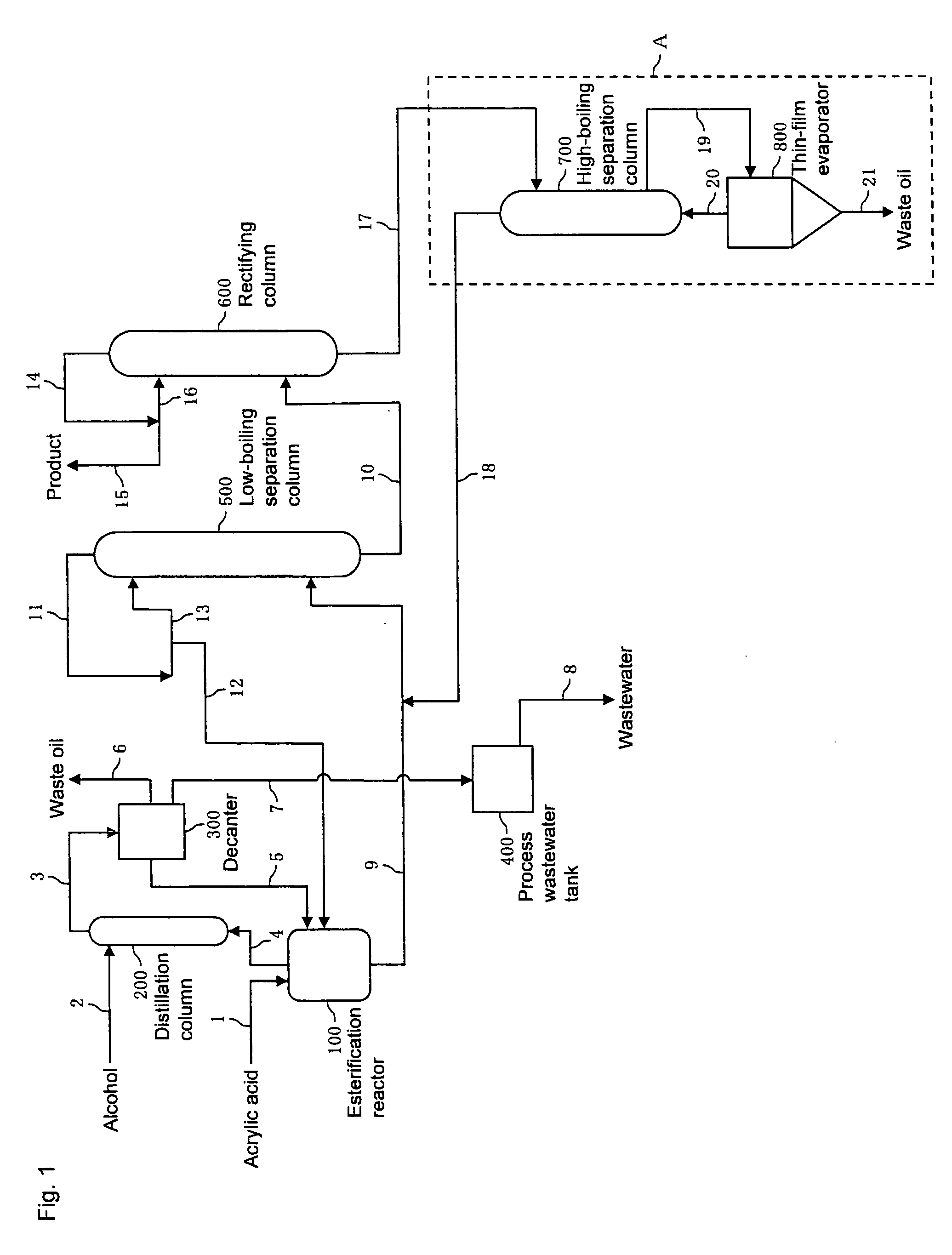
[0048]To the esterification reactor 100 shown in FIG. 1 were supplied 400 kg / h of acrylic acid containing from 10 to 50 ppm of maleic acid and from 100 to 500 ppm of β-acryloxypropionic acid, 740 kg / h of 2-ethylhexanol, and 1,590 kg / h of a recovered alcohol liquid, and after 20 days of operation, the reaction was carried out at a reaction temperature of 85° C. and a conversion of acrylic acid of 50%, thereby giving a product acrylic ester at a yield of 990 kg / h from the top of the rectifying column 600. At this time, 25 kg / h of waste oil was discharged from the bottom of the thin-film evaporator 800, and 115 kg / h of the distillate from the high-boiling separation column 700 was circulated to the low-boiling separation column 500. The acid components contained in the obtained product acrylic ester were in an amount of from 25 to 35 ppm (in terms of acrylic acid). The measurement of acid components in the product acrylic ester was carried out by the titration of acid components (the s...
example 2
[0049]To the esterification reactor 100 shown in FIG. 1 were supplied 400 kg / h of acrylic acid containing from 10 to 50 ppm of maleic acid and from 100 to 500 ppm of β-acryloxypropionic acid, 740 kg / h of 2-ethylhexanol, and 1,590 kg / h of a recovered alcohol liquid, and after 230 days of operation, the reaction was carried out at a reaction temperature of 100° C. and a conversion of acrylic acid of 50%, thereby giving a product acrylic ester at a yield of 965 kg / h from the top of the rectifying column 600. At this time, 50 kg / h of waste oil was discharged from the bottom of the thin-film evaporator 800, and 90 kg / h of the distillate from the high-boiling separation column 700 was circulated to the low-boiling separation column 500. The acid components contained in the obtained product acrylic ester were in an amount of from 25 to 35 ppm (in terms of acrylic acid). The results are shown in Table 1.
example 3
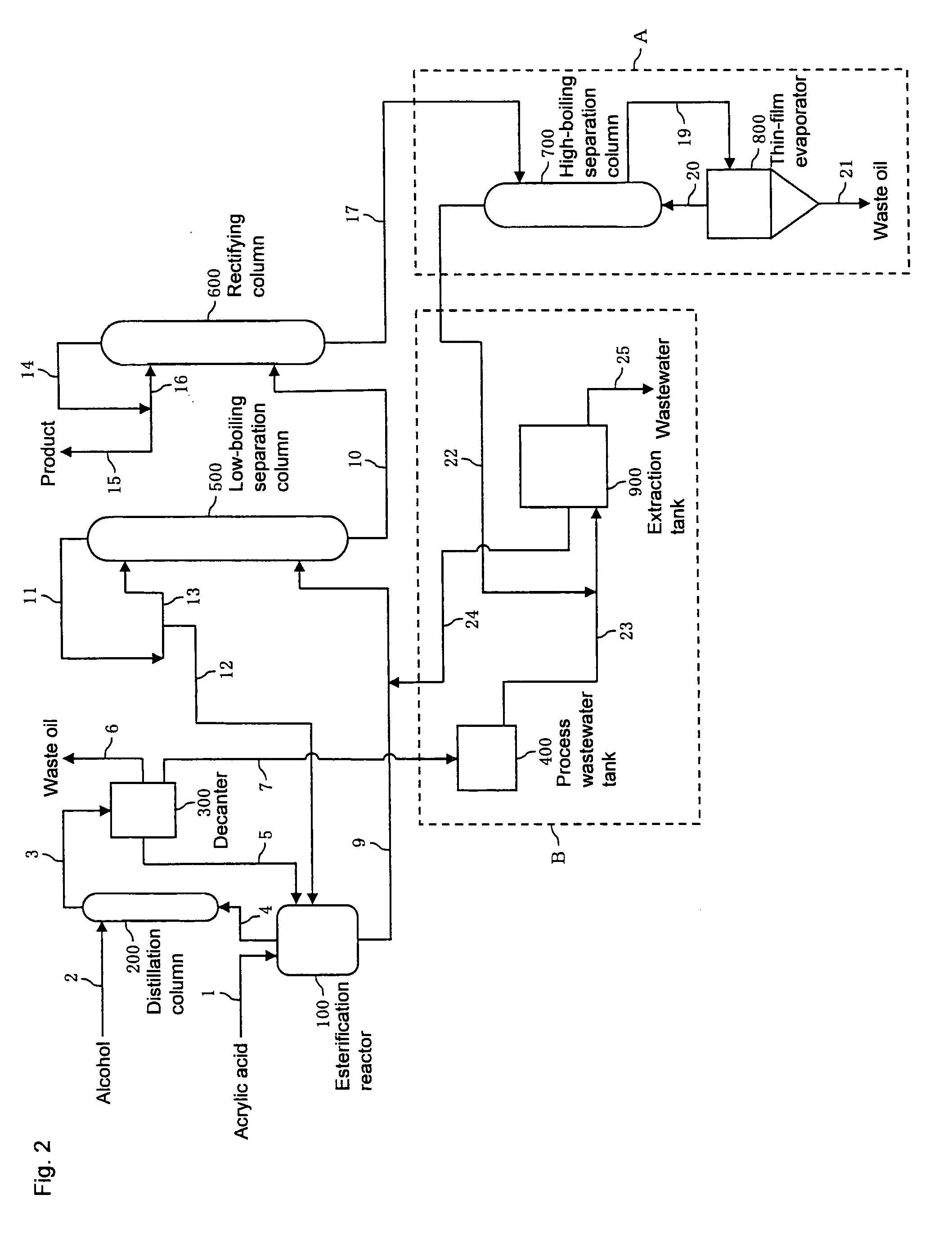
[0050]To the esterification reactor 100 shown in FIG. 2 were supplied 400 kg / h of acrylic acid containing from 10 to 50 ppm of maleic acid and from 100 to 500 ppm of β-acryloxypropionic acid, 740 kg / h of 2-ethylhexanol, and 1,590 kg / h of a recovered alcohol liquid, and after 20 days of operation, the reaction was carried out at a reaction temperature of 85° C. and a conversion of acrylic acid of 50%, thereby giving a product acrylic ester at a yield of 1,000 kg / h from the top of the rectifying column 600. At this time, 15 kg / h of waste oil was discharged from the bottom of the thin-film evaporator 800, and 125 kg / h of the distillate from the high-boiling separation column 700 and 140 kg / h of wastewater from the wastewater tank 400 were mixed and supplied to the extraction tank 900 shown in FIG. 2. The water phase was removed as wastewater, and the organic phase containing an acrylic ester was circulated to the low-boiling separation column 500. The acid components contained in the o...
PUM
| Property | Measurement | Unit |
|---|---|---|
| Fraction | aaaaa | aaaaa |
| Fraction | aaaaa | aaaaa |
| Fraction | aaaaa | aaaaa |
Abstract
Description
Claims
Application Information
 Login to View More