[0019]The recoil control device's components can be advantageously prepared with comparatively large parts or large diameter spindles or rods, which simplifies manufacture. This advantage of the present invention greatly improves the reliability in service and the resistance to jamming by sand, mud, and other environmental contaminants and simplifies cleaning and dismantling of the firearm.
[0020]The mechanisms and aspects of the invention can be used to complement or improve existing or conventional firearms and can be combined with various arrangements, attachments, and combinations, including without limitation internal release systems, loading systems, ejection systems, gas injection systems, recoil reduction systems, muzzle brakes, sighting systems, tripods, mounting systems, and firing mechanisms.
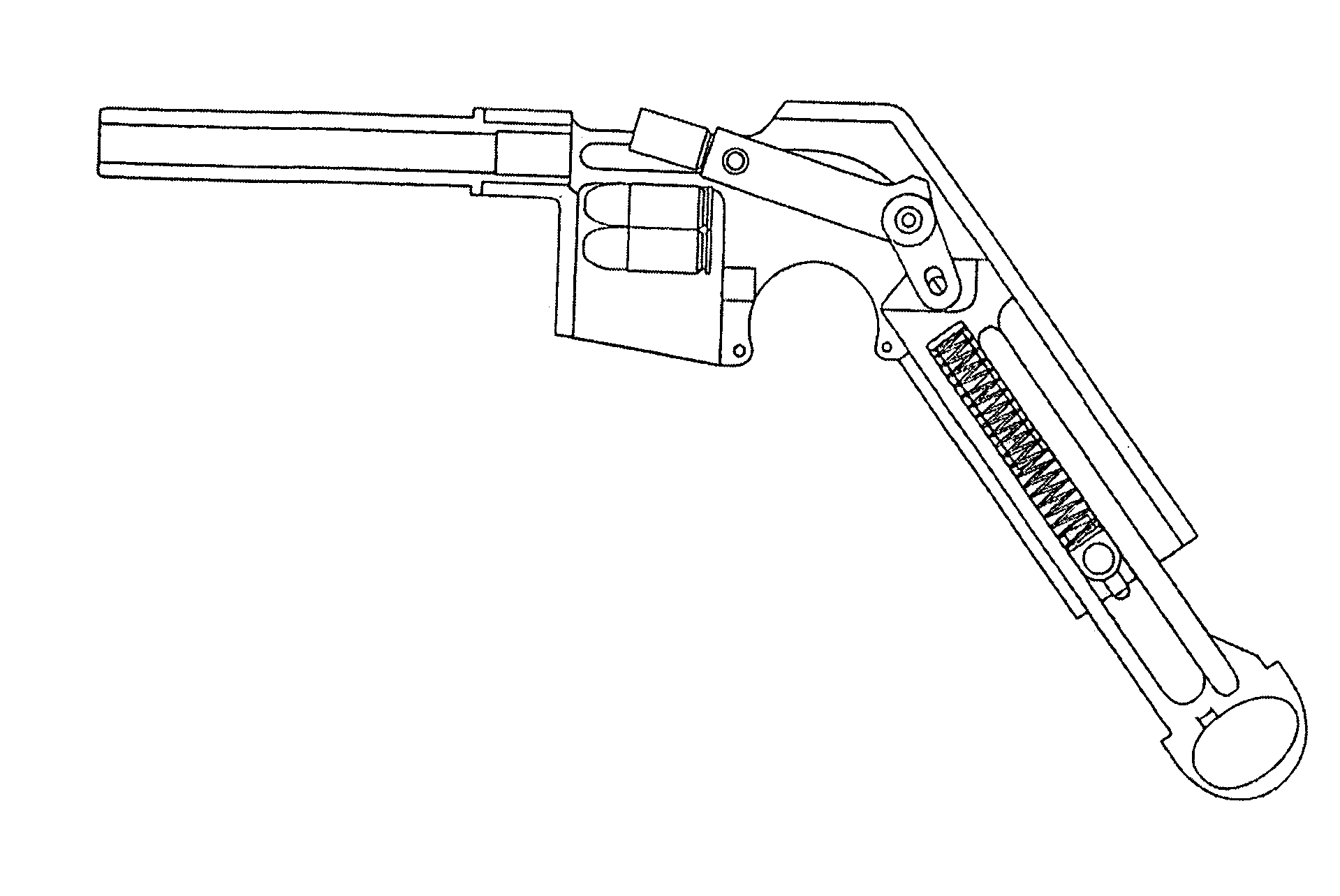
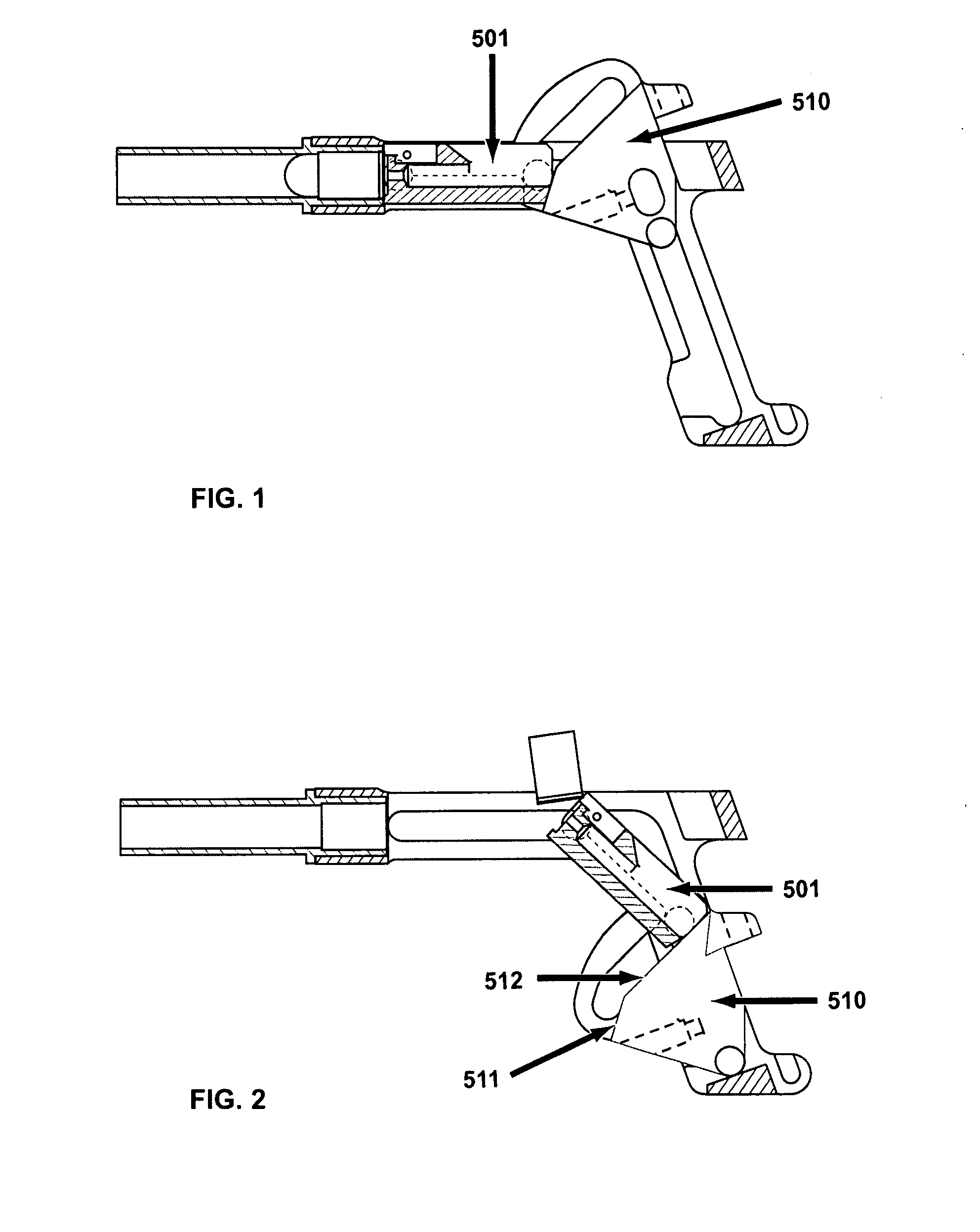
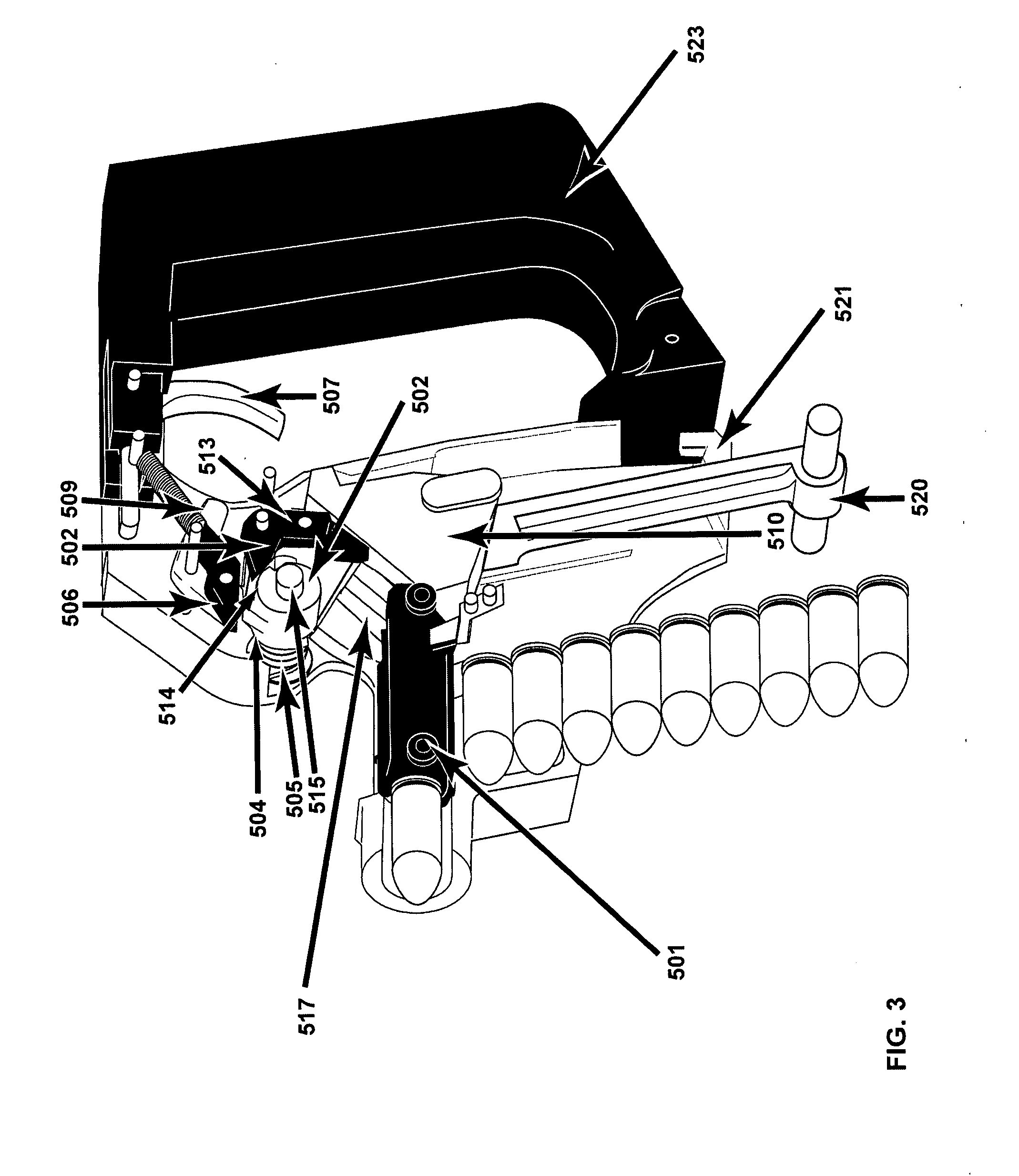
[0021]In one general aspect, the invention comprises an improved and novel recoil control device for use in a firearm, such as a semiautomatic or automatic firearm, in which, for example, a bolt head is configured to alternate between a forward position and a rearward position in response to the firing of one or more cartridges; and an inertia block is connected to the bolt head such that the bolt head imparts an impulse to the inertia block as it alternates between its forward position and its rearward position, the impulse having a component, or force distribution or vectorial force component, lateral to the firing axis of the barrel of the firearm. The force transferred to the inertia block can be in any one of several directions and the inertia block can therefore traverse one of a variety of paths from the impulse imparted through the bolt head, including, but not limited to: a downward sloping, straight path toward the anterior of the firearm; a curved or curvi-linear path; a path extending outward from the barrel; a path moving inward toward the barrel; and a path crossing over the barrel. The path chosen relates to the design characteristics of the firearm desired.
[0022]Similarly, the inertia block or mass appropriate for a particular firearm relates to the design characteristics of the firearm. In one embodiment, the inertia block comprises a sloped or angled surface, or a leading sloped surface, that can be contacted by the bolt head to transmit the impulse from firing. In other embodiments, the inertia block comprises a part or parts that reciprocates between two or more positions and moves in response to the impulse from the bolt head. Multiple inertia blocks can also be used so that they move together in response to the bolt head. In another preferred embodiment, the recoil control device of the present invention can be incorporated into heavy caliber firearm and cannon mechanisms. For example, a heavy caliber rifle, such as a vehicle-mounted rifle or portable rifle of between 0.50 caliber and 105 mm, or even higher as in a 155 mm cannon, can be produced with an inertia block to translate forces out of the axis of the barrel.
[0023]The transfer of the impulse of percussion from the bolt head to the inertia block can be through direct contact between the two parts or through a simple or even a complex linkage. In one embodiment, one or more pin and rod assemblies are used. In another embodiment, a pin connected to the bolt head moves within a slot connected to the inertia block. In other embodiments, one or more reciprocating rods connect the bolt head to the inertia block.
[0024]For most firearms of the invention, the inertia block and bolt head are designed to automatically return to their resting or chambered position. A variety of mechanisms can be used to move the bolt head and / or inertia block in the return path. A preferred embodiment employs a spring operably connected to or contacting the inertia block, which can be referred to as the return spring. A variety of spring types can be adapted for this purpose. Alternative return or recovery mechanisms can be designed by one of skill in the art.



 Login to View More
  Login to View More